Original paper
Training-Free Long-Term Multi-Object Tracking for Sports Video Analytics
- Publication
- Publication venue not yet verified
- First submitted to arXiv
- arXiv:2608.15688
Cite this paper · BibTeX
The citation identifies the linked source version. It cites the original paper and its authors.
@misc{multiobjecttrackingmcbytepp2026,
  title = {{Training-Free Long-Term Multi-Object Tracking for Sports Video Analytics}},
  author = {Tomasz Stanczyk and Seongro Yoon and Francois Bremond},
  year = {2026},
  eprint = {2608.15688},
  archivePrefix = {arXiv},
  url = {https://arxiv.org/abs/2608.15688}
}
In a soccer broadcast, the camera follows the ball. The ball goes out to the right wing, and the left back drops out of the frame; half a minute later the ball comes back, and the left back walks into shot again. To a human viewer, it's the same player. To most online trackers, the old track was deleted long ago for going unmatched too long, and the player gets a new number.
McByte used frame-by-frame mask propagation to handle short-lived problems like players bunching up and the camera whipping around. But once someone leaves the frame, their mask disappears too, and they still aren't recognized when they come back. It's also slow, managing only 1 frame per second on SoccerNet.
A little over a year later, the same Inria team (Tomasz Stanczyk, Seongro Yoon, Francois Bremond) released McByte++. The framework stays the same, with three changes. Mask propagation switches to a much lighter model, camera motion compensation is applied only when its estimate is reliable, and an online re-ID is added that kicks in only when a new tracklet appears. As in the earlier work, there's no training anywhere, and no per-dataset parameter tuning.
Defining the problem
There are two common ways of keeping identities over long spans.
One is offline processing. Graph methods like SUSHI do global optimization over a long time window, and GTA waits for the tracker to finish the whole video, then goes back to split tracklets apart and join them up. The results are good, but you need the complete results before you can start, which rules them out for live analysis.
The other is comparing appearance online at every frame. Since DeepSORT, trackers like StrongSORT and Deep OC-SORT have put re-ID features into the per-frame matching cost. The problem is that appearance features in sports scenes are very unstable: teammates wear identical jerseys, motion blurs, and players block one another. Using them for matching at every frame ends up latching onto the wrong person all too easily.
The authors' idea is to keep the two jobs apart. Short-term matching stays with position, motion and masks as before, and appearance is used to answer just one question, whether the person who just appeared is someone who left earlier.
Solving the problem
Overall pipeline
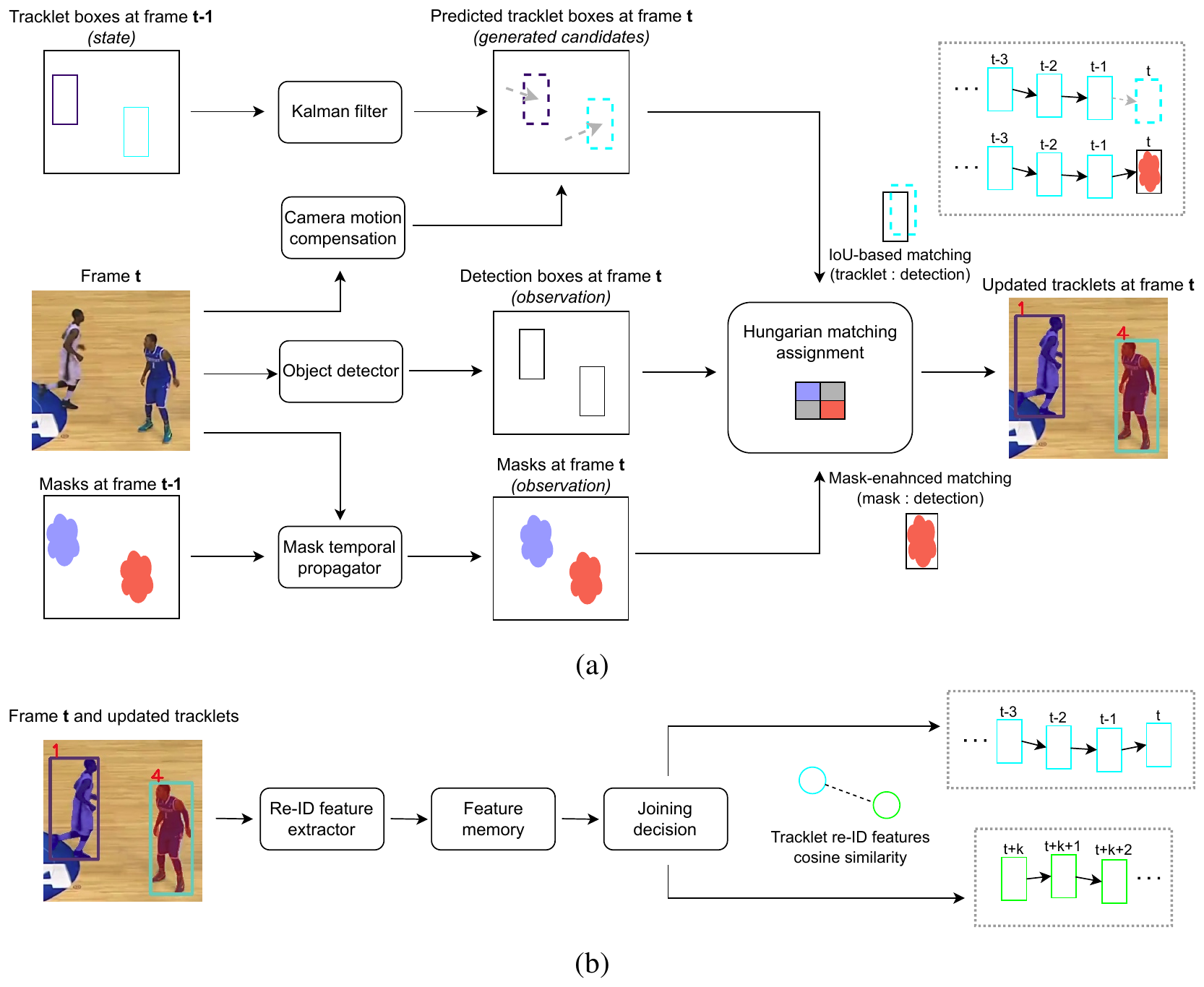
(a) is short-term tracking, almost the same as McByte apart from an extra camera motion compensation block; (b) is the newly added long-term tracking.
A lighter mask model
McByte propagates masks with Cutie; McByte++ switches to EdgeTAM. EdgeTAM is a lightweight version of SAM 2 designed for edge devices. It creates a mask when a new tracklet appears, then updates it frame by frame along with the tracklet.
How the masks are used carries over from the earlier work. Masks are only checked when IoU runs into ambiguity (several candidates with similar costs) or isolation (the box is too far away to match). The mask has to be visible, the fraction of the detection box it fills, , has to be at least 0.05, and the fraction of it that falls inside the box, , at least 0.90. If all of these pass, is subtracted from the IoU cost.
Conditional camera motion compensation
In the earlier work, once camera motion compensation (CMC) was switched on, it was applied at every frame. The authors later found that on frames with little texture, heavy blur or large areas of uniform background, the estimated affine transform can be wildly off; applying it shrinks boxes to a point or blows them up, and the Kalman filter goes haywire along with them. The grass of a soccer pitch comes very close to that.
McByte++ first checks whether the estimated transform is reasonable, with no excessive scaling or translation. Only if it is does it get applied; if not, there's no update, and the last reliable estimate stays in use.
The estimate itself still comes from matching ORB keypoints. For stability and speed, frames are downscaled before the computation. The earlier work halved them; this time they're cut to a quarter.
Checking faces only when someone new shows up
The re-ID model is a pretrained OSNet, with no fine-tuning at all. The whole process has six steps.
- Each time a tracklet is matched to a reliable detection, an appearance feature is taken from the box and -normalized.
- The features over the whole tracklet are averaged and normalized again to serve as the tracklet's appearance representative. A single frame's feature is often off because of blur or occlusion; averaged, they're steadier.
- When a tracklet ends (occluded for too long, or out of the frame), its representative feature is stored in long-term memory.
- When a new tracklet appears, the cosine similarity between its feature and every entry in memory is computed.
- Linking back requires a mutual condition. The identity in memory that the new tracklet most resembles must, among all new tracklets, most resemble this one in return, and the similarity must exceed a threshold. Once linked, that memory entry is deleted, so it can't be assigned twice.
- If no link is made within a short time, the tracklet is confirmed as a new identity. The decision is delayed so as not to jump to conclusions.
From start to finish, appearance never enters the per-frame matching cost. It only decides whether a new tracklet inherits an old number.
The mutual condition blocks identity grabs. Suppose two players from the same team leave the frame one after the other, and one person comes back whose feature most resembles A in memory; but at the same moment there's another new tracklet that resembles A even more. The two sides' "most alike" don't agree, so nothing is linked for now, and they compare again next time.
The paper includes an example from SoccerNet. At frame 98, players 1 and 2 are both on the pitch; at frame 246, both are out of the frame. Player 2 comes back at frame 305, while player 1 doesn't return until frame 574, gone for at least thirteen seconds at 25 frames per second, and both get their original numbers back.
Discussion
The experiments use SportsMOT and SoccerNet-tracking 2022 and 2023. Detection uses YOLOX, with ground-truth boxes provided for SoccerNet 2022; the 2023 version provides no detections, so a YOLOX trained on SportsMOT is used instead. The detection confidence threshold is fixed at 0.6, and every dataset uses the same settings.
What each step does
| Setting | HOTA | IDF1 | FPS |
|---|---|---|---|
| McByte | 85.0 | 79.9 | 1.04 |
| Only Cutie → EdgeTAM | 84.6 | 79.5 | 6.49 |
| Then downscale by 4 | 84.1 | 78.9 | 10.51 |
| Switch to conditional CMC | 84.1 | 78.9 | 10.71 |
| Add online re-ID (threshold 0.8) | 87.5 | 84.5 | 8.69 |
| Then add offline GTA | 88.6 | 87.2 | 7.46 |
Compiled from Table 1 of the paper, SoccerNet-tracking 2022 test set.
Swapping only the mask model makes it more than six times faster, and HOTA drops 0.4. Changing the downscaling factor from 2 to 4 makes it another 60% faster, and HOTA drops another 0.5; going to 6 is both slower and worse. Conditional compensation makes almost no visible difference here, with the same HOTA and 0.2 more frames per second.
Re-ID brings the biggest change, adding 3.4 HOTA and 5.6 IDF1 at a cost of only 2 frames per second. MOTA stays around 97 throughout; detection hasn't changed, and all the progress is in association.
The SportsMOT test set follows the same pattern. McByte is at 76.9 HOTA and 3.6 frames per second; with the mask model swapped and the frames downscaled, it's 75.8 at 19.1 frames; with re-ID added, it reaches 79.9, and IDF1 jumps from 76.0 to 83.6.
Choosing the threshold
The re-ID threshold was tried from 0.6 to 0.9. At 0.6 it's too loose, merging different players who look alike into one person, and SoccerNet HOTA is only 85.7. At 0.9 it's too strict, failing to link the same person back after a change of angle or lighting, with HOTA at 85.0 and IDF1 down to 80.3, close to the level without re-ID. A threshold of 0.8 gives the highest HOTA on both datasets.
These ablations, though, were all done on test sets. With no validation set for SoccerNet 2022, that's excusable; SportsMOT does have one, and the authors still picked the threshold on the test set. Fortunately the gap between 0.7 and 0.8 is small, just 0.4 HOTA on SportsMOT, so the choice itself has limited impact on the results.
Against other methods
| Method | Trained | HOTA | IDF1 |
|---|---|---|---|
| Deep-EIoU | Yes | 77.2 | 79.8 |
| SportMamba | Yes | 77.3 | 77.7 |
| DiffMOT | Yes | 76.2 | 76.1 |
| McByte | No | 76.9 | 77.5 |
| McByte++ | No | 79.9 | 83.6 |
| McByte++ + GTA | No | 81.5 | 86.0 |
Compiled from Table 5 of the paper, SportsMOT test set.
In the table, Deep-EIoU and SportMamba use their own detectors, while DiffMOT and everything below it use the same detections. Among the online methods, McByte++ has the highest HOTA and IDF1 in the table.
In the GTA paper, Deep-EIoU with GTA reaches 81.0 HOTA and 86.5 IDF1, on par with McByte++ plus GTA at 81.5 and 86.0. In other words, when offline processing is allowed, the two routes come out about even; McByte++'s advantage shows when you can only run online.
On the SportsMOT validation set, the authors also carry over the earlier work's comparison against mask-based trackers such as DEVA, Grounded SAM 2 and MASA. With the same YOLOX detections swapped in, the best of the three is MASA at 73.6 HOTA; McByte is at 83.9, and the online McByte++ at 85.5, with an IDF1 of 87.6. Masks aren't enough to track with on their own and only help as an aid inside a framework with track management, which matches the earlier work's conclusion.
The SoccerNet 2023 results aren't as pretty. The official evaluation server was unavailable while the authors were writing the paper, so they could only compare against McByte. McByte gets 64.1 HOTA. McByte++ without re-ID gets 62.4, 1.7 below the earlier work; with re-ID it's back to 64.3, with IDF1 going from 76.5 to 78.6 and speed from 1.46 to 11.13 frames per second. With the lightweight mask model and the larger downscaling factor, it lost 1.7 on this data and needed re-ID to make that back.
Speed and hardware
The paper doesn't say which GPU it used; the McByte paper says A100. The fastest setting this time runs at 19 frames per second on SportsMOT, and at 14.6 with re-ID. The datasets are all 25-frames-per-second video, so there's still some way to go before real time.
The authors also mention SAM 3. It's strong at video object tracking, but its memory needs exceed the GPUs they had on hand, and long sports videos with dozens of people on the field at once wouldn't run, so it wasn't compared.
The authors themselves admit that teammates who look very alike can still be linked wrongly when their appearance changes a lot. The code is public under the Apache-2.0 license.
Conclusion
Players who leave the frame finally have someone who remembers them. The remembering is restrained, too. Each tracklet keeps just one averaged feature, brought out for comparison only when someone new appears, and a link is made only when both sides pick each other and the similarity is high enough.
This paper reads more like an engineering tidy-up of McByte. None of the three changes is complicated on its own, but together they make it several times faster (more than eight times on SoccerNet) and keep identities for longer. Still, the threshold was picked on the test set, the hardware isn't spelled out, and on SoccerNet 2023 it could only be compared with itself. To know how it does on other sports and with other detectors, you'll probably have to run it yourself.