Original paper
No Train Yet Gain: Towards Generic Multi-Object Tracking in Sports and Beyond
- Publication
- CVPR Workshops 2025Workshop
- First submitted to arXiv
- arXiv:2506.01373
Cite this paper · BibTeX
The citation identifies the linked source version. It cites the original paper and its authors.
@misc{multiobjecttrackingmcbyte2025,
  title = {{No Train Yet Gain: Towards Generic Multi-Object Tracking in Sports and Beyond}},
  author = {Tomasz Stanczyk and Seongro Yoon and Francois Bremond},
  year = {2025},
  eprint = {2506.01373},
  archivePrefix = {arXiv},
  url = {https://arxiv.org/abs/2506.01373}
}
On a basketball court, five or six players crowd under the basket fighting for a rebound. Boxes pile on top of boxes, jerseys share a color, and one player is blocked so thoroughly that only a shoe sticks out. A second later the camera follows the ball to the other half of the court, the picture smears into a blur, and everyone's box jumps outside its predicted position.
Trackers in the ByteTrack family predict positions with a Kalman filter and then match by IoU. When people bunch up, several candidates have about the same IoU and you can't tell who is who; when the camera swings, predicted boxes and detection boxes don't line up, the IoU is too low, and nothing matches at all. The usual fix is to tune thresholds per dataset, or even per video, and retune for every new venue.
The other route is segmentation models. Models like SAM and SAM 2 can cut out object outlines in fine detail, and video segmentation models can pass masks along frame by frame. But used directly for multi-object tracking, they lack track management for new objects entering and old ones leaving, and the results aren't good.
Tomasz Stanczyk, Seongro Yoon and Francois Bremond of Inria in France joined the two. The framework is ByteTrack as is, plus a mask propagated frame by frame for every tracklet, consulted only when IoU can't settle things. All the models use off-the-shelf pretrained weights, with no training and no per-dataset parameter tuning. The paper calls this approach masked-cued, and the name McByte is those two letters plus ByteTrack.
Defining the problem
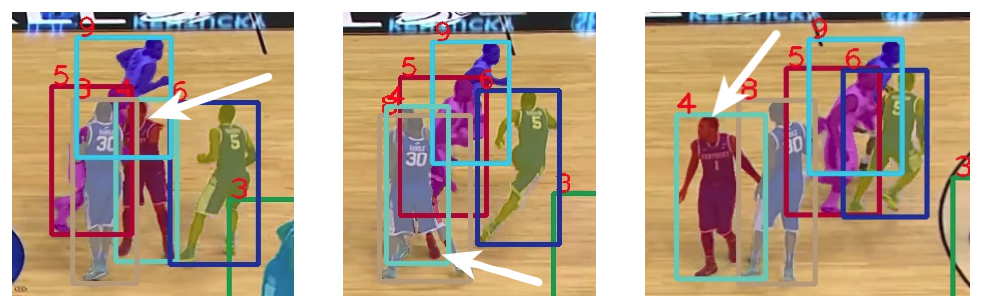
Player 4 in the figure is blocked by teammates, and in the middle image only a shoe sticks out. The detection box is hard to judge at this point, but the mask, propagated down from earlier frames, still clings to that shoe.
This temporal continuity is exactly what the authors want to exploit. The mask is passed on from the previous frame and carries "where this person just was and what shape they had"; a static mask cut straight from the same image has no such layer.
But masks go wrong too. The propagation model drifts, can carry the mask over onto someone nearby, and may lose the mask entirely under full occlusion. So the heart of this paper is setting the rules for when masks may be used, and how far.
Solving the problem
Overall pipeline
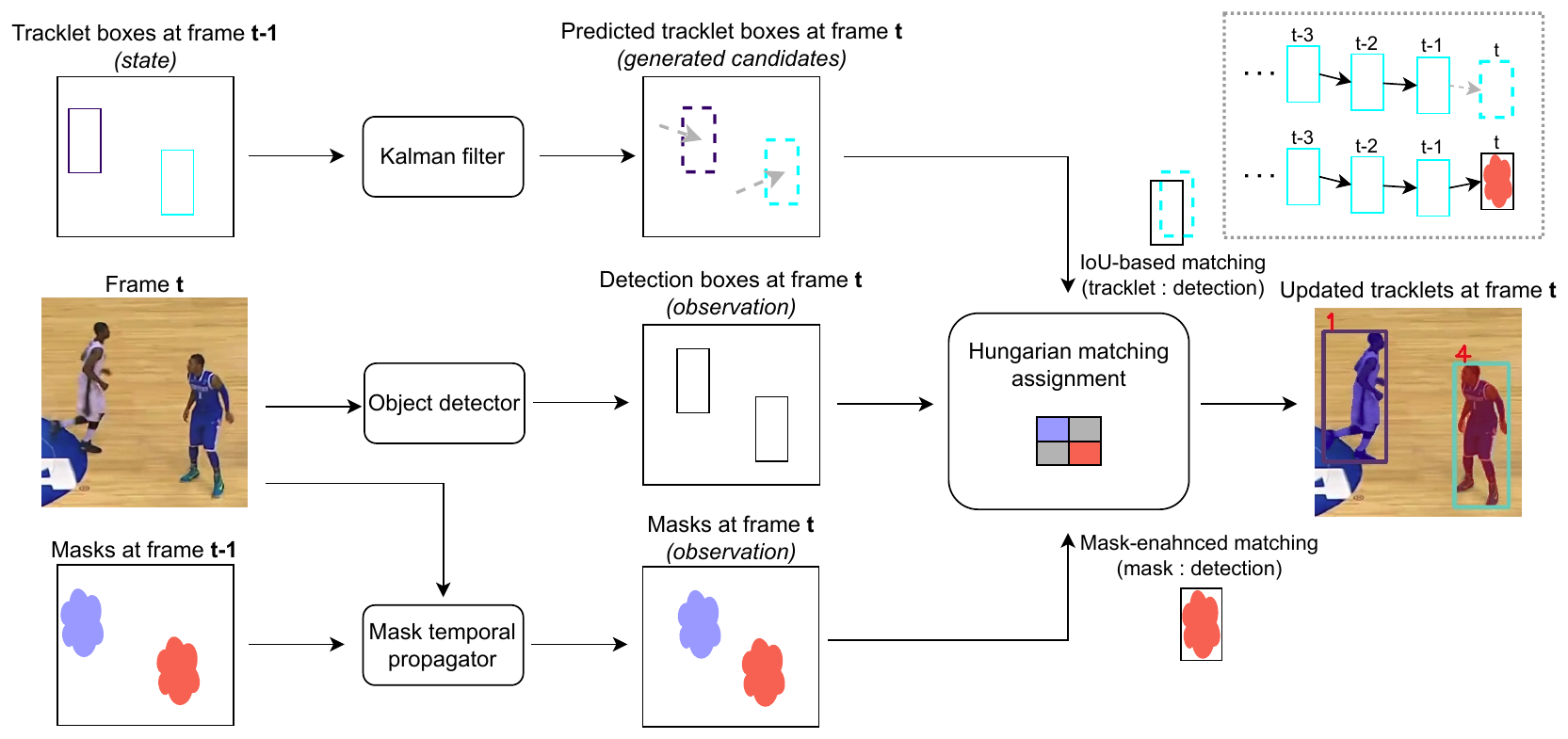
The top two rows are ByteTrack. Detections are split by confidence into a high and a low group, which are matched in turn against the Kalman filter's predicted boxes by IoU, with a cost of handed to the Hungarian algorithm.
The bottom row is the new part. When a new tracklet appears, SAM (ViT-B) makes a mask for it, just this once; after that, the video object segmentation model Cutie propagates every tracklet's mask forward frame by frame. When a tracklet ends, its mask is deleted along with it.
Two ratios
To measure whether a mask and a detection box agree, the authors use two pixel ratios. Write tracklet 's mask as and detection box as , with the number of pixels:
asks how much of the mask falls inside the box, and asks how much of the box the mask fills.
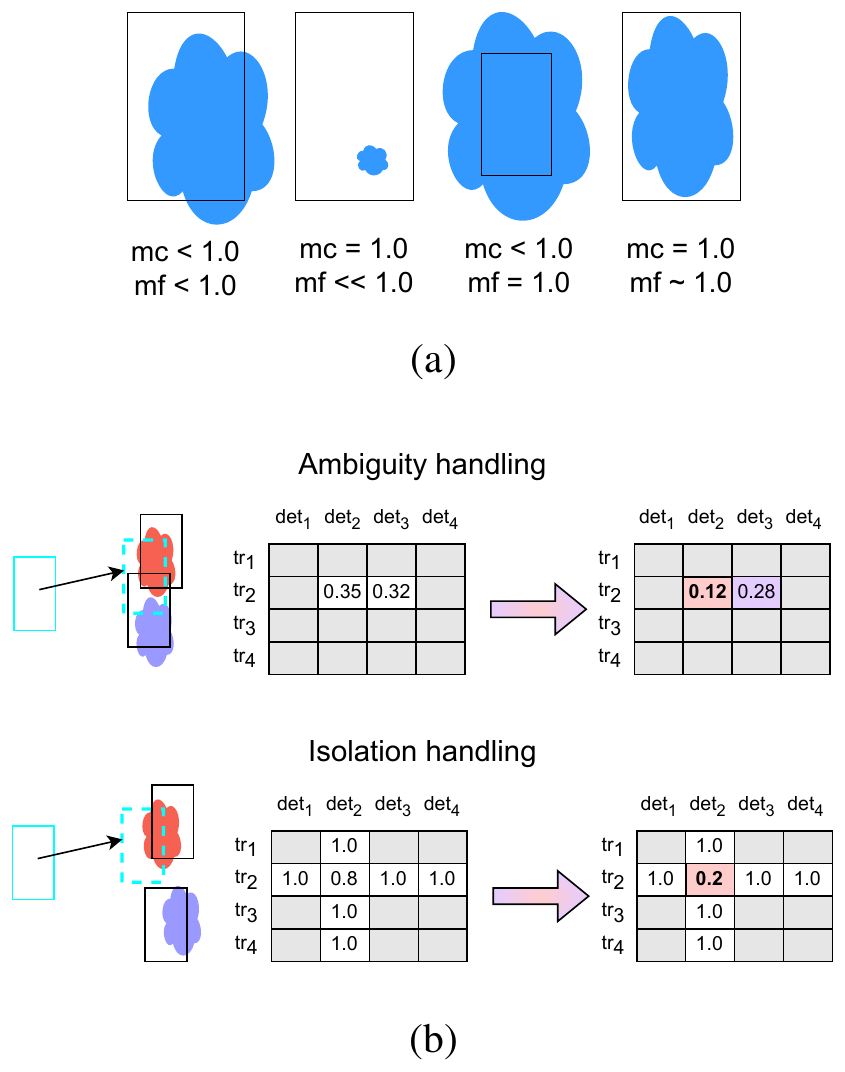
Of the four cases in the top row, the ideal one is on the far right, with both ratios close to 1. The second is the most suspicious, with only a speck of mask inside the box; it could be noise, or it could be someone else's mask.
When masks get a say
Masks only come into play in two situations, shown in panel (b).
The first is ambiguity. More than one detection has an IoU cost below the threshold for the same tracklet, or the same detection matches more than one tracklet, usually because people are bunched together and their boxes overlap.
The second is isolation. There's no ambiguity, but the tracklet's predicted box and the detection box are too far apart, the IoU cost is above the threshold, and they can't be matched. This is common with blurry frames or sudden camera movement.
In either situation, four more checks have to pass:
- The tracklet's mask is visible in this frame.
- The mean confidence over all of the mask's pixels is above 0.6.
- is above 0.05. The threshold is deliberately set very low so that a person blocked down to a single corner can still be used; anything that can't even clear it is most likely noise or someone else's mask.
- is above 0.9. Detection boxes aren't always accurate, so the mask is allowed to stick out of the box a little.
Only when all four pass is the cost rewritten:
If any one of them fails, the cost stays at the original .
Only is actually used to lower the cost. If several people all stand fully inside the same large box, their masks all have an of 1, and there's no telling whose box it really is. measures how much of the box is filled and is better at telling which mask truly lines up with the box, so serves only as a threshold.
In the ambiguity example in panel (b), tr2's costs to det2 and det3 start at 0.35 and 0.32, nearly the same; with the mask added they become 0.12 and 0.28, and det2 clearly wins. The isolation example is even more direct. At 0.8 there was no match, and after the subtraction it's 0.2.
These three thresholds (0.6, 0.9, 0.05) are the same for every dataset and every video. The boundary between high- and low-confidence detections is also fixed at 0.6, ByteTrack's default when it isn't tuned per sequence. The authors say adjusting around these values makes little difference to the results.
When the camera moves
Last comes camera motion compensation (CMC). ORB keypoints are used to estimate the affine transform between consecutive frames, and the Kalman filter's predicted boxes are moved along with it, following StrongSORT and Deep OC-SORT.
Discussion
The experiments use four datasets. SportsMOT covers basketball, volleyball and soccer, with the camera moving fast to follow the ball. DanceTrack is dancers, with nonlinear motion and plenty of occlusion. SoccerNet-tracking 2022 is soccer broadcasts; it provides ground-truth detection boxes and has no validation set, so ablations can only be reported on the test set. MOT17 is pedestrians on the street, used to see whether the method holds up outside sports. Detection always uses the community's standard YOLOX weights, the same as the other methods.
How to use the masks
On the DanceTrack validation set, the authors add the mask usage step by step:
| Setting | HOTA | IDF1 | MOTA |
|---|---|---|---|
| ByteTrack | 47.1 | 51.9 | 88.2 |
| a1: mask only; unseen → no match | 48.6 | 44.4 | 80.8 |
| a2: mask only; unseen → IoU | 45.3 | 41.5 | 82.2 |
| a3: IoU first; mask on ambiguity/isolation | 56.6 | 57.0 | 89.5 |
| a4: a3 + mask confidence | 57.3 | 57.7 | 89.6 |
| a5: a4 + threshold | 58.8 | 60.1 | 89.6 |
| a6: a5 + threshold | 62.1 | 63.4 | 89.7 |
| a6 + CMC | 62.3 | 64.0 | 89.8 |
Compiled from Table 1 of the paper, DanceTrack validation set.
The first two rows make the mask the lead, and IDF1 ends up seven to ten points below ByteTrack instead. Once a mask goes wrong, association goes wrong with it. a2 is worse still, since within one frame some tracklets are matched by mask and others by IoU, two standards mixed together.
Switching to IoU first, with the mask helping only when needed (a3), adds a full 9.5 HOTA in one go. Every check added after that pushes it higher again, and the threshold step adds 3.3. Camera motion compensation helps very little on DanceTrack, where the stage cameras barely move to begin with.
Comparing the full McByte with ByteTrack on the four datasets, HOTA goes up on all of them. The SportsMOT validation set goes from 69.0 to 83.9, SoccerNet from 72.1 to 85.0 and DanceTrack from 47.1 to 62.3. MOT17 only goes from 68.4 to 69.9; pedestrians on the street walk predictably, and IoU was already enough.
Against other trackers
| Dataset | ByteTrack | OC-SORT | McByte |
|---|---|---|---|
| SportsMOT | 64.1 | 73.7 | 76.9 |
| DanceTrack | 47.7 | 55.1 | 67.1 |
| SoccerNet 2022 | 72.1 | 82.0 | 85.0 |
| MOT17 | 63.1 | 63.2 | 64.2 |
Compiled from the HOTA in Tables 3 to 6 of the paper, test sets.
Every method compared uses the same detections. The runner-up on SportsMOT is DiffMOT at 76.2, and on DanceTrack it's Hybrid-SORT at 65.7. On MOT17, the ByteTrack and OC-SORT numbers come from per-sequence tuning; in the untuned group, McByte and DiffMOT tie at 64.2, while Deep OC-SORT in the tuned group reaches 64.9.
The appendix also lists methods that need heavy training. On DanceTrack, MOTRv2 has 73.4 (the version with extra association data, validation-set training and a model ensemble) and MOTIP 67.5; on MOT17, SUSHI has 66.5. These methods need large amounts of training data and may not use the same detections, so the authors kept them out of the comparison in the main text.
The authors also compare against C-BIoU. The C-BIoU paper reports a SoccerNet HOTA of 89.2, higher than McByte, but its buffer scales are set by hand per dataset, and the SoccerNet setting is written up separately in a technical report. C-BIoU has no public code, so the authors reimplemented it from details its authors provided, with one set of parameters for every dataset. SoccerNet fell to just 72.2, and DanceTrack from 60.6 to 45.8. The reimplementation may not match the original exactly, but these numbers at least show that C-BIoU's results lean heavily on hand-tuned buffer scales.
Against other mask-based trackers
On the SportsMOT validation set, the authors ran DEVA, Grounded SAM 2 and MASA:
| Method | Orig. HOTA | Orig. MOTA | YOLOX HOTA | YOLOX MOTA |
|---|---|---|---|---|
| DEVA | 39.3 | −109.6 | 42.4 | −57.0 |
| Grounded SAM 2 | 45.9 | −13.9 | 66.1 | 91.4 |
| MASA | 39.4 | −27.2 | 73.6 | 97.0 |
| McByte | — | — | 83.9 | 98.9 |
Compiled from Table 8 of the paper, SportsMOT validation set.
A negative MOTA means the total number of errors already exceeds the number of objects in the frames. DEVA has no track management and stays negative even with a good detector. Grounded SAM 2 often joins segments up wrongly when stringing them into tracks; MASA improves the most once given YOLOX, but loses targets under long occlusions.
Speed
The appendix notes that McByte runs at roughly 3 to 5 frames per second on a single A100. SAM runs only once when a new tracklet appears, but Cutie has to propagate the masks of every tracklet at every frame, and with many people in the frame that overhead gets considerable. The authors consider it worth it in exchange for not having to tune parameters. A little over a year later, the same team's McByte++ swapped Cutie for the lighter EdgeTAM, mainly to deal with this speed.
The code is public under the MIT license and has been included in Roboflow's trackers package.
Conclusion
Put a mask in the lead role and it makes a mess of matching; as IoU's sidekick, it's very good at the job. The biggest jump in the ablation table comes from demoting it from lead to sidekick, and the three checks after that set the rules for when it gets to speak up.
The whole method uses only off-the-shelf YOLOX, SAM, Cutie and a Kalman filter. The authors trained no models at all and used one set of thresholds for all four datasets. In sports tracking, where parameters usually have to be retuned game by game, that's very practical.
The price is a speed of three to five frames per second, nowhere near real time. And on data like MOT17, where pedestrians walk predictably, an extra point or two of HOTA may not be worth that many times the computation.