Original paper
YOLO11-JDE: Fast and Accurate Multi-Object Tracking with Self-Supervised Re-ID
- Publication
- WACV Workshops 2025Workshop
- First submitted to arXiv
- arXiv:2501.13710
Cite this paper · BibTeX
The citation identifies the linked source version. It cites the original paper and its authors.
@misc{multiobjecttrackingyolo11jde2025,
  title = {{YOLO11-JDE: Fast and Accurate Multi-Object Tracking with Self-Supervised Re-ID}},
  author = {Iñaki Erregue and Kamal Nasrollahi and Sergio Escalera},
  year = {2025},
  eprint = {2501.13710},
  archivePrefix = {arXiv},
  url = {https://arxiv.org/abs/2501.13710}
}
The trackers in the JDE, FairMOT and CSTrack line all have the detector output appearance features on the side. The detector is easy to train, but appearance features depend on identity-labeled data: the same person has to carry the same ID number across frames, and datasets such as CUHK-SYSU, PRW and MOT17 were all labeled one person at a time. During training, each identity is then treated as a class for classification.
This paper, from the University of Barcelona and Aalborg University, sets out to do without identity labels. The authors add a Re-ID branch to YOLO11's small model, train on detection data only, and use data augmentation to manufacture "same person" pairs themselves. The whole model has fewer than ten million parameters.
Defining the problem
What appearance features have to learn is "the same person close, different people far apart." Learned as classification, a training set with thousands of identities needs thousands of classes, and every identity has to be labeled. Detection datasets without identity labels, such as CrowdHuman with an average of 23 people per image, can only be used to train detection; the appearance branch gets nothing out of them.
An old problem is still around, too. Detection wants people of the same class to have similar features, while re-ID wants every person kept apart; with the two tasks sharing one network, how the losses are balanced matters a great deal.
This paper asks whether the appearance branch can be trained well enough for tracking without any identity labels at all.
Solving the problem
One more branch
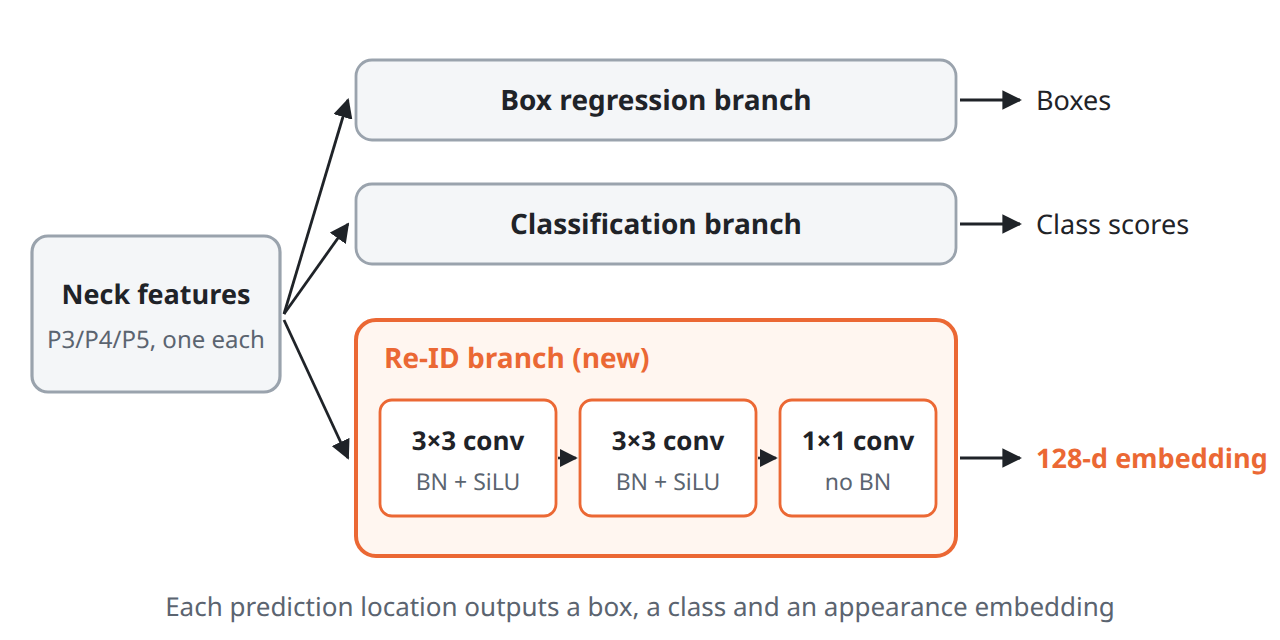
YOLO11's prediction head is already decoupled, with boxes and classes on separate branches. The authors add a third in the same style: two 3×3 conv layers, each followed by BN and SiLU, then a final 1×1 conv that turns the channel count into the embedding dimension. The last layer has no BN, a convention in re-ID toolkits such as FastReID. Each prediction location thus has a box, a class and a 128-dimensional appearance vector at the same time.
Finding the same person in the mosaics
Without identity labels, how do you know which two boxes are the same person? The authors do it in two steps.
Step one gives every box an ID number. For data without identity labels, like CrowdHuman, the official code simply gives every box a unique number of its own; data with track IDs (MOT17, for example) can keep its original numbers. That way, in data like CrowdHuman, each number corresponds to just one box in one photo.
Step two is left to Mosaic. Mosaic, a staple of YOLO-family training, scales, crops and recolors four photos and then stitches them into one.
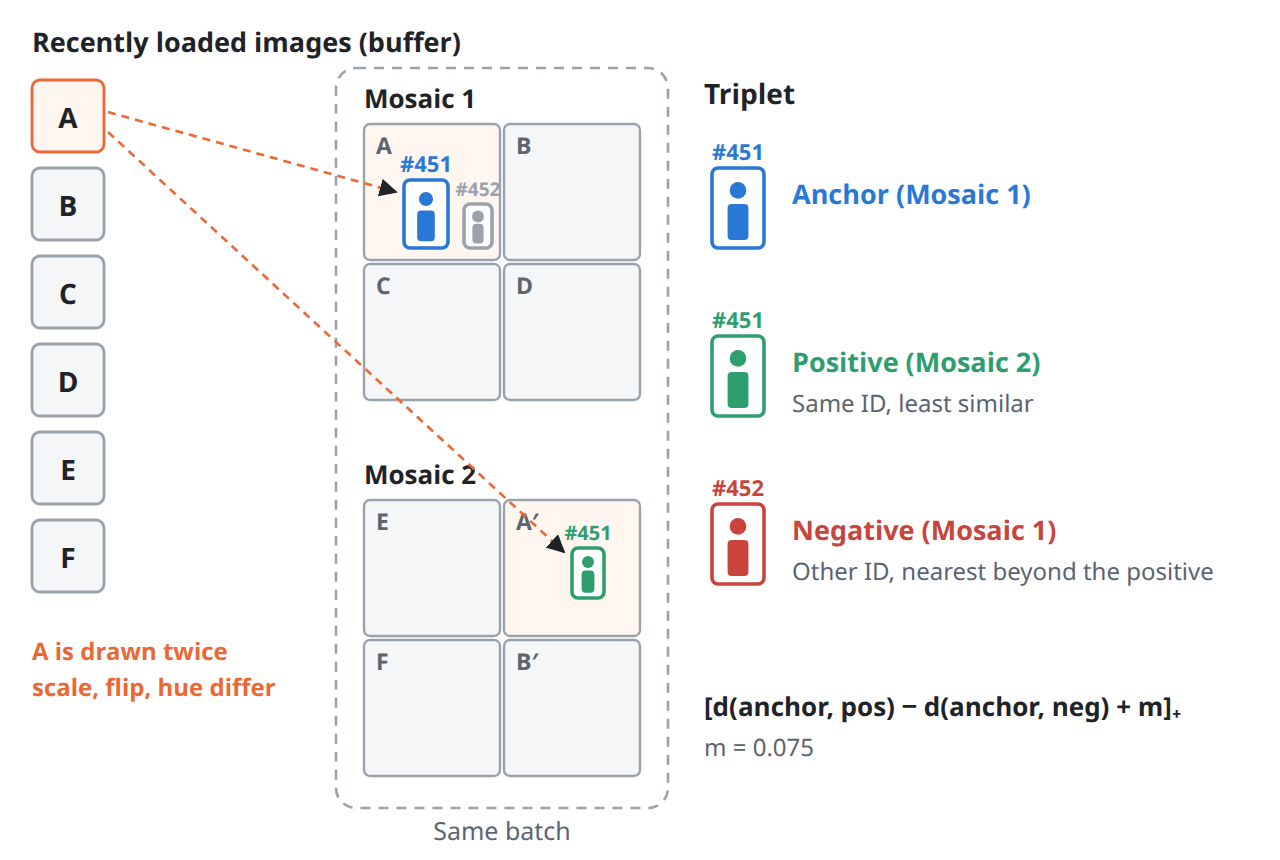
The key lies in how Mosaic picks the other three photos. In the Ultralytics implementation, it doesn't pick at random from the whole dataset but from a buffer of "recently loaded images," and repeats are allowed. Once a photo is loaded, over the stretch that follows it's likely to be drawn into several mosaics, each time with a different scale, flip and hue.
That's exactly what happens to photo A in the figure. It appears in mosaic 1 and again, looking different, in mosaic 2, and the two mosaics are in the same batch. The person in A is numbered #451, so the #451 in the two mosaics become a positive pair, the "same person"; #452 in the same photo, along with everyone in the other photos, are negatives. The authors say this lets the model learn appearance features almost for free, since detection is trained with Mosaic anyway.
Triplet loss
With positives and negatives in hand, the loss is a triplet loss:
is the distance between the anchor and the positive, and the distance between the anchor and the negative. The positive has to be closer than the negative, by at least , or there's a loss.
The number of triplets that can be formed in a batch grows with the cube of the number of embeddings, far too many to compute them all. The authors pick just one triplet per anchor. The positive is the farthest one with the same number, in other words the least similar; the negative is "semi-hard," the nearest among the negatives that are farther away than the positive. Negatives that are too easy never violate the margin and teach nothing, while ones that are too hard (closer than the positive) tend to make training unstable.
Matching during tracking
The tracker follows ByteTrack's two-stage design. High-confidence detections are matched first, with a cost that combines three cues. The Kalman filter's predicted position is fused with appearance similarity, pairs with too low an IoU are ruled out, and IoU distance is combined with detection confidence; the two are then weighted linearly into the final cost. Low-confidence detections and whatever is left from the first round are matched again using IoU only.
Discussion
Ablations
The ablations all run in a simplified setting: YOLO11s trained for 30 epochs on CrowdHuman plus the detection boxes from the first half of MOT17, validated on the second half of MOT17, with FairMOT's tracker to begin with. Each item keeps the best setting and carries it into the next.
Mining strategy. Hardest positives with semi-hard negatives work best, at HOTA 55.91 and IDF1 65.31. With the hardest of both, HOTA drops to 51.66. Interestingly, the combinations with easy negatives get the highest MOTA. Easy negatives hardly ever violate the margin, so the re-ID loss is close to zero and the model is effectively concentrating on detection.
Margin and weight. Raising the margin from 0.05 to 0.075 is slightly better, at HOTA 56.37 and IDF1 66.45. A triplet loss weight of 1 is best, with 0.5 and 1.5 both a little worse. The authors observe a trend of detection getting better as the magnitude of the re-ID loss gets lower.
Dimension. 64 dimensions give the highest MOTA and 128 the best HOTA and IDF1, while 256 is worse on all three.
The results for training data were unexpected.
| Training data | HOTA | MOTA | IDF1 |
|---|---|---|---|
| CrowdHuman | 52.39 | 58.53 | 65.12 |
| + MOT17 (no IDs) | 56.37 | 56.38 | 66.45 |
| + MOT17 (with IDs) | 55.21 | 57.06 | 64.54 |
Compiled from Table 6 of the paper, MOT17 validation set.
With CrowdHuman alone, MOTA isn't low but HOTA is on the low side; MOT17 images are still needed to adapt to the scenes. When MOT17 is added, also using its identity labels actually leaves both HOTA and IDF1 lower than leaving them out. In this setting, the positives Mosaic manufactures are already enough, and real identity labels bring no benefit. Adding more detection data such as ETH and CityPersons improves detection, but the tracking metrics don't budge.
The tracker's effect
Switching to the authors' own tracker raises HOTA on the MOT17 training set from 56.89 with FairMOT's tracker to 60.06, and IDF1 from 66.89 to 71.84. Retuning the FairMOT tracker's parameters only gets to 57.25. The detector's score distribution and features have both changed, so the old tracker parameters may no longer fit.
MOTChallenge
The final model is trained for 100 epochs with a 1280-pixel input.
| Dataset | HOTA | MOTA | IDF1 | FPS |
|---|---|---|---|---|
| MOT17 | 56.6 | 65.8 | 70.3 | 35.9 |
| MOT20 | 53.1 | 70.9 | 66.4 | 18.9 |
Compiled from Table 8 of the paper, test sets.
On MOT17, this isn't a good result. FairMOT, another JDE-type method, gets HOTA 59.3 and MOTA 73.7, CSTrack 59.3 and 74.9, and CountingMOT, which uses YOLOX-X, 63.6 and 81.3. The gap is mostly in MOTA, that is, in detection itself. The authors also put the overall shortfall down to detection ability rather than the appearance features. It does have fewer ID switches than some rivals, 3,177 on MOT17 against 3,303 for FairMOT and 3,567 for CSTrack; but RelationTrack, SimpleTrack, QDTrack and TCBTrack all have only 1,374 to 2,157, while CountingMOT has as many as 5,118.
On MOT20 its relative position is better.
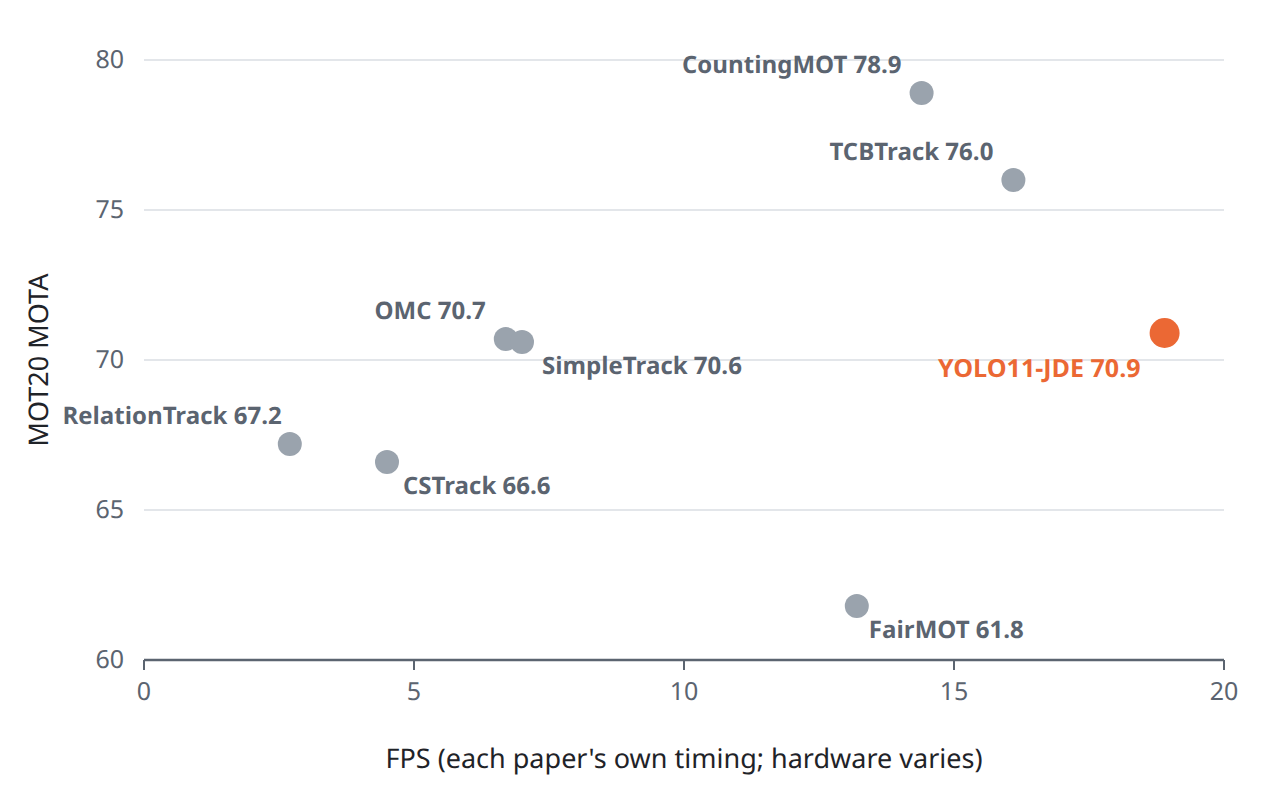
YOLO11-JDE sits farthest to the right. Its MOTA of 70.9 is mid-pack, and at 18.9 frames per second it's faster than every other method in the table. The authors didn't train on MOT20 and credit its better showing in crowded scenes to CrowdHuman, which averages 23 people per image, so after Mosaic a single image holds about 90 people.
The FPS in the figure deserves some caution, though. The paper doesn't say which GPU the speed was measured on, and most of the other methods' FPS figures are quoted from their own papers, on different hardware. Someone asked on the official GitHub which GPU was used for timing, and there's no reply so far. TCBTrack and CountingMOT use YOLOX-X, with ten times the parameters, yet in the table they're only a little slower; a comparison like that is hard to settle until it's rerun on the same card.
Limitations
All the positives come from different transformations of the same photo. Scaling, flipping and recoloring can be simulated; what the same person looks like after turning around, changing pose or walking into different light can't be. That limitation is this note's own inference. MOT17 images were part of the training, but the authors used them "without identity labels." The next steps the authors themselves list are stronger augmentation, such as rotation, perspective transforms and random erasing inside the boxes, plus better decoupling of re-ID from detection.
Also, the official code is built on Ultralytics and inherits its AGPL-3.0 license. Check the license terms before putting it into a commercial product.
Conclusion
This paper's contribution is in how it trains, not in the architecture. One ordinary three-layer conv branch, plus the repeated photos Mosaic produces anyway, is enough to learn appearance features good enough for tracking without any identity labels at all; in the authors' experiments, adding real identity labels didn't even do better.
Detection is its weak spot, and its MOT17 MOTA trails similar methods by a wide margin. If you want a small, fast tracker and would rather not label identities, this is a good starting point; if you're chasing leaderboard scores, both the detector and the speed-measurement conditions still need work.