Original paper
TOPIC: A Parallel Association Paradigm for Multi-Object Tracking under Complex Motions and Diverse Scenes
- Publication
- IEEE Transactions on Image Processing 2025Journal
- First submitted to arXiv
- arXiv:2308.11157
Cite this paper · BibTeX
The citation identifies the linked source version. It cites the original paper and its authors.
@misc{multiobjecttrackingtopic2023,
  title = {{TOPIC: A Parallel Association Paradigm for Multi-Object Tracking under Complex Motions and Diverse Scenes}},
  author = {Xiaoyan Cao and Yiyao Zheng and Yao Yao and Huapeng Qin and Xiaoyu Cao and Shihui Guo},
  year = {2023},
  eprint = {2308.11157},
  archivePrefix = {arXiv},
  url = {https://arxiv.org/abs/2308.11157}
}
Picture the entrance of a beehive. Dozens of bees crowd around the opening, crawling slowly and blocking one another; every so often one suddenly takes off, still in place in one frame and on the far side of the image in the next.
This kind of scene is hostile to multi-object tracking. For the slow crawlers, which look identical and keep occluding each other, appearance features are no help. For the one that suddenly takes off, speed and direction change in an instant, and the position the Kalman filter predicts misses completely.
For this, the authors, from Xiamen University, Peking University Shenzhen Graduate School and other institutions, built a bee dataset, BEE24, and proposed a new way to do association, TOPIC. Its idea is direct, letting both appearance and motion cues do the matching; when the two disagree, it checks whether the object is moving fast or slowly right now, then decides which one to trust.
Defining the problem
Three association paradigms
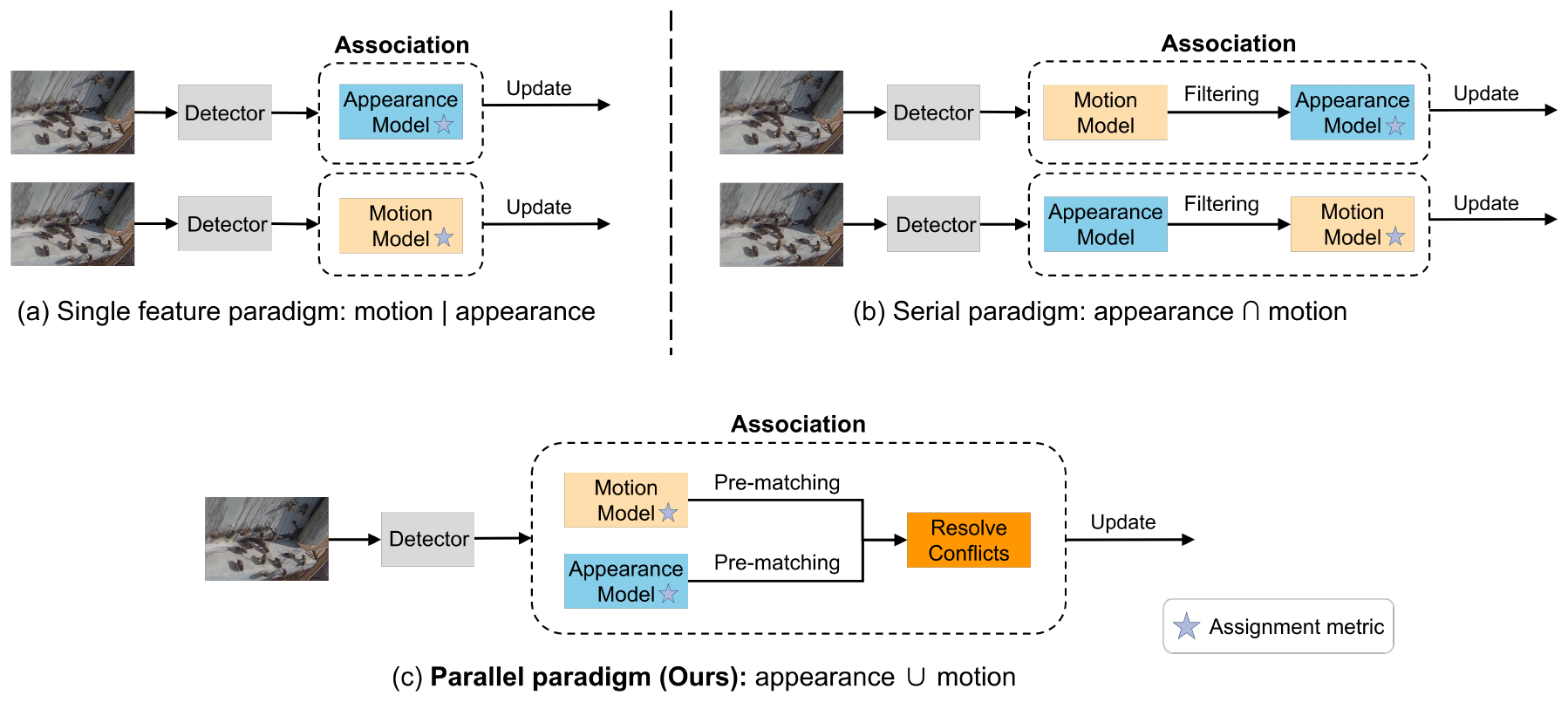
The authors divide existing trackers into two types.
The first is single-feature, panel (a). ByteTrack and OC-SORT look only at motion, matching by box positions and Kalman filter predictions; some others look only at appearance.
The second is serial, panel (b). Most methods since DeepSORT work this way, first using one feature to filter out impossible matches and then the other to do the actual assignment. FairMOT leads with appearance and uses motion as the filter; TraDeS does the reverse. The authors liken this to taking the intersection of the two features, where a match only counts if both sides nod. The problem is that the filter itself makes mistakes too, and as soon as a correct match gets filtered out, it becomes a miss.
Speed decides whom to trust
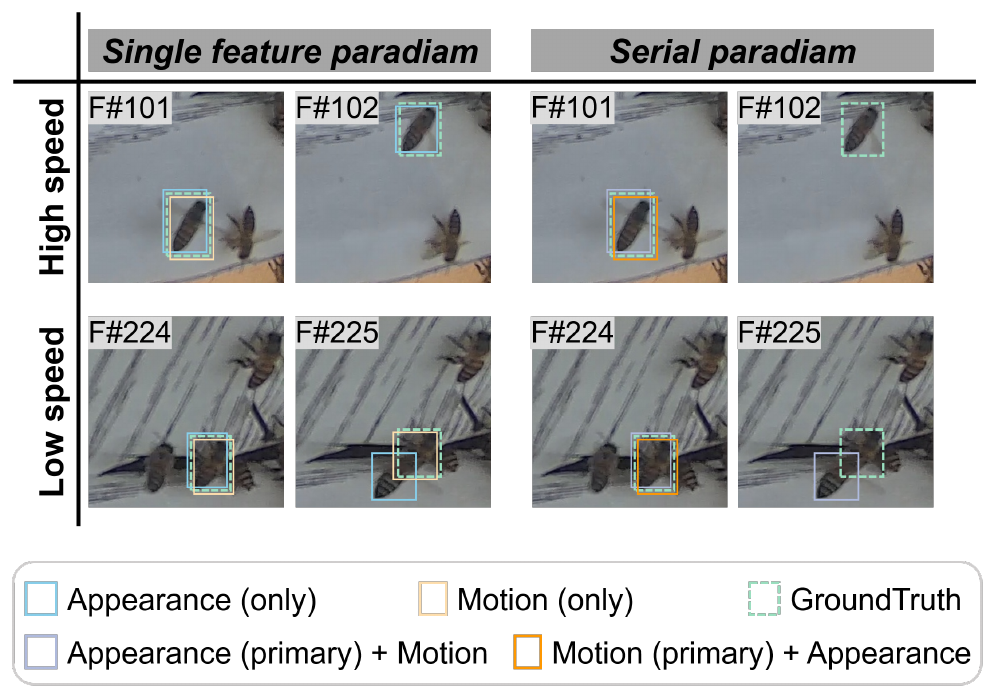
The authors use this figure to show why neither paradigm is enough. The bee in the top row flies from the bottom to the top within a single frame. The motion model predicts it's still near where it was, so naturally it can't be matched; but bees in flight keep their distance from their companions and their appearance stays complete, so looking at appearance alone actually picks it out. The bee in the bottom row crawls slowly beside its companions, half blocked, looking a lot like the one next to it. At this point it moves almost in a straight line, and position prediction alone is enough to keep up with it.
When things move fast, appearance is more reliable; when they move slowly, motion is more reliable. From this the authors conclude that motion speed is strongly correlated with how reliable each of the two features is, and this is the starting point of the whole paper.
BEE24
Existing datasets rarely show this situation. The pedestrians in MOT17 and MOT20 walk slowly in steady directions; the dancers in DanceTrack move in varied ways but don't travel fast either, and the authors class all three as low-speed scenes. The authors set up cameras in front of five beehives and shot 36 videos at 25 frames per second and a resolution of 950 × 590. The videos average 26 seconds and run up to 200 seconds; each video has 126 tracks on average, for 446,908 annotated boxes in total. The bees are small and look almost identical; some sit still, some crawl and some suddenly take off, and the same bee's speed can change drastically. Of the videos, 31 are used for training and 5 for testing.
Solving the problem
Two rounds of matching
TOPIC's full name is Two rOund Parallel matchIng meChanism, two rounds of parallel matching.
It first computes two cost matrices. The appearance cost is 1 minus the cosine similarity of two re-ID features; the motion cost is 1 minus the IoU, with predicted boxes taken from OC-SORT's motion model.
In the first round, the Hungarian algorithm runs once on each cost matrix, giving two sets of matches. Matches that both sets agree on are accepted outright.
The second round handles the matches they disagree on. For each track with a conflict, it computes the track's motion level:
is the track's most recently observed box, and is its box in this frame. The less the two boxes overlap, the more it has moved, and the closer the motion level gets to 1. A track that has just appeared has no history and defaults to 1. If the motion level is greater than or equal to the threshold , the appearance match is used; otherwise, the motion match.
Let's run it once with two tracks and three detection boxes. Appearance matching gives A–1 and B–2; motion matching gives A–1 and B–3. Both sides agree on A–1, so it's accepted in the first round. B has a conflict. Suppose the IoU between B's previous box and its box in this frame is only 0.2, so its motion level is 0.8. If is 0.3, then 0.8 is over the threshold and B is moving fast, so appearance is trusted and B gets 2; nobody wants detection box 3, and it becomes a candidate for a new track. With the serial paradigm and motion as the filter, B and 2 would be too far apart and get filtered out first, and B would be lost just like that.
With , conflicts always go to appearance; with , they go to motion except for new tracks and cases where the previous box and the current one don't overlap at all. The official code doesn't use the same across datasets. MOT17 gets 0.3, BEE24 0.38, DanceTrack 0.9, MOT20 0 and GMOT-40 1. On those last two datasets, conflicts are in fact settled almost entirely by one fixed side. (Speed was supposed to decide whom to trust; in the end, the dataset does)
AARM: making appearance features easier to tell apart
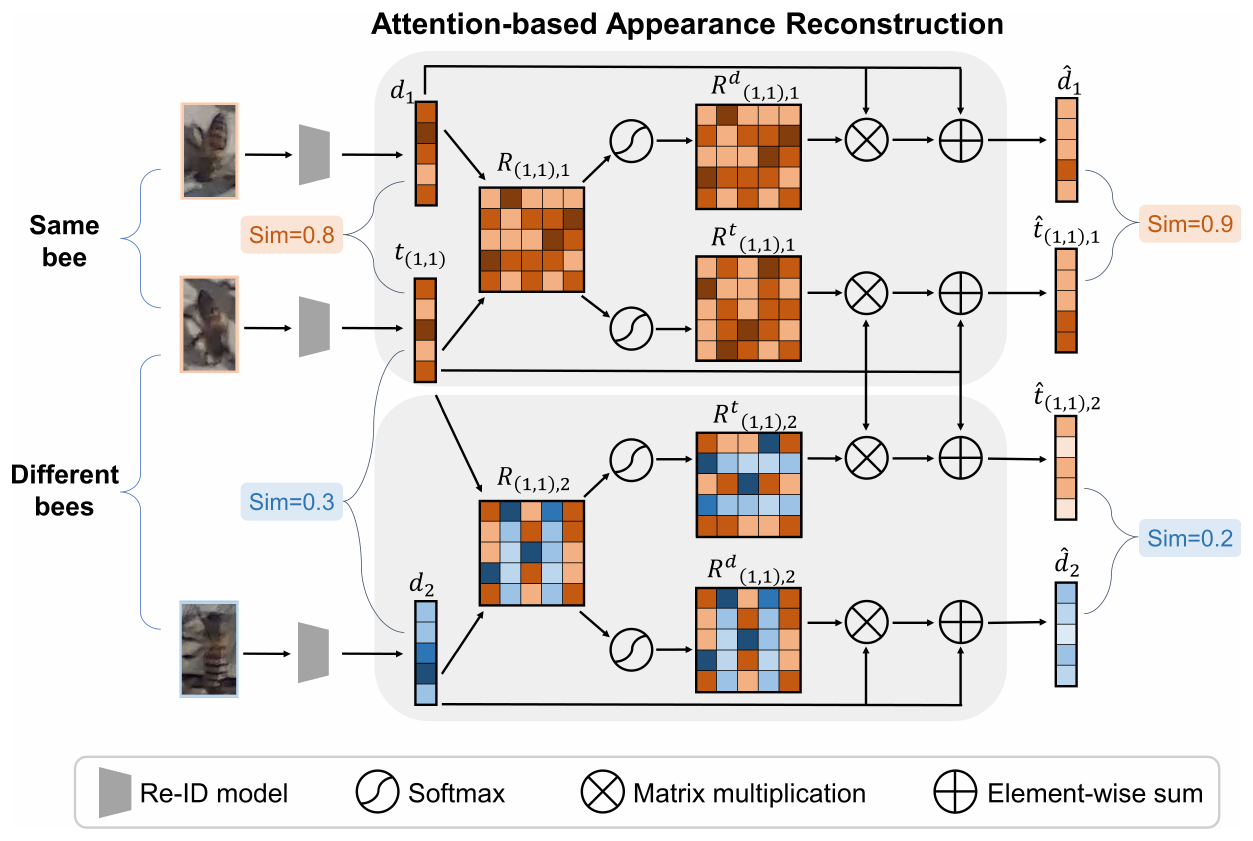
The other component, AARM, works on the appearance features themselves. It takes one historical embedding of a track and the current detection's embedding , normalizes each, then takes their outer product to get a attention map. After a softmax, this map is used to reconstruct the two embeddings residually, and , and the similarity is computed on the reconstructed embeddings. A track stores several historical embeddings, and the one with the highest similarity is taken.
The authors' explanation is that the same object's features in different frames have more parts in common, which reinforce each other during reconstruction; for different objects, the opposite happens. In the figure, the same bee's similarity rises from 0.8 to 0.9, while that of different bees falls from 0.3 to 0.2. AARM has no trainable parameters and can be plugged straight into other trackers.
Discussion
The detector is YOLOX, the motion model is OC-SORT's, and re-ID uses the AGW model from FastReID. Re-ID is the only part of the whole system that needs training, about 3 hours on two RTX 3090s.
Plugging TOPIC into existing trackers
The authors attached TOPIC and AARM to both single-feature and serial trackers and tested each on five datasets. The path built on ByteTrack, on the MOT17 validation set, is the easiest to read:
| Setting | HOTA | MOTA | IDF1 | Misses |
|---|---|---|---|---|
| ByteTrack | 64.4 | 73.2 | 75.8 | 11,975 |
| + appearance | 64.8 | 73.4 | 75.9 | 11,797 |
| + appearance + TOPIC | 66.8 | 76.1 | 77.3 | 9,923 |
| + appearance + TOPIC + AARM | 67.7 | 77.8 | 79.7 | 9,125 |
Compiled from Table II of the paper, MOT17 validation set.
Simply adding appearance changes almost nothing. Switching to TOPIC's way of matching adds 2.0 HOTA and cuts the misses by nearly two thousand. With AARM on top, HOTA ends up 3.3 above the original ByteTrack. Along the same path on BEE24, HOTA goes from 43.2 to 45.3 and MOTA from 59.2 to 63.2.
Someone might ask why not just add the two cost matrices together with weights. The authors tried that too.
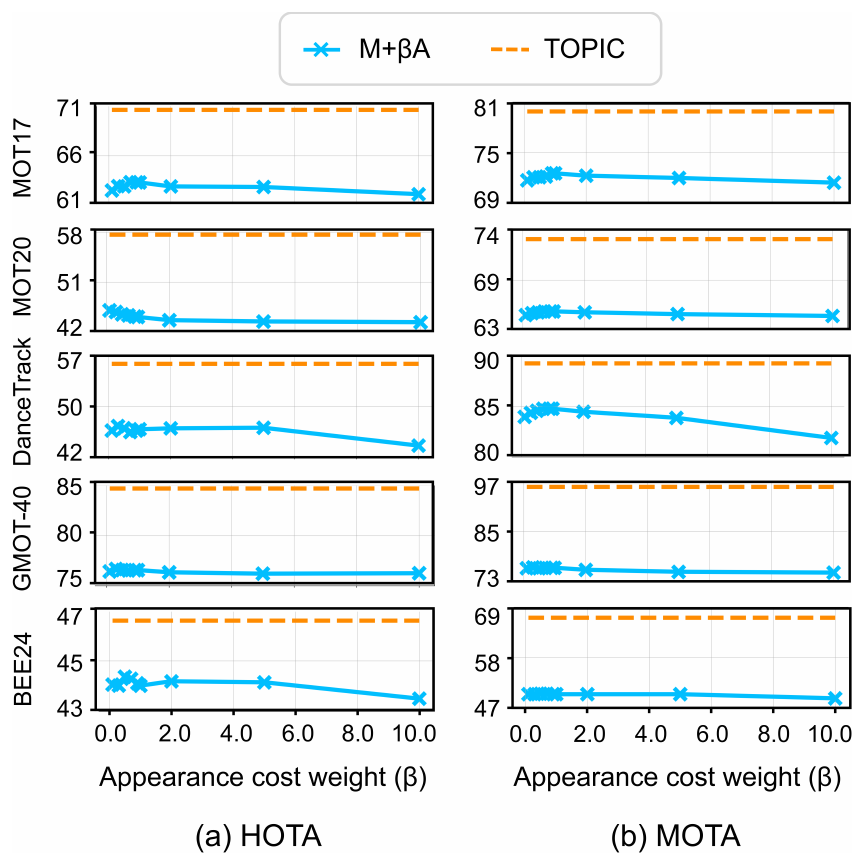
With the appearance weight swept from 0.1 to 10, the weighted sum never catches up with TOPIC on any of the five datasets. The authors' explanation is that a weighted sum assumes the two features contribute in a fixed ratio; in reality, the same object should follow appearance at one moment and motion the next, so the ratio isn't fixed.
How sensitive is the threshold α?
The effect of depends on how often conflicts happen. On GMOT-40, 15.4% of matches run into a conflict, and HOTA and MOTA swing by about 6 points with . DanceTrack's conflict rate is 13.3%, not far behind, yet matters much less there; the authors think many of those conflicts are cases where both features match wrong, so it makes no difference which one you follow. The authors also tried replacing the motion level with a normalized center distance, and it did worse than IoU on all five datasets. Center distance ignores object size, and the same 20-pixel shift means something completely different for a large object and a small one.
Against other trackers
| Dataset | ByteTrack | OC-SORT | TOPICTrack |
|---|---|---|---|
| MOT17 | 63.1 | 63.2 | 63.9 |
| MOT20 | 61.3 | 62.1 | 62.6 |
| DanceTrack | 47.3 | 55.1 | 58.3 |
| GMOT-40 | 75.6 | 82.2 | 84.7 |
| BEE24 | 43.2 | 42.7 | 46.6 |
Compiled from the HOTA in Tables III to VII of the paper, test sets.
HOTA is higher on all five datasets than ByteTrack and OC-SORT, which also use YOLOX detections, with the clearest gaps on BEE24 and GMOT-40. MOTA is another story. On MOT17, TOPICTrack gets 78.8 against ByteTrack's 80.3; on MOT20 the gap is wider, 72.4 against 77.8, with over forty thousand more misses, not fewer. The abstract says the parallel paradigm cuts misses by 6% to 81%, but that is against the authors' own baselines in the ablations; set against ByteTrack on the MOT20 test set, it doesn't hold.
In the DanceTrack comparison table, 58.3 is the top score. But MOTRv2, published before this paper, already had 69.9 on the DanceTrack test set, and it isn't listed. Leave it out of the table, and naturally you can't lose to it.
On speed, the paper only compares running with and without re-ID, which costs 1 to 18 milliseconds more per frame, growing with the number of objects, and gives no FPS for the whole system.
The state of reproduction
The official code is public under the MIT license and has over four hundred stars on GitHub. Open the issues, though, and the picture looks rather different.
BEE24 is the authors' own dataset and the home turf of the whole paper. In May 2025, someone opened an issue whose very first question was which five videos the test set actually consists of. The folder holds BEE24-12, 13, 16, 34 and 36, but the annotation files used for evaluation are 12, 13, 16, 18 and 20. After aligning the two, running the officially provided weights gave a HOTA of 39.6, where the paper says 46.6 (TOPICTrack #21, 2025-05).
Over the following months, more people reported back, with HOTA always landing between 37 and 40. That score not only falls short of the paper, it's also below ByteTrack (43.2) and OC-SORT (42.7), the very trackers TOPICTrack beats in the paper's tables.
In the same issue, one user tried every way of running it they could think of. The official test script gives 37.3. Changing the script's parameters to match the demo program gives 46.5, about the same as the paper. Running the demo directly gives 51.2, higher than the paper. Same code, a 9-point gap from parameters alone, and another 5 points from switching to the demo. In the paper, TOPICTrack's winning margin over ByteTrack on BEE24 is 3.4 points.
The module switches don't line up well either. The official BEE24 test script turns on only TOPIC, not AARM; another issue found that the demo program turns on neither, and that switching them on by hand made the scores drop noticeably (TOPICTrack #29, 2026-05). (So the run with the best score may not use this paper's method at all)
These issues were opened between April 2025 and May 2026, and the authors haven't answered a single one; the repository stopped at its last update in March 2025. Under the issue reporting mismatched folders and NaNs from a self-trained re-ID, the only advice came from an account plugging its own debugging guide along the way.
If you want to compare with TOPIC on BEE24, run it yourself rather than copying the paper's 46.6. That is, provided you can guess which set of parameters the paper used.
Conclusion
If something moves fast, go by its face; if it moves slowly, go by its position. TOPIC's starting point is easy to grasp, and the implementation is simple too. Each feature does its own matching once, agreements are accepted directly, and disagreements are settled by the motion level.
The paper's clearest gains are on BEE24 and GMOT-40. Yet BEE24 is the authors' own dataset; the community can't get back to the paper's score with the official scripts and only roughly matches it after changing the parameters, and the authors have never come forward to say which set the paper used. The threshold also has to be tuned per dataset, and on MOT20 and GMOT-40 it simply went to the two extremes. On MOT20, MOTA loses to ByteTrack as well.
Parallel matching itself isn't hard to plug into an existing tracker, and the extra cost is low. If you want to use it, measure the conflict rate and the right again on your own data; don't count on copying the paper.