Original paper
TAO: A Large-Scale Benchmark for Tracking Any Object
- Publication
- ECCV 2020Conference
- First submitted to arXiv
- arXiv:2005.10356
Cite this paper · BibTeX
The citation identifies the linked source version. It cites the original paper and its authors.
@misc{multiobjecttrackingtao2020,
  title = {{TAO: A Large-Scale Benchmark for Tracking Any Object}},
  author = {Achal Dave and Tarasha Khurana and Pavel Tokmakov and Cordelia Schmid and Deva Ramanan},
  year = {2020},
  eprint = {2005.10356},
  archivePrefix = {arXiv},
  url = {https://arxiv.org/abs/2005.10356}
}
By 2020, object detection had COCO's 80 classes, and LVIS had pushed the vocabulary past a thousand. On the multi-object tracking side, the mainstream benchmarks were still stuck on MOT17's pedestrians and KITTI's cars and pedestrians.
The year before, Tracktor had just shown that a tracker with no dedicated association module, one that simply feeds the previous frame's boxes back into the detector to regress them again, could match the best methods of the time. You can read that as a sign that a simple method is enough, or that the benchmarks are too small and everyone is going around in circles on the same few street scenes.
Achal Dave and Deva Ramanan of Carnegie Mellon University, Cordelia Schmid of Inria and colleagues went with the second reading. They built a dataset for tracking "any object," called TAO (Tracking Any Object), then moved the trackers of the day onto it to see how much skill they had left once pedestrians and cars were gone.
Defining the problem
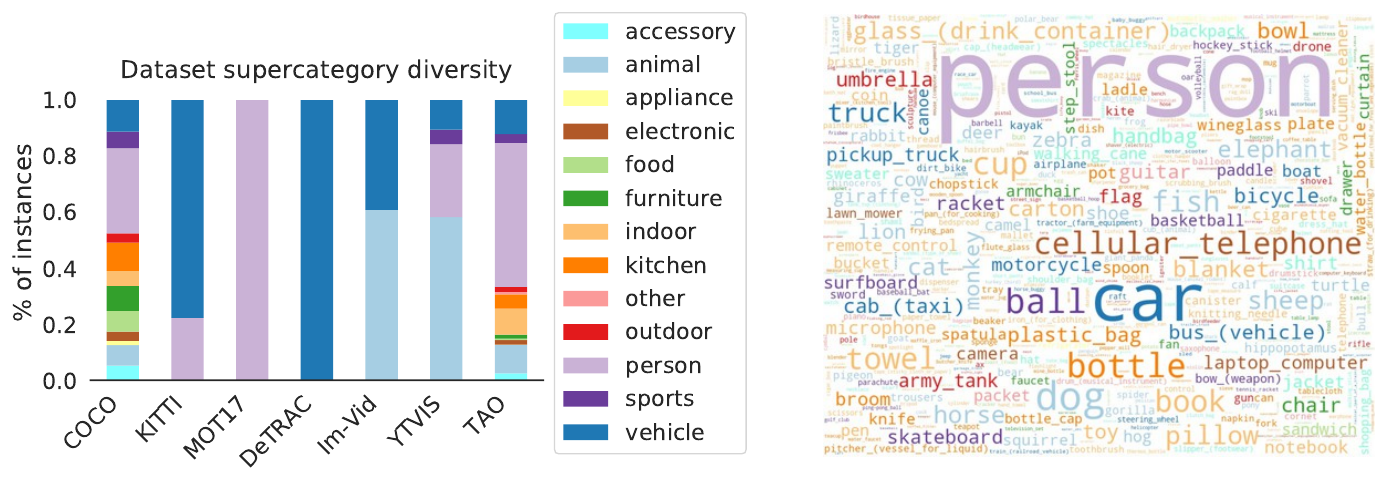
The left panel colors each dataset's annotated instances by supercategory. The MOT17 column is all people, DeTRAC all vehicles, KITTI vehicles plus people; ImageNet-Vid and YTVIS add animals, but they still don't go beyond these three big groups. TAO's column is as mixed as COCO's. In the word cloud on the right, besides person and car, there are small hand-held things like bottle, cup and cellular_telephone.
Here is the scale of a few major tracking datasets:
| Dataset | Classes | Eval. videos | Avg. length | Labeled |
|---|---|---|---|---|
| MOT17 | 1 | 7 | 35.4 s | 30 fps |
| KITTI | 2 | 29 | 12.6 s | 10 fps |
| ImageNet-Vid | 30 | 1,314 | 10.6 s | ~25 fps |
| YTVIS | 40 | 645 | 4.6 s | 5 fps |
| TAO | 833 | 2,407 | 36.8 s | 1 fps |
Compiled from Table 1 of the paper.
Datasets with many classes have short videos; datasets with long videos have few classes. TAO wants both, and its evaluation videos add up to more than 88,000 seconds, nearly 30 times as much as YTVIS. The price is in the last column, with only one frame labeled per second.
Building a dataset like this means answering three questions first. Where do the videos come from? What counts as "an object to track"? And with thousands of videos and hundreds of classes, how do you keep the annotation cost down?
Solving the problem
Videos from existing datasets
Draw from a single domain, and methods tend to work only in that domain. All of TAO's videos come from existing datasets. Charades has people interacting with objects indoors, AVA has movie clips, HACS has everyday YouTube videos, LaSOT was originally a single-object tracking benchmark, BDD and ArgoVerse are driving footage, and a few more were drawn from Flickr's YFCC100M.
To be selected, a video needs a resolution of at least 480p; movies are first cut by shot into clips without scene changes; every clip is checked by a person, and those that are too grainy or too shaky are dropped; and there must be at least two moving objects in view.
The split proportions are the reverse of a typical dataset. The training set has only 500 videos, validation 988 and test 1,419. The authors' reasoning is that TAO is mainly for evaluation, detectors can be trained on image datasets like LVIS, and trackers only need a training set large enough to tune hyperparameters. Clips from the same uploader, the same driving sequence or the same movie never appear in two different splits.
Only label what moves
How do you decide the classes? The usual approach is for curators to draw up a list first and then go find matching videos. TAO turns this around, labeling the objects first and naming them last.
Annotators watch the videos without any class list, looking only for "objects that move at some point in the video," whether they move on their own or are carried by someone. At most 10 are labeled per video, with a box drawn once per second, and another annotator checks the work afterward.
Only then are the objects named. The annotation interface autocompletes from LVIS's 1,230 categories; when nothing fits, such as a door or a pen cap, the annotator types in a free-form name. In the end, 16,144 objects (95%) fall into 488 LVIS categories, and the other 894 (5%) use 345 free-form categories, 833 classes in total.
With "it moves" as the selection criterion, what gets labeled is what tracking actually runs into. A cup in someone's hand, a phone being picked up and a ball being kicked away simply don't exist in MOT17.
Can't label everything? Record where it's complete
At most 10 objects per video means plenty of things go unlabeled. If a tracker follows an unlabeled camel in the corner of the frame, is that a mistake?
TAO handles this with the federated annotation it borrows from LVIS. For each class , videos fall into three kinds:
- : every in the video is labeled.
- : the video is verified to contain no .
- : some are labeled, with no guarantee that all of them are.
Precision is computed only on videos in and ; recall uses and . Videos that are in none of the three are simply skipped when evaluating .
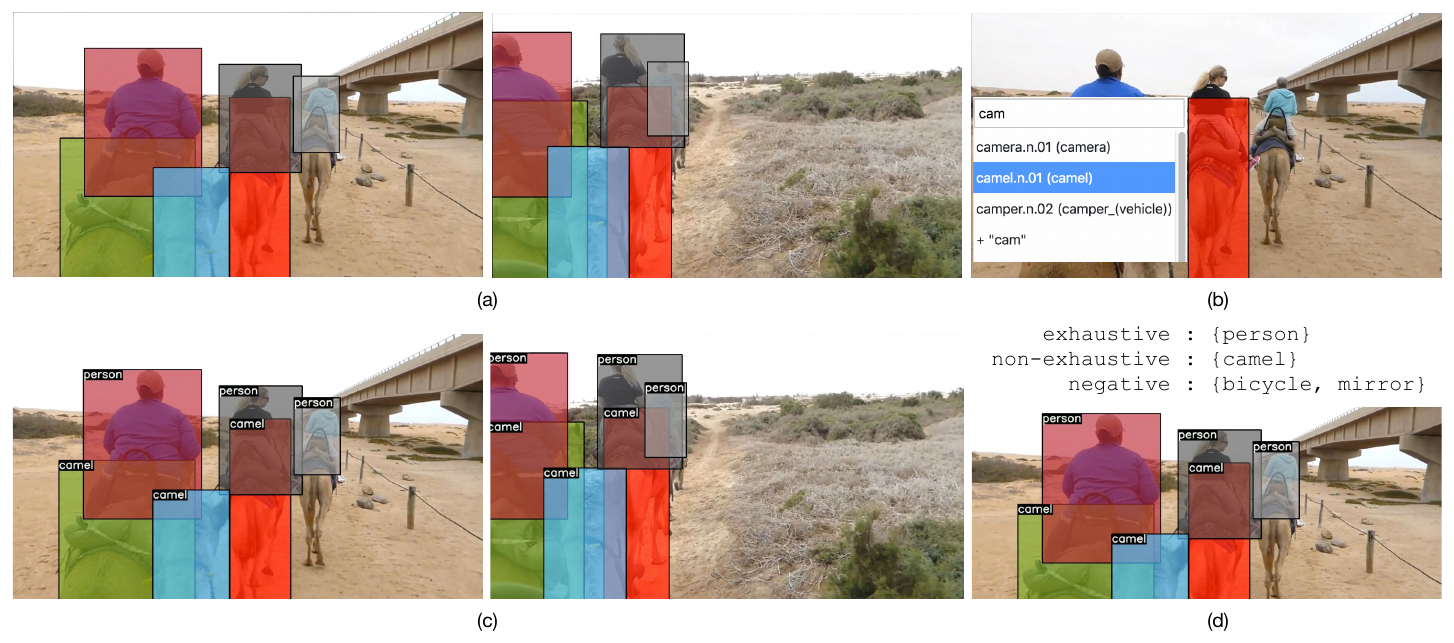
In the desert video in the figure, the annotators confirmed that all the people are labeled, so the video belongs to ; the camels are labeled but not guaranteed to be complete, so it belongs to ; bicycles and mirrors are verified absent, so it belongs to and .
Now suppose a tracker outputs four tracks that match no annotation:
- A "person" track. Every person is labeled, so this extra one counts as a false positive.
- A "bicycle" track. The video is verified to have no bicycles, so this is a false positive too.
- A "camel" track. It might be following that unlabeled camel; there's no way to tell, so it doesn't count toward precision.
- A "dog" track. Nobody checked whether this video has any dogs, so the whole video is skipped when evaluating the dog class.
Precision and recall can still be estimated with only a small fraction of objects labeled; that's what federated annotation is for. Cases 3 and 4 also leave a loophole, which will come up again later.
Track mAP with 3D IoU
Detection uses IoU to judge whether a box is right. TAO extends it to whole tracks, summing the intersections and the unions over all frames separately:
is the ground-truth track and the predicted one. If the object is absent in a frame, or nothing is output there, that frame counts as an empty box.
For example, say the ground-truth track appears in 4 annotated frames, with a box area of 100 in each. The predicted track overlaps the ground-truth box perfectly in the first 2 frames and outputs nothing in the last 2. The intersection is 200, the union 400, and the 3D IoU is exactly 0.5.
TAO sets its threshold right at 0.5. You pass only by tracking for half the time; tracking 30% of it earns nothing, the same as tracking 5%. The authors say this is deliberate. Just as a detector gets no credit for a loose box, a tracker gets no credit for loosely tagging along for a few frames. For partial credit, you can average over multiple thresholds, as COCO does.
Once each track is judged right or wrong, tracks are ranked by their scores, and per-class AP is computed the LVIS way and averaged; that's TAO's Track mAP. A track's score is the average of its per-frame scores.
Discussion
All of the experiments below tune hyperparameters on the training set and report results on the validation set.
Detection alone is hard
A Mask R-CNN-style detector trained on LVIS and COCO gets an mAP of only 27.1 at IoU 0.5 on the TAO validation set. Trained on LVIS alone, it can't even detect people well, which is why COCO is mixed in.
Stuck on both classification and linking
The authors compare two ways of linking per-frame detections into tracks, the offline Viterbi linking common on ImageNet-Vid and the online SORT.
To pull the problems apart, they also prepare two kinds of oracle. The class oracle gives the correct class to any predicted track whose 3D IoU with a ground-truth track exceeds 0.5. The track oracle consults the ground truth to link each frame's detection boxes perfectly, but leaves the boxes' original classes unchanged.
| Linking | Class oracle | Track oracle | Track mAP |
|---|---|---|---|
| None | 0.6 | ||
| Viterbi | 6.3 | ||
| SORT | 13.2 | ||
| Viterbi | ✓ | 15.7 | |
| SORT | ✓ | 30.2 | |
| None | ✓ | 31.5 | |
| None | ✓ | ✓ | 83.6 |
Compiled from Table 3 of the paper, TAO validation set; "None" treats each detection box as a track of its own.
The first surprise is that SORT beats Viterbi. Viterbi is an offline method tuned for ImageNet-Vid, and a single run on the TAO training set takes over a month, so the authors could only tune its output score threshold; SORT is light enough to be tuned properly.
With the class oracle, SORT more than doubles, from 13.2 to 30.2; the track oracle alone also reaches 31.5. Use both together and it jumps to 83.6. Classification and linking each account for half the problem, and only fixing both gets you close to full marks. The typical failure the authors see in the tracking results is semantic flicker, where the predicted class of the same object jumps back and forth between similar classes.
How SORT was tuned up
The appendix keeps the log of tuning SORT on the TAO training set. SORT's default parameters were designed for pedestrians. A track that goes unmatched is deleted after 1 frame, a track is confirmed only after 3 consecutive matches, and a detection is linked only at an IoU of 0.3 or more. The authors adjusted parameters one at a time by coordinate descent:
- Lower the IoU threshold to 0.1, keep tracks alive for 100 frames and confirm them after 1 frame, and Track mAP rises from 4.3 to 8.2. Objects in TAO move a lot and the videos are long, so SORT has to be more patient.
- Lower the detection score threshold from 0.1 to 0.0005, and it rises to 11.3.
- Raise the output cap from 300 boxes per image to 10,000 while making NMS stricter, and it finally reaches 16.3.
Steps 2 and 3 amount to having the detector spit out as many boxes as possible, keeping even those with a score of just 0.0005. These low-score tracks sit at the very end of the PR curve, so they don't drag down the precision already reached earlier; and for classes that aren't fully labeled, their false positives don't even count. Every so often one happens to hit a missed object, and recall goes up.
That's this note's reading; the TAO paper itself doesn't analyze it this way. Two years later, TETer called out the loophole. Its authors copied a video's tracks several times, pasted on other classes the detector had guessed, and Track mAP went from 0 to 62.9.
People are easier to track
People are the class the tracking community has studied most. The authors had Tracktor++ use the same detector, taking only its "person" predictions, and compared AP on the person class against SORT and Viterbi. Viterbi gets 16.5, SORT 18.5 and Tracktor++ 36.7.
Remove Tracktor++'s re-identification (re-ID) and camera motion compensation, and AP drops to 25.9. That runs contrary to the Tracktor paper's own observation. Back on MOT17, these two components didn't help much, raising MOTA only from 61.5 to 61.9. On TAO, the same comparison goes from 61.6 to 66.6. TAO has far more camera shake and occlusion, and that's where these two components earn their keep.
People are also much easier to track than other classes. SORT's AP on person is 18.5, against 13.2 averaged over all classes. In MOTA the gap is even wider, 54.8 for person against an all-class average of only 6.7. The authors explain that MOTA weighs detection more heavily while 3D IoU severely punishes tracking errors; person detectors are especially accurate, so their advantage is magnified in MOTA.
Single-object trackers given the answer
Single-object trackers need no classes at all. The user boxes the target in the first frame, and the tracker follows it from there. The authors handed these trackers each object's ground-truth box, also gave them the class oracle, and compared them with SORT, which had the class oracle too.
| Method | From first frame | From largest box |
|---|---|---|
| SORT | 30.2 | — |
| SiamRPN++ | 29.7 | 35.9 |
| ATOM | 30.9 | 38.6 |
| DiMP | 33.2 | 38.5 |
Compiled from Table 5 of the paper, TAO validation set, Track mAP; all with the class oracle, and ATOM and DiMP retrained with TAO videos excluded.
Starting from the frame where the object first appears, the best one, DiMP, gets 33.2, just 3 points above SORT, and that's with the correct initial box handed to it. Starting instead from the frame where the object is largest and tracking both forward and backward scores somewhat higher, but that requires seeing the whole video first and can't be used online.
Switch to MOTA and IDF1, and DiMP pulls far ahead, with a MOTA of 24.4 and an IDF1 of 55.1, while SORT gets only 11.3 and 15.6. Lower the 3D IoU threshold to 0.1, and DiMP's mAP is 71.0 against SORT's 36.9. Single-object trackers are very accurate for a short stretch after initialization; they just don't hold out long, and under a 3D IoU threshold of 0.5, that brief accuracy earns no points.
From this, the authors put forward a somewhat provocative view. With large-vocabulary detectors trained on data like LVIS, detection-based multi-object trackers can already hold their own against single-object trackers that need a human to supply the initial box.
Conclusion
TAO decides its vocabulary by "label only what moves," keeps costs down with federated annotation, and ends up with a tracking benchmark of 2,907 videos and 833 classes. In the analysis, classification and linking are each a bottleneck, and only with both oracles together does Track mAP jump from around 30 to 83.6; the simple online SORT beats heavyweight offline linking; and the value of Tracktor++'s re-ID and camera compensation only shows in scenes like TAO's.
Its weaknesses come from the same trade-offs. With one labeled frame per second, an object may already have moved a long way between two adjacent annotated frames; and the cap of 10 objects per video, the federated rules and Track mAP together leave large amounts of low-score output almost unpunished. A later TAO challenge winner had its frames piled high with boxes scoring around 0.01.
TETer, OVTrack and MASA all went on to report results on TAO, only with the main metric switched to TETA, which TETer proposed.