Original paper
MMPTRACK: Large-scale Densely Annotated Multi-camera Multiple People Tracking Benchmark
- Publication
- WACV 2023Conference
- First submitted to arXiv
- arXiv:2111.15157
Cite this paper · BibTeX
The citation identifies the linked source version. It cites the original paper and its authors.
@misc{multiobjecttrackingmmptrack2021,
  title = {{MMPTRACK: Large-scale Densely Annotated Multi-camera Multiple People Tracking Benchmark}},
  author = {Xiaotian Han and Quanzeng You and Chunyu Wang and Zhizheng Zhang and Peng Chu and Houdong Hu and Jiang Wang and Zicheng Liu},
  year = {2021},
  eprint = {2111.15157},
  archivePrefix = {arXiv},
  url = {https://arxiv.org/abs/2111.15157}
}
For a cashierless store to know who took what, the first step is knowing where every customer walked from the moment they came in until they left.
A single camera tracking people can hardly manage this. Shelves block people, people block people, and when several people crowd together in the checkout queue, a single camera's view is just a tangle of overlapping figures. So these systems usually mount several cameras with overlapping views on the ceiling: a person hidden from one camera can still be seen by another.
The problem is data. Training and evaluating multi-camera tracking needs a box and an identity for every person in every frame of every camera, and the same person's identity has to agree across cameras. Annotation like this is staggeringly expensive, so the public multi-camera datasets are all small.
This paper from Microsoft gets its annotations another way. They add depth cameras to the environment, first track people in 3D space using the depth data, then project the tracks back to every color camera; humans only have to fix what the tracker got wrong.
Problem Definition
The authors list a few existing multi-camera datasets. WILDTRACK has 7 overlapping cameras and 3D annotations, but only 400 frames are labeled; DukeMTMC has over two million frames and more than 2,700 people, but its cameras barely overlap; the other datasets have low resolution, few frames and few people.
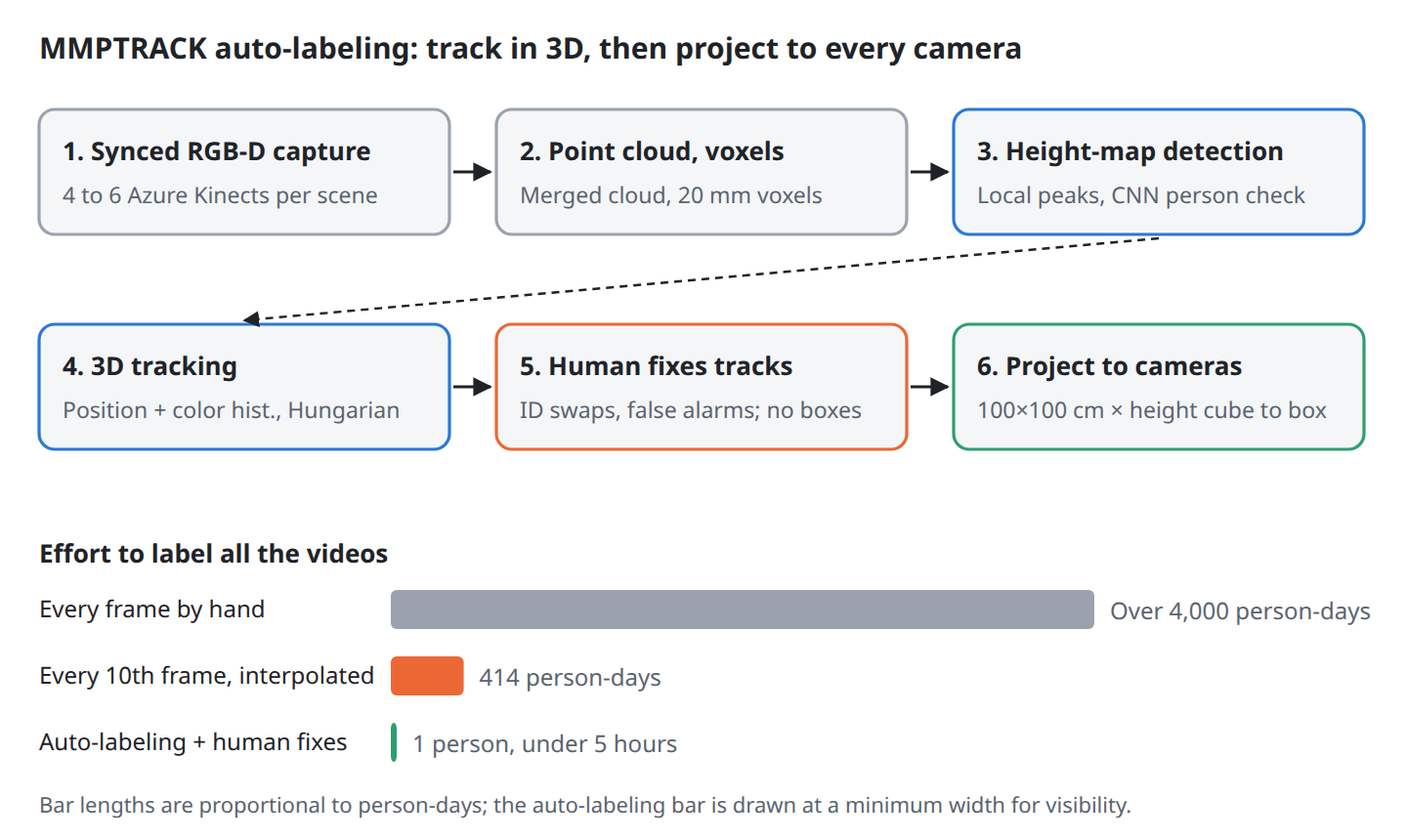
To build a large dataset with heavily overlapping cameras and annotations in every frame, drawing boxes by hand one image at a time is not practical. The authors estimate that labeling every frame of their data by hand would take more than four thousand person-days; labeling every tenth frame and interpolating would still take 414 person-days.
Solution
Setup and Calibration
The authors built five scenes in a Microsoft lab: a cafe, a factory, a lobby, an office and a retail store. Each scene has 4 to 6 Azure Kinects, cameras that record color images and depth at the same time, for 23 cameras across the five scenes. The retail scene has the most, 6.
The cameras have fixed positions and angles, and each camera's position in world coordinates has to be calibrated first. The authors placed a set of ArUco markers in the scene; these are printed black-and-white square codes whose corner coordinates a camera can compute as soon as it sees them. If a camera can see a marker, an edge connects the two, forming a graph of interleaved cameras and markers; as long as this graph is connected, graph optimization solves for every camera's extrinsic parameters and every marker's position at once.
Tracking People with Depth
Tracking happens in 3D space.
The data from all the depth cameras is merged into one point cloud using the calibration parameters, then cut into small cubes (voxels) 20 millimeters on a side. A cube with any point inside is marked 1, otherwise 0.
These cubes are then projected onto the ground to form a top-down map. The value at each position on the map is the height of the highest voxel at that position. Seen from directly above, every person is a little hill, with the top of the head as the summit.
Detection then becomes simple. First, every local maximum on the top-down map becomes a candidate; a patch is cut around each candidate and handed to a CNN that decides whether it is a person.
Tracking is the standard "detect, then associate". In every frame, detections are matched to existing tracks with a cost matrix built from their spatial distance and the difference between their color histograms, solved with the Hungarian algorithm; any detection left unmatched starts a new track.
The beauty of this approach is that the top-down map has nothing to do with lighting, camera angles or background, so it works as is in a new scene. The authors' 3D tracker was trained on a separate dataset that shares neither scenes nor subjects with this one.
Humans Only Fix
The 3D tracker still makes mistakes, most commonly ID switches between two people and things that are not people taken for people. Annotators only have to fix these two kinds of error: change switched IDs back and delete whole tracks that are false alarms. Since corrections are made a whole track at a time and no boxes need to be drawn, it goes fast.
The corrected 3D tracks are then projected back to every color camera. The authors estimate each person's height from the local maximum of the top-down height map, place a cm cube of height where the person stands, project it into every camera's image, and take the bounding rectangle as the 2D box.
Correcting the whole dataset took one annotator under 5 hours. The authors put the cost at about one eight-hundredth of traditional methods.
On quality, the authors took 1,000 consecutive frames from each scene, annotated them entirely by hand and compared. The IDF1 is 100 in all five scenes, and the MOTA is 100 everywhere except the retail scene at 99.9; across the whole comparison, only 4 hand-labeled targets were not matched.
The Dataset
Recording took four half-days with 7 subjects each time, 28 people in all, of varied ages, genders and ethnicities. They acted freely in the scenes; in the retail scene, that meant pushing carts, carrying baskets and queuing to check out.
The result is 576 minutes, about 9.6 hours, of video at 15 frames per second, more than 510,000 time steps in all, with every camera view annotated at every time step. The retail scene is the longest, at 172 minutes.
Discussion
The evaluation metrics are MOTA and IDF1, computed on the top-down ground plane with a distance threshold of 1 meter. MOTA mainly reflects how many detections are missed or spurious; IDF1 reflects whether identities stay consistent from start to finish, and the latter matters more for an application like a cashierless store that needs to know "who took what".
Two Baselines
The authors test two real-time multi-camera trackers.
DMCT predicts a foot-point heat map for every person in each camera's image, projects them onto the ground and merges them into one top-down heat map, then detects and tracks on the top-down heat map. On the merged heat map you can take local maxima directly, or train a separate YOLOv5 to detect on the top-down heat map; the latter is marked TD. The authors also labeled the foot points of people in about 600,000 Open Images photos as extra training data, marked Ext.
VoxelTrack instead estimates 3D human skeletons first and tracks with the skeletons. Its 3D part was trained on synthetic data, and since MMPTRACK has no skeleton annotations, only a kind of virtual fine-tuning is possible.
| Method | IDF1 | MOTA | ID switches |
|---|---|---|---|
| VoxelTrack | 50.8 | 76.8 | 4,922 |
| DMCT | 56.0 | 88.8 | 2,677 |
| DMCT-TD | 68.1 | 93.2 | 935 |
| DMCT-Ext | 56.6 | 89.0 | 3,013 |
| DMCT-Ext-TD | 74.1 | 94.6 | 641 |
Source: Table 5 of the paper, test set.
Look first at the gap between MOTA and IDF1. The best setting has a MOTA of 94.6, so detection is almost always right; but its IDF1 is only 74.1, so a person's identity still often breaks off or jumps to someone else partway through the video. For an application that must track every customer, this IDF1 is not good enough yet, and the authors agree.
Training a separate detector on the top-down heat map is the change with the biggest effect: IDF1 jumps from 56.0 to 68.1, and ID switches fall from over two thousand to just over nine hundred. The 600,000 extra Open Images photos add only 0.6 on their own, and 6 points only when combined with TD.
VoxelTrack comes last; the authors attribute this to its models being trained on COCO and synthetic data, with no way to really train them on this dataset.
Retail Is the Hardest
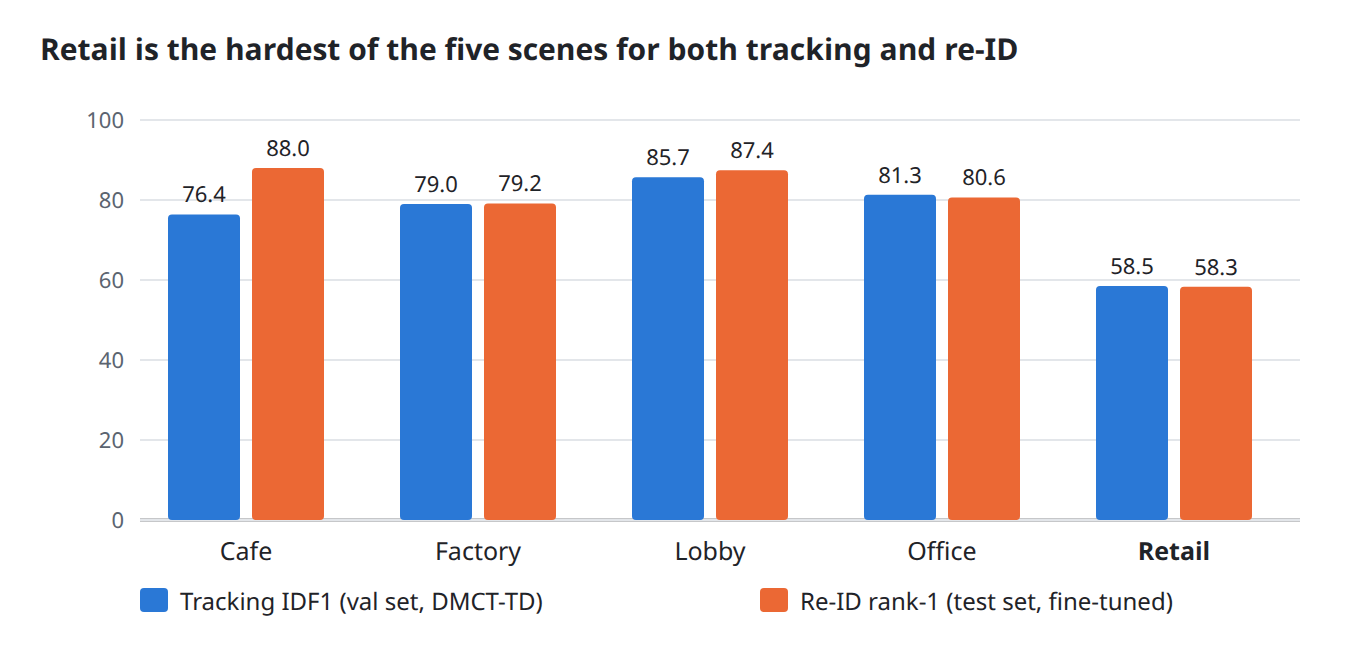
Split the results by scene and retail is clearly the hardest. With DMCT-TD and training data from the scene, the other four scenes have an IDF1 between 76 and 86; retail has only 58.5.
Person re-identification is the same story. The authors take a model pretrained on MSMT and fine-tune it on MMPTRACK. The other scenes get a rank-1 between 79 and 88, while retail gets only 58.3; its mAP is only 33.25, against 51 to 64 for the other scenes. The authors put this down to the cluttered background of the retail scene, with too many colors and textures from shelves and products.
Re-identification has another interesting result. MMPTRACK's training set has only 14 people, yet a model trained on it from scratch beats a model trained only on MSMT (more than four thousand people) in every scene. Data with few people but exactly matching viewpoints, scenes and lighting is more useful than data with many people from somewhere else.
Another finding concerns scene-specific data. Without TD, having training data from the scene makes a big difference: the cafe's IDF1 rises from 39.4 to 64.2. With TD, the gap narrows, and some scenes even do better without their own data. The top-down heat map has little to do with camera positions and backgrounds, so it holds up better across scenes.
Can You Get It?
The paper says the dataset "will be publicly released upon the acceptance of this work". The data later appeared on the website of the ICCV 2021 workshop on multi-camera multiple people tracking, for research use only; you have to apply by email and sign a user agreement. The website notes that the subjects were all paid and signed consent for public release for research.
Conclusion
The most useful thing MMPTRACK left behind is its annotation method. Add a few depth cameras, let a 3D tracker do most of the work, and have people fix only ID switches and false alarms: annotation cost drops from thousands of person-days to a few hours, and the quality still reaches an IDF1 of 100.
With this approach, any store deploying multi-camera tracking can record a batch of data in its own store with the same equipment and train a model of its own. That is exactly what the authors recommend in their conclusion, and for chain stores with similar interiors this route is especially cost-effective.
But the experiments also show the job isn't finished. The best tracker's IDF1 in the retail scene is under sixty percent, and person re-identification is no better. A retail store's shelves, products and queuing crowds are much harder than a lobby or an office; knowing what each customer took starts with tracking every person well, and there is still a long way to go.