Original paper
Harnessing Chain-of-Thought Reasoning in Multimodal Large Language Models for Face Anti-Spoofing
- Publication
- CVPR 2026Conference
- First submitted to arXiv
- arXiv:2506.01783
Cite this paper · BibTeX
The citation identifies the linked source version. It cites the original paper and its authors.
@misc{faceantispoofingfacecot2025,
  title = {{Harnessing Chain-of-Thought Reasoning in Multimodal Large Language Models for Face Anti-Spoofing}},
  author = {Honglu Zhang and Zhiqin Fang and Ningning Zhao and Saihui Hou and Long Ma and Renwang Pei and Zhaofeng He},
  year = {2025},
  eprint = {2506.01783},
  archivePrefix = {arXiv},
  url = {https://arxiv.org/abs/2506.01783}
}
Hand a recaptured photo to a general-purpose multimodal large language model and ask it, "Is this a spoof?" What happens?
The appendix of this paper happens to run exactly that experiment. The authors gave Rose-Youtu's attack images straight to a model with no fine-tuning, computed the share it classified as attacks for each attack type, and compared that with the results after training on FaceCoT:
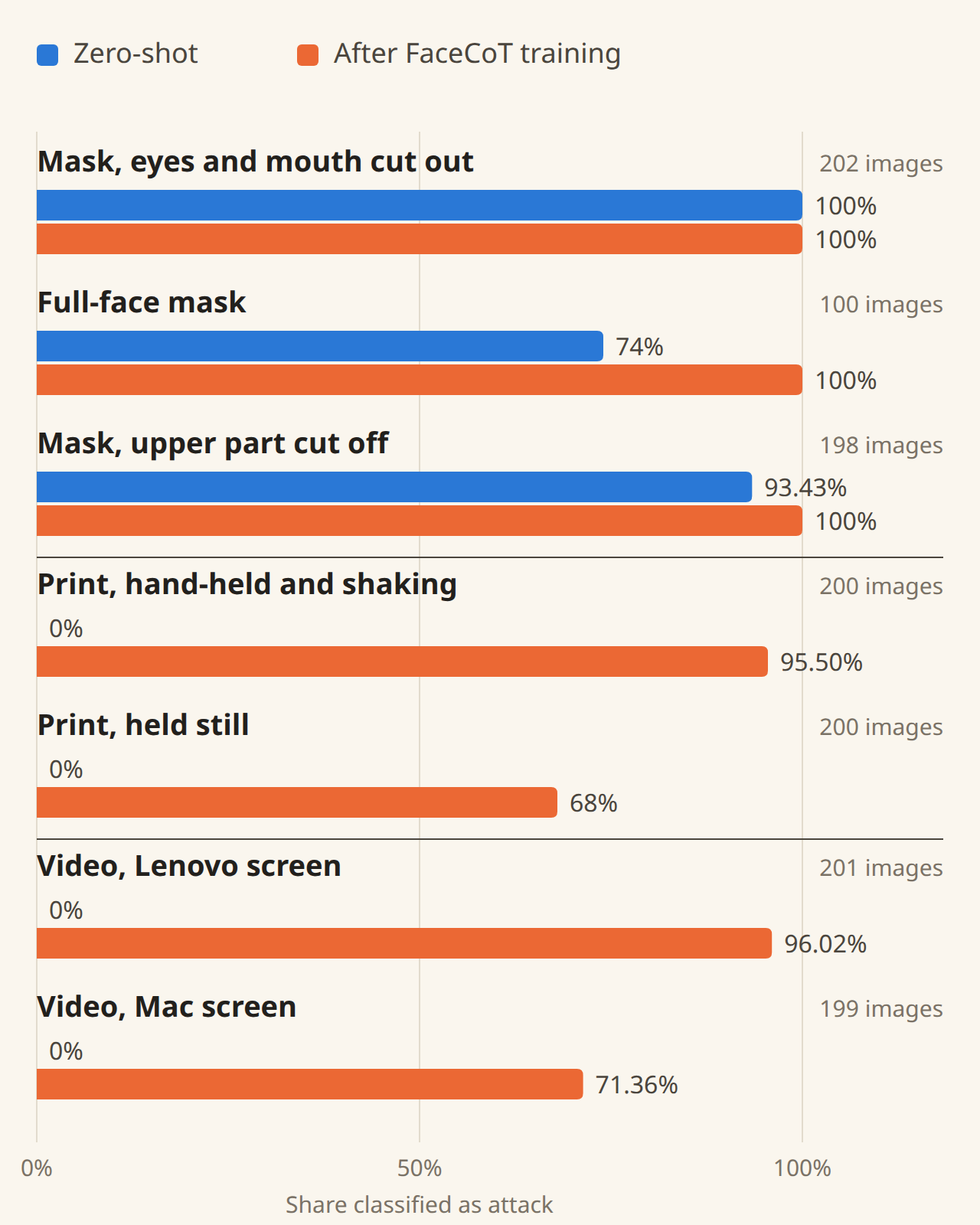
It recognizes most of the masks, but does not catch a single print or screen. To a general-purpose model, a face on a screen just looks like a face.
A team from Didi Chuxing, Beijing University of Posts and Telecommunications, and Beijing Normal University thinks what is missing is data. Anti-spoofing datasets have only images and live/spoof labels. To teach a large language model to state the basis for its judgment step by step, you first need an image-text question-answering dataset. So they built FaceCoT, 1.08 million question-answer pairs, each with six-part reasoning, and designed a two-stage training method to use it.
Defining the Problem
I-FAS has the model answer live or spoof first, then add a one-sentence explanation. The explanation comes from a fine-tuned captioning model and mentions attack media such as screen or paper. That carries a little more meaning than a bare label, but in the end it is only one sentence.
What the authors want is the whole judgment process. Look at the whole image first, then the face, list the details of the facial features and skin, then reason, describe the attack method, and only then reach a conclusion. That takes a dataset where every sample has this kind of reasoning written out, and a training method that can learn reasoning and classification at the same time.
For the training method, the authors give a separate reason. If you mix reasoning text and classification labels and train end to end, classification converges quickly, and training is over before the reasoning has been learned; the vision encoder never gets a chance to learn anything from those detailed descriptions.
Solving the Problem
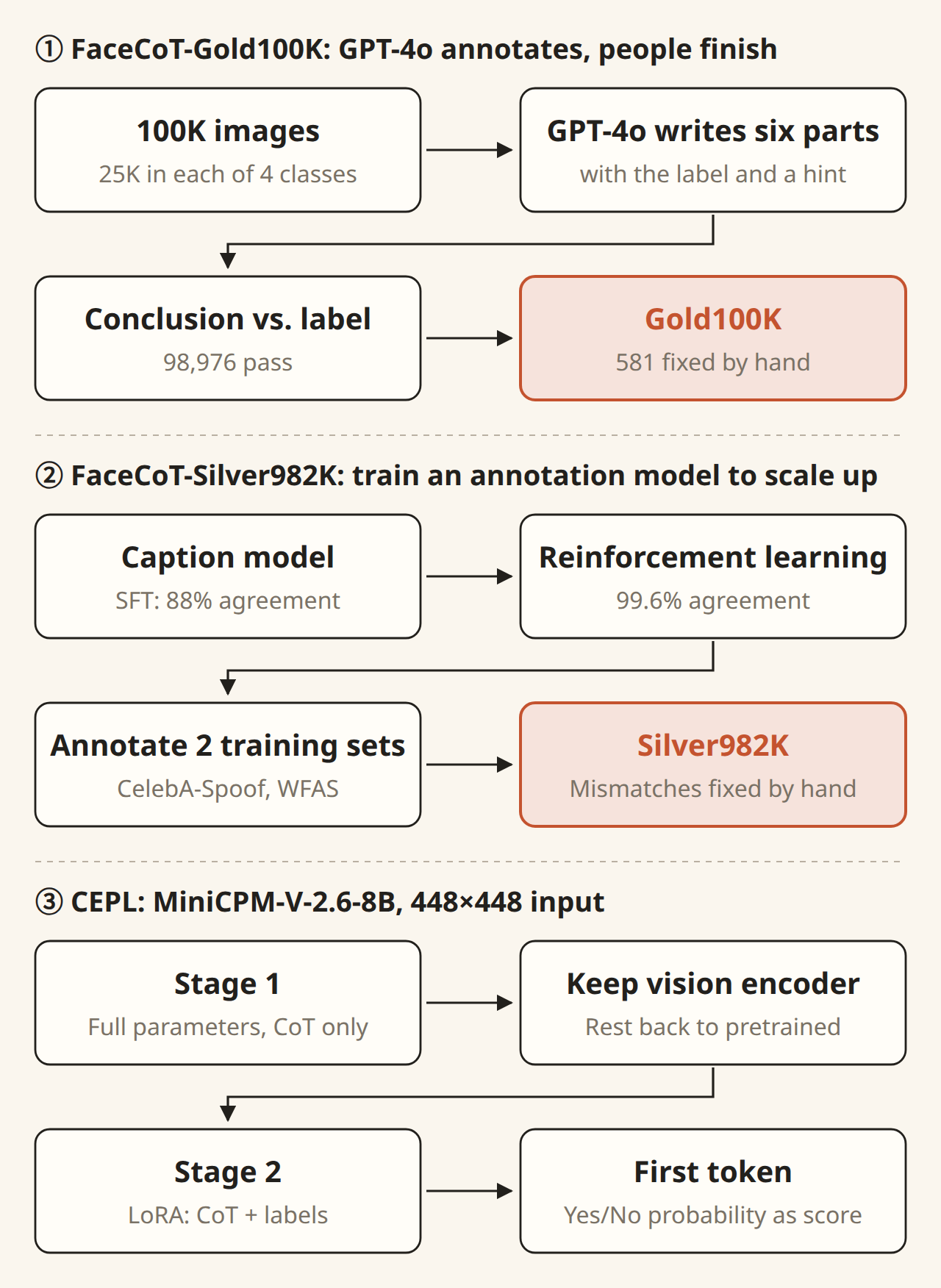
The pipeline has three parts. The first two build the data, and the third trains the model.
Where the Data Comes From
The images come from two datasets. CelebA-Spoof has 625,000 images of 10,000 people with 10 attack types; WFAS is in-the-wild data collected in uncontrolled environments, with 1.38 million images, 853,000 of them attacks and 529,000 live, covering 14 attack types.
The curated 100,000 images fall into four classes of 25,000 each:
- Live: all taken from WFAS, because its scenes are the most varied.
- Print: 5,000 each of photos and posters, and 3,000 each of newspapers, albums, A4 sheets, face prints, and upper-body prints.
- Replay: 10,000 each of phones and tablets, and 5,000 computer screens.
- Mask: 12,768 3D masks, 10,579 region masks, 1,488 garage-kit figures, and 165 lifelike dolls.
Under the three attack classes there are 14 attack types in all. Within each class, the authors kept the counts of the subcategories as close as they could.
Six-Part Reasoning
Every answer is split into six tags:
<Caption>What the whole image shows</Caption>
<Facial Description>What the face looks like</Facial Description>
<Facial Attributes>Details of the eyes, nose, mouth, skin, and so on</Facial Attributes>
<Reasoning>Combine the information above and judge step by step</Reasoning>
<Spoofing Description>The attack method and its key traces</Spoofing Description>
<Conclusion>Yes or No</Conclusion>
The question is "You are a face anti-spoofing expert … answer the question: Is this a spoof?", so Yes means spoof and No means live.
The example at the start of the paper is a person holding a paper mask printed with a woman's face, with holes cut where the eyes, nose, and mouth are. The six parts read, in order:
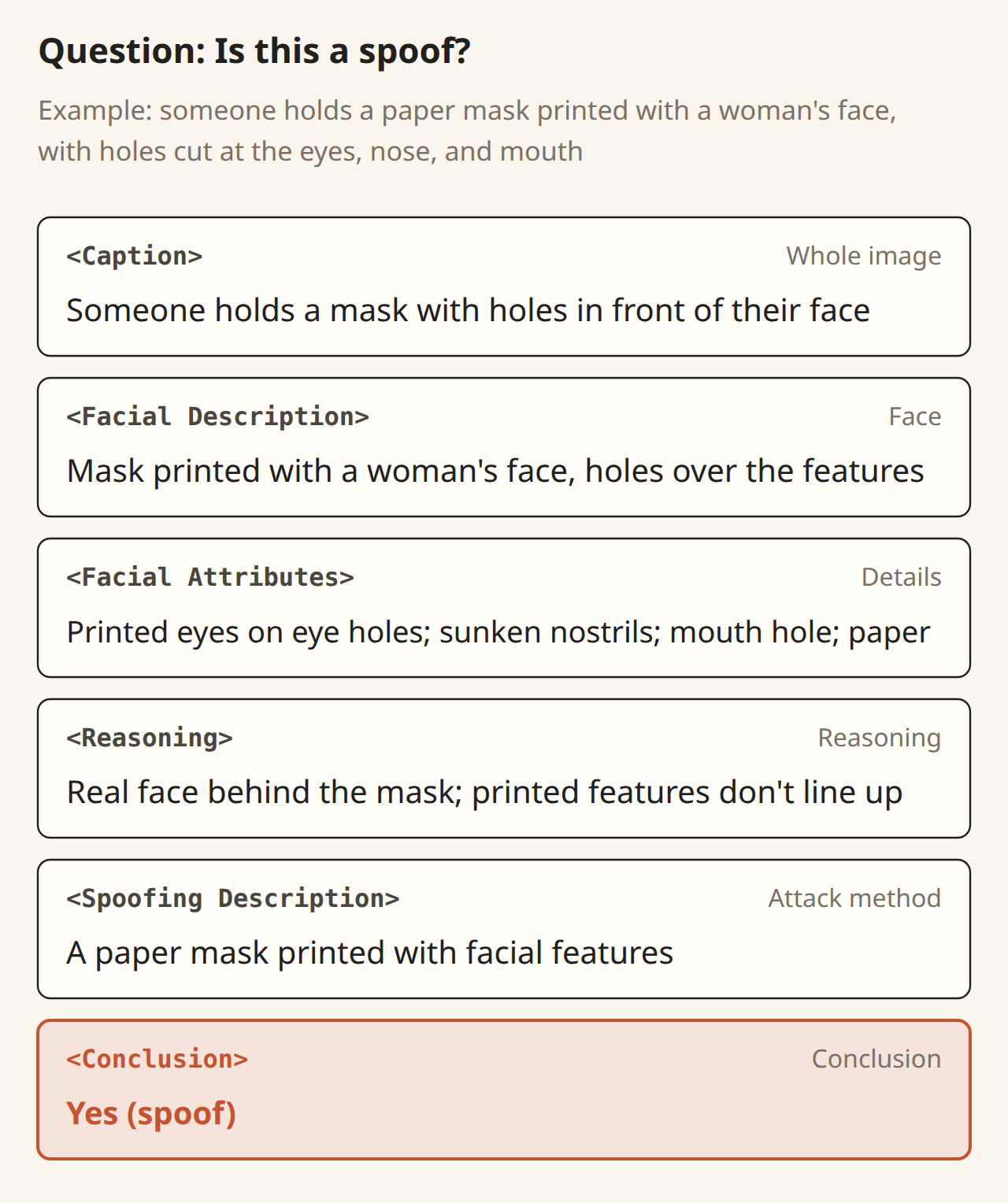
From large to small, from the whole to the parts, and the conclusion comes last. The authors say this mimics the order in which people judge whether a face is real.
GPT-4o Writes with the Answer in Hand
GPT-4o wrote the six-part text for Gold100K. The appendix lists the five things GPT-4o receives each time: the image, a system prompt, the question, a hint, and the image's label.
The system prompt casts it as an "examiner," has it answer in the six-part format, and requires the conclusion to match the standard answer exactly. So what GPT-4o writes is not its own judgment but a worked solution by someone who already knows the answer.
Why give it the answer and a hint? The appendix has an example. Given a recaptured image of a Japanese newspaper, GPT-4o saw that the content came from a newspaper, yet ruled that it was not an attack. Its reasons were that the face was clear and natural with no signs of retouching, and that the newspaper showed no sign of face swapping or tampering. It had taken "attack" to mean digital tampering.
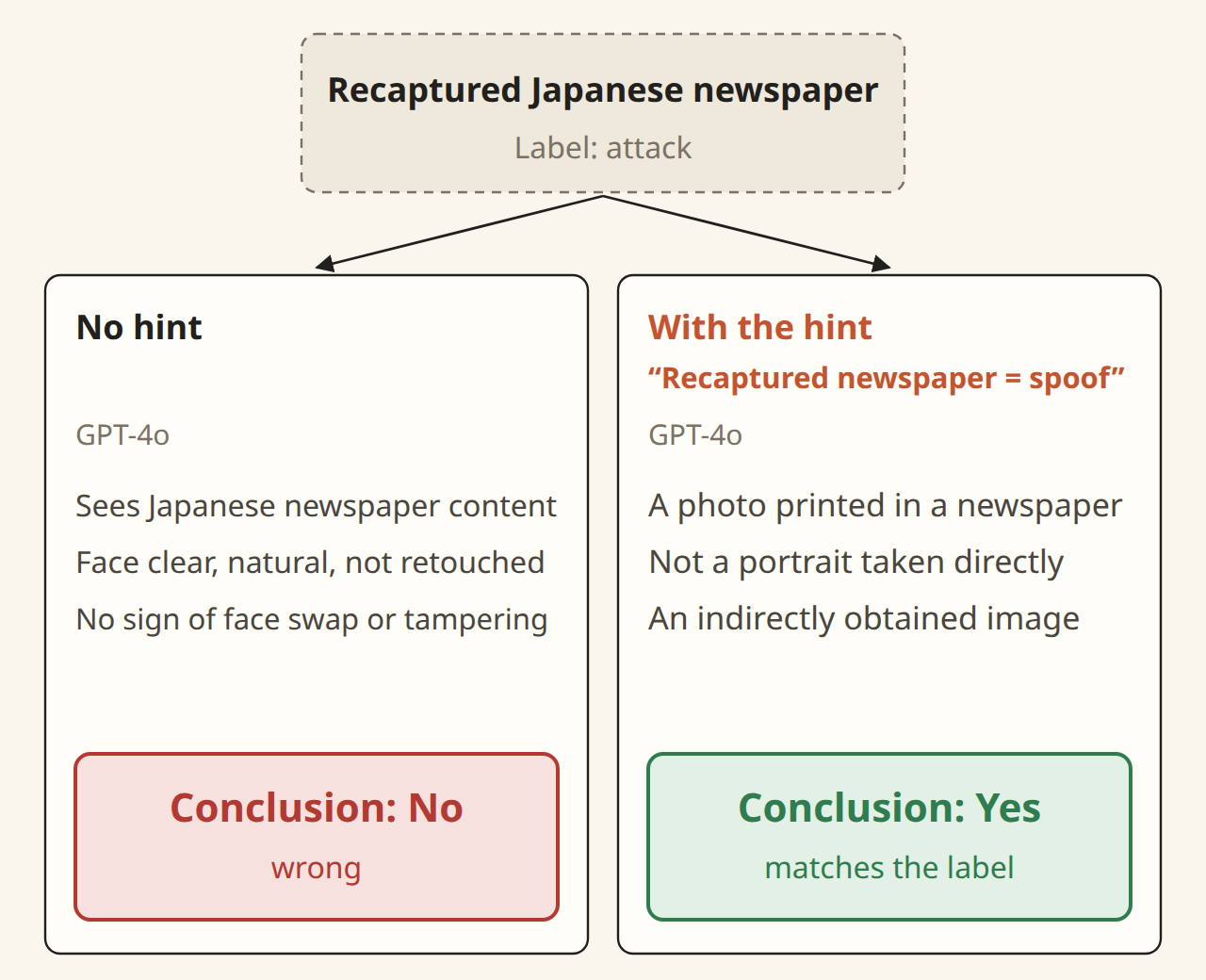
Add the hint "Photographing a newspaper page constitutes spoofing," and GPT-4o changes its answer. The newspaper really does show a real person; whether photographing a newspaper counts as an attack is a rule of the anti-spoofing task itself. So the authors wrote a one-line hint for each of the ten print and screen attack types, such as "Photographing a poster constitutes spoofing" and "Photographing a phone screen constitutes spoofing." The model could already identify masks on its own, so masks got no hint.
This is probably part of why the zero-shot model took every print and screen for a live face. Nobody had taught it this rule.
Once the text is written, a regular expression pulls out the contents of <Conclusion> and compares them with the label. In the first round, 98,976 matched; the rest went back to GPT-4o for another round, and the 581 that still did not match were marked as hard cases and handed to people. The annotators first check the conclusion, then find where the reasoning or description went wrong, fix it, and rework the later parts so they follow on smoothly.
GPT-4o cost about 0.01 US dollars per image, roughly 1,000 US dollars for 100,000 images.
Scaling Up to 982,000
Labeling another million images with GPT-4o plus people would be too expensive. Instead, the authors train a caption model that specializes in writing six-part reasoning.
First comes supervised fine-tuning on Gold100K. When this model labels images it has not seen, only 88% of its conclusions agree with the labels, and the common faults are wrong content and broken formatting. Next comes a round of reinforcement learning with just two rewards. A conclusion that matches the label earns 1 point, and output that follows the six-part template earns 1 point; a KL penalty keeps it from drifting too far from the supervised fine-tuned version. Afterward, on 2,000 randomly drawn unlabeled images, the agreement rate rises to 99.6%.
Annotating the CelebA-Spoof and WFAS training sets with this model gives Silver982K, about 368,000 of which are live. Samples whose conclusions do not match their labels are again corrected by hand. Training the caption model took about a day on 8 A100s, and the annotation itself about 288 GPU-hours; the manual cleanup of both subsets took 6 annotators three days.
CEPL: Train the Eyes First, Then Learn to Speak
The backbone is MiniCPM-V-2.6-8B, made up of a vision encoder, a resampler, and a language model, with inputs resized to 448×448. CEPL (CoT-Enhanced Progressive Learning) has two stages:
- Stage 1, visual enhancement pretraining: full-parameter fine-tuning supervised only by the six-part reasoning text. The goal is for the vision encoder to follow the detailed descriptions in the text, such as mask edges, paper texture, and screen glare, and learn to pay attention to those places.
- Stage 2, multi-task joint training: only Stage 1's vision encoder is kept; the resampler and the language model go back to their original pretrained weights, LoRA is added to the language model, and training then uses the reasoning text and the binary labels together.
Why reset the language model in Stage 2? The paper only says that it keeps the details the vision encoder learned and restores the other modules to their pretrained weights, without explaining further. One way to read it is that Stage 1 is just a means of training the vision encoder through text supervision, and whatever the language model learned in that stage need not be kept.
Training uses AdamW with a learning rate of 1e-6, up to 10 epochs, a batch size of 256, and 8 A100s; every experiment is averaged over three random seeds.
Where the Score Comes From
The anti-spoofing metrics HTER and AUC need a continuous score. The appendix spells out the procedure. Decoding is greedy with randomness turned off, and the score takes the Yes and No logits of the first token the model generates and applies softmax:
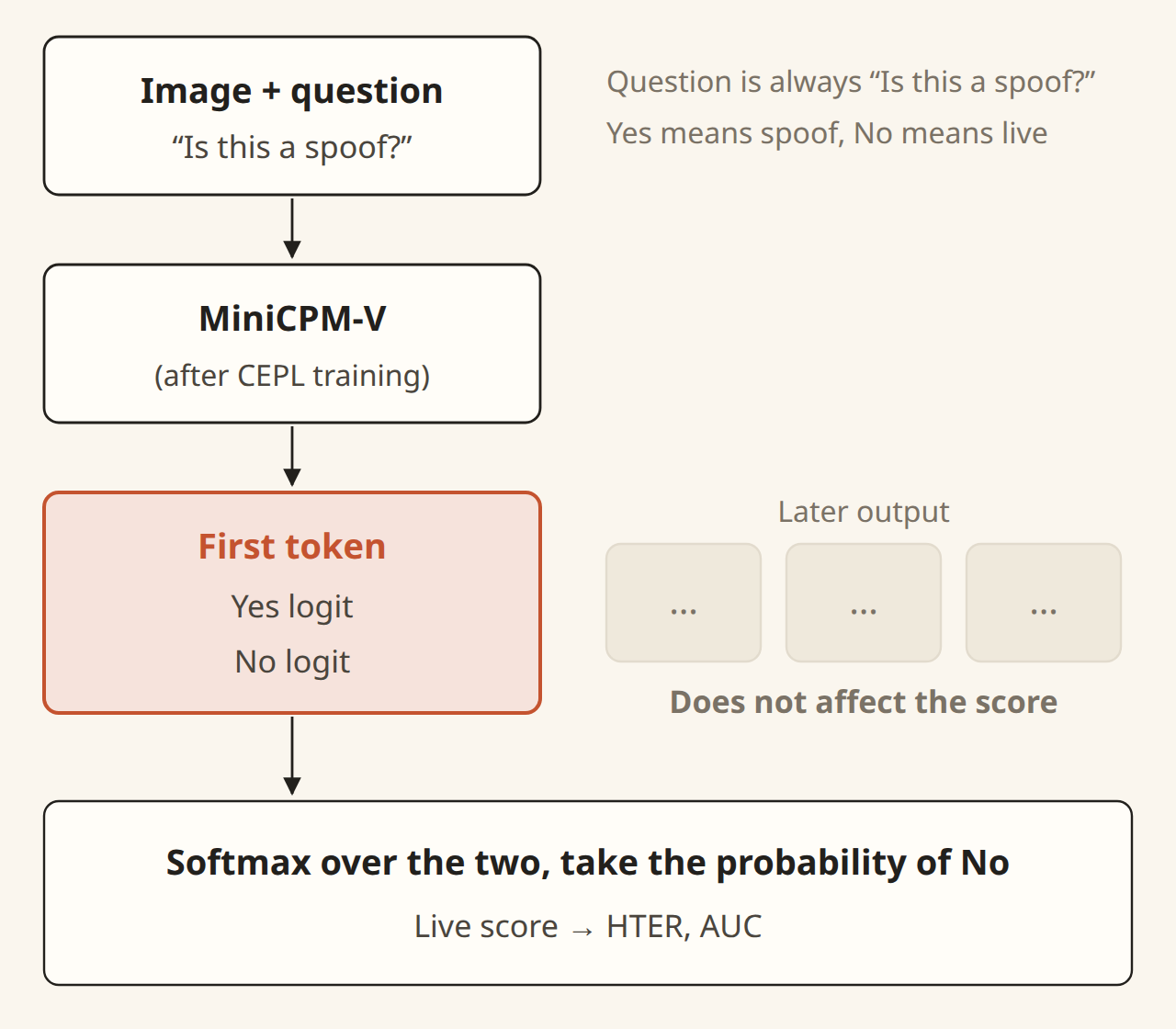
When the first token comes out, there is no reasoning text yet. So the results in the tables measure the model's ability to answer directly. The six-part reasoning affects how the model learns; the score itself is settled before any reasoning text appears.
Discussion
One-to-Eleven
The protocol follows I-FAS's Protocol 2, testing the trained model directly on 11 datasets: MSU-MFSD, CASIA-MFSD, Replay-Attack, OULU-NPU, SiW, Rose-Youtu, HKBU-MARs-V1+, WMCA, SiW-M-V2, CASIA-SURF-3DMask, and HiFiMask.
When comparing, keep the training data straight. The baselines in the table are all trained only on CelebA-Spoof, while the authors' model comes in three versions. HTER and AUC are both averages over the 11 datasets (%):
| Method | Training images | HTER | AUC |
|---|---|---|---|
| ViTAF | CelebA-Spoof | 23.85 | 82.82 |
| ViT-L | CelebA-Spoof | 21.08 | 85.61 |
| FLIP | CelebA-Spoof | 18.73 | 87.90 |
| I-FAS | CelebA-Spoof | 11.30 | 93.71 |
| Ours-CelebA | CelebA-Spoof | 8.56 | 96.37 |
| Ours-100K | Gold100K | 7.65 | 96.59 |
| Ours-All | All 1.08M | 6.30 | 97.77 |
The paper's "HTER reduction of 5.00%" compares Ours-All with I-FAS. Ours-All adds WFAS images, so the conditions differ. The closest match is Ours-CelebA, which uses only CelebA-Spoof images, and HTER falls from 11.30% to 8.56%. Its six-part reasoning was written by the caption model, and the caption model learned from Gold100K, which contains WFAS images.
Dataset by dataset, the effect of the training data is clearer (HTER, %):
| Test dataset | I-FAS | CelebA | All |
|---|---|---|---|
| CASIA-SURF-3DMask | 6.18 | 6.21 | 0.40 |
| HiFiMask | 28.23 | 28.68 | 15.93 |
| HKBU-MARs-V1+ | 18.64 | 6.96 | 7.34 |
| OULU-NPU | 14.86 | 9.47 | 5.86 |
| WMCA | 20.07 | 11.51 | 10.16 |
| SiW | 4.02 | 0.79 | 0.48 |
| MSU-MFSD | 5.63 | 8.33 | 5.00 |
| Replay-Attack | 9.15 | 9.87 | 12.75 |
- On CASIA-SURF-3DMask and HiFiMask, CelebA-Spoof alone scores almost the same as I-FAS; the big improvement comes only once WFAS is added. The gains on these two datasets come mainly from the mask data in WFAS.
- HKBU-MARs-V1+, also a mask dataset, drops from 18.64% to 6.96% with CelebA-Spoof alone. OULU-NPU, WMCA, and SiW also improve clearly with CelebA-Spoof alone.
- Some go the other way. MSU-MFSD is worse than I-FAS with CelebA-Spoof alone; on Replay-Attack, adding more data actually raises HTER from 9.87% to 12.75%, higher than I-FAS's 9.15%.
CoT, CEPL, and Resolution
The ablations are all trained on Gold100K. The chart below puts together the HTERs scattered across several tables:
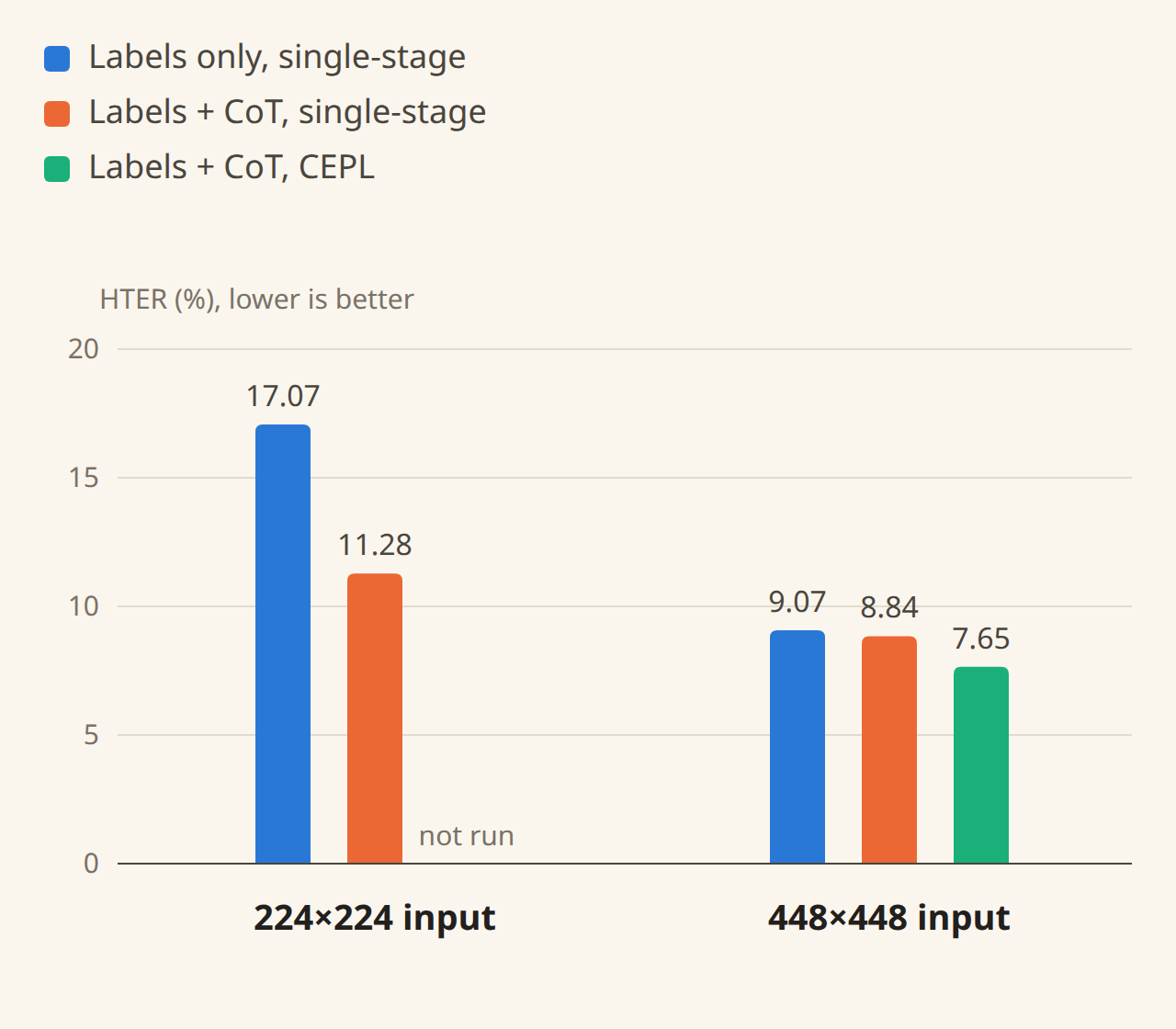
Reading the chart in order:
- Resolution has the biggest effect. With labels only, going from 224 to 448 drops HTER from 17.07% to 9.07%.
- CoT helps most at low resolution. At 224, adding the six-part reasoning lowers HTER by nearly 6 percentage points; at 448, with the same single-stage training, it lowers it by only 0.23. The authors' reading is that the reasoning text helps the model recover details it cannot see clearly at low resolution. Put the other way around, when the image is clear enough, that text has little left to add.
- At 448, what makes the difference is CEPL, from 8.84% to 7.65%.
- Adding reinforcement learning after CEPL does not help; HTER is 7.80%. The authors think the supervised data is already plentiful, so the marginal benefit of reinforcement learning is very small.
The appendix also notes that most anti-spoofing methods, I-FAS included, use 224×224 inputs. In the main table this paper competes at 448×448, and judging from the ablation above, that alone may give it a sizable edge.
There is also a comparison on data quality. Training on data annotated by the caption model with supervised fine-tuning only gives an HTER of 8.00%; switching to the version with reinforcement learning lowers it to 6.87%.
Other Backbones, Zero-Shot, and the Old Protocol
- Swapping the backbone: MiniCPM-V-2.6-8B has an average zero-shot HTER of 17.91%, and 6.30% after training; Qwen2.5-VL-7B goes from 19.60% zero-shot to 9.32% after training. Both backbones benefit, and MiniCPM-V does better.
- The hardest attacks: on Rose-Youtu, the attacks caught least often after training are still static prints (68.00%) and videos played on a Mac screen (71.36%).
- OCIM: the appendix also runs the old protocol in which the four datasets O, C, I, and M take turns as the test set, with an average HTER of 1.06% against I-FAS's 1.33%. Two of the four settings have a worse HTER than I-FAS: ICM→O at 2.81% vs 1.74%, and OCI→M at 0.42% vs 0.32%. The authors themselves say AUC on this protocol is already above 99% across the board, so it can barely tell methods apart.
Unanswered Questions
- The HTER threshold: the paper does not say how the threshold is chosen, nor which checkpoint within the up-to-10 epochs is used. AUC needs no threshold, so it is less affected.
- Faithfulness of the reasoning: the six-part reasoning was originally written by GPT-4o with the answer in view, and the model learns that style of writing; the score is also taken from the first token, before any reasoning. Whether the reasons the model writes are the cues it actually relies on is something the paper does not test. In their limitations, the authors also mention that FaceCoT could be used to evaluate interpretability, but they have not done so yet.
- Inference cost: an 8B model takes 448×448 images, and the paper reports no inference time.
- Openness: the dataset must be requested from the authors under a signed agreement, for academic use only, and only the text annotations are released; you have to obtain the images from CelebA-Spoof and WFAS yourself. The GitHub page says the model weights and code will be released after the paper is formally accepted, and still marks them as not released.
Conclusion
FaceCoT builds an anti-spoofing question-answering dataset of 1.08 million samples, each with six-part reasoning. The first 100,000 were written by GPT-4o with the answers in hand and finished off by people; the rest were added by an annotation model tuned with reinforcement learning. Training MiniCPM-V on it brings the average One-to-Eleven HTER down to 6.30%; with CelebA-Spoof images alone, it still reaches 8.56%.
The most practical part, though, is the ablation table. With labels only, switching the input from 224 to 448 drops HTER from 17.07% to 9.07%; at 448, the six-part reasoning helps by only another 0.23 percentage points in single-stage training. If your multimodal anti-spoofing model is still being fed 224-pixel faces, raise the resolution first, then decide whether to spend 1,000 US dollars having GPT-4o write worked solutions.
TAR-FAS, at the same CVPR, takes a different route. Instead of writing longer reasoning, it lets the model call up old tools such as LBP and FFT partway through its reasoning. Both papers use the same One-to-Eleven setup, and when trained only on CelebA-Spoof, TAR-FAS's 7.54% is a little lower than this paper's 8.56%, though the backbones and input resolutions both differ.
As for the prints and screens from the opening that were taken for live faces, the general-purpose model can't take all the blame. At first, even GPT-4o needed a reminder before it knew that photographing a newspaper breaks the rules too.