Original paper
MinerU2.5: A Decoupled Vision-Language Model for Efficient High-Resolution Document Parsing
- Publication
- ACL Industry Track 2026Conference
- First submitted to arXiv
- arXiv:2509.22186
Cite this paper · BibTeX
The citation identifies the linked source version. It cites the original paper and its authors.
@misc{documentunderstandingmineru252025,
  title = {{MinerU2.5: A Decoupled Vision-Language Model for Efficient High-Resolution Document Parsing}},
  author = {Junbo Niu and Zheng Liu and Zhuangcheng Gu and Bin Wang and Linke Ouyang and Zhiyuan Zhao and Tao Chu and Tianyao He and Fan Wu and Qintong Zhang and Zhenjiang Jin and Guang Liang and Rui Zhang and Wenzheng Zhang and Yuan Qu and Zhifei Ren and Yuefeng Sun and Yuanhong Zheng and Dongsheng Ma and Zirui Tang and Boyu Niu and Ziyang Miao and Hejun Dong and Siyi Qian and Junyuan Zhang and Jingzhou Chen and Fangdong Wang and Xiaomeng Zhao and Liqun Wei and Wei Li and Shasha Wang and Ruiliang Xu and Yuanyuan Cao and Lu Chen and Qianqian Wu and Huaiyu Gu and Lindong Lu and Keming Wang and Dechen Lin and Guanlin Shen and Xuanhe Zhou and Linfeng Zhang and Yuhang Zang and Xiaoyi Dong and Jiaqi Wang and Bo Zhang and Lei Bai and Pei Chu and Weijia Li and Jiang Wu and Lijun Wu and Zhenxiang Li and Guangyu Wang and Zhongying Tu and Chao Xu and Kai Chen and Yu Qiao and Bowen Zhou and Dahua Lin and Wentao Zhang and Conghui He},
  year = {2025},
  eprint = {2509.22186},
  archivePrefix = {arXiv},
  url = {https://arxiv.org/abs/2509.22186}
}
Anyone who has built a RAG system or prepared LLM training data has probably come across the name MinerU. It's an open-source document parsing tool from the OpenDataLab team at Shanghai AI Laboratory: PDFs go in, Markdown or JSON comes out, with tables converted to HTML, formulas to LaTeX, headings, paragraphs, and captions each labeled, and the reading order sorted out. It has more than 80,000 stars on GitHub, and several OCR and document parsing notes on this site use it as a point of comparison.
Early MinerU was a pipeline chaining several specialized models, one each for layout detection, text recognition, formula recognition, and table recognition; version 2.0 added a 0.9B vision-language model version. In version 2.5, layout, text, tables, and formulas are all handed to a single 1.2-billion-parameter model, but it isn't made to read the whole page in one go.
Defining the Problem
The authors divide document parsing at the time into two camps.
Pipelines split the work across a chain of specialized models. They're easy to interpret and easy to improve one stage at a time, but with many parts, errors in one stage pass to the next, complex pages such as multi-column layouts and tables spanning pages often cause trouble, and deployment and maintenance are a hassle.
End-to-end approaches have a vision-language model look at the whole page and write Markdown directly. Semantic understanding is better, and GOT, olmOCR, and dots.ocr all take this route. The problem is that document pages have very high resolution, and long documents are prone to hallucination.
The efficiency problem of end-to-end models can be worked out on the page in the paper's Figure 2. The original is pixels; MinerU2.5's vision encoder cuts 14-pixel patches and then merges each group of adjacent patches into one token, so one visual token covers about pixels. Reading the whole page at native resolution gives:
About eleven thousand visual tokens.
Attention cost grows with the square of the token count. Worse, many of these 10,000-plus tokens are blank margins, line spacing, and gaps between paragraphs, yet they cost just as much in attention. The authors see this token redundancy as the main reason end-to-end models are slow and memory-hungry.
But shrinking the whole page won't do either: small text and formula subscripts blur away.
You need to see the structure of the whole page and also read every small character clearly. Could the two be done separately?
Solving the Problem
One Model, Two Passes
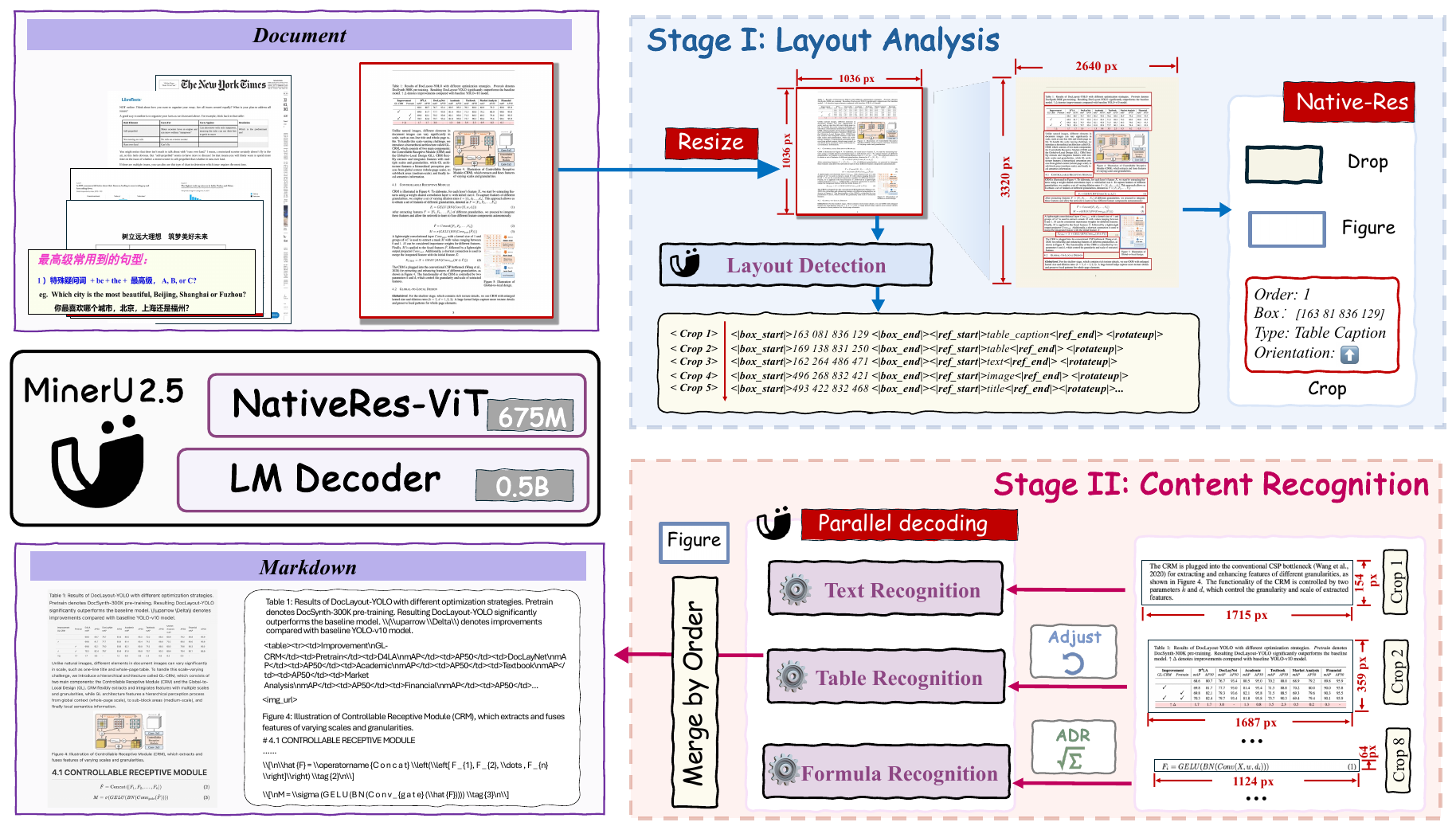
MinerU2.5's architecture follows Qwen2-VL and has three components:
- Vision encoder: a 675-million-parameter NaViT, initialized from Qwen2-VL-2B, supporting arbitrary resolutions and aspect ratios, with 2D-RoPE for position. The authors point out that Qwen2.5-VL switched to window attention for efficiency, which actually made document parsing worse, so they didn't follow.
- Patch merger: merges adjacent visual tokens into one with pixel-unshuffle, then applies a two-layer MLP.
- Language model: a 500-million-parameter Qwen2-Instruct. The authors argue that document parsing depends relatively little on a large language model, so 0.5B is enough; its positional encoding is switched from 1D-RoPE to M-RoPE to better handle crops of all aspect ratios.
The same model runs two passes, switching tasks with different prompts. Let's follow that page through.
First pass: look at a thumbnail, lay out the page. Every page is resized to , that is, visual tokens, with the prompt “Layout Detection:”. For each block, the model outputs four things: coordinates, type, rotation, and reading order. The output in the figure looks like this:
<|box_start|>163 081 836 129<|box_end|><|ref_start|>table_caption<|ref_end|><|rotateup|>
<|box_start|>169 138 831 250<|box_end|><|ref_start|>table<|ref_end|><|rotateup|>
The thumbnail size is a compromise found by trial: too small loses detail, too large runs into NaViT's quadratic cost. The authors also found that, rather than keeping the page's original aspect ratio, a fixed square thumbnail makes box localization more stable and training more efficient.
Second pass: back to the original, crop the blocks. Using the first pass's coordinates, blocks are cropped from the page at original resolution, given one of three prompts according to their type, “Text Recognition:”, “Table Recognition:”, or “Formula Recognition:”, and decoded in parallel. Each crop is capped at pixels, that is, at most 2048 visual tokens.
Converting at the same , the three crops in the figure come to roughly:
- Crop 1, a text passage: about tokens.
- Crop 2, a table: about tokens.
- Crop 8, a single-line formula: about tokens.
These token counts are this note's estimates, converted at pixels per token.
Every block is read at native resolution, so small text isn't shrunk away; but each attention computation runs over only a few hundred tokens, and the blank parts of the page never enter the second pass at all. Finally, the results are assembled into Markdown in the reading order from the first pass.
In deployment, the authors also had to deal with repetitive generation. Small models easily get stuck writing the same word over and over, yet repetition inside tables and formulas is often legitimate. Their approach is to adjust the frequency penalty and presence penalty according to the block type determined in the first pass: higher penalties for paragraphs, lower for tables.
Rewriting Outputs So a Small Model Can Learn Them
Beyond the two-pass skeleton, the authors also redefined several subtasks.
Tables are output as OTSL instead. OTSL is a table structure language proposed by IBM in 2023 that describes the relationships between cells with 5 kinds of tokens, whereas HTML tables need more than 28 kinds of structural tags. The authors say switching to OTSL roughly halves the average sequence length, so the small model is less likely to get lost partway through a long table; the output is converted back to HTML afterward. If a table is rotated, the first pass detects the angle, and the table is straightened when it is cropped.
Formulas use a decomposition method the authors call ADR (Atomic Decomposition & Recombination). “Atomic formulas,” such as a single fraction or one matrix, are recognized directly; a derivation spanning several lines aligned at the equals signs is a “compound formula,” which is first split into atomic formulas, line by line, at the layout stage, each recognized as LaTeX, and then reassembled by position into an environment such as align.
Layout gets a new label set. Elements that are often thrown away, such as page headers, page footers, page numbers, and page footnotes, are all kept, since the authors consider them useful for RAG; figures are subdivided into images, charts, and chemical structures; and code, algorithms, references, and lists each get their own class.
The Data Engine
With only 1.2 billion parameters, much of the model's performance comes from the data.
The authors first select data from an internal document pool (public web documents plus commercial purchases), clustering page images to pick out varied layouts, stratifying by metadata so that papers, textbooks, reports, slides, and other types are all represented, and using a pretrained detector to balance the proportions of elements such as headings, tables, and formulas, while keeping Chinese and English roughly equal in number.
The pretraining data is first auto-labeled with the older MinerU2 pipeline and then corrected piece by piece. Text is checked and revised by Qwen2.5-VL-72B, formulas are replaced with the output of an internally retrained UniMERNet, and tables are regenerated with an internal table model.
The fine-tuning data has to be chosen more carefully. The authors want to spend human annotation on the samples the model is least sure about, so they designed IMIC (Iterative Mining via Inference Consistency):
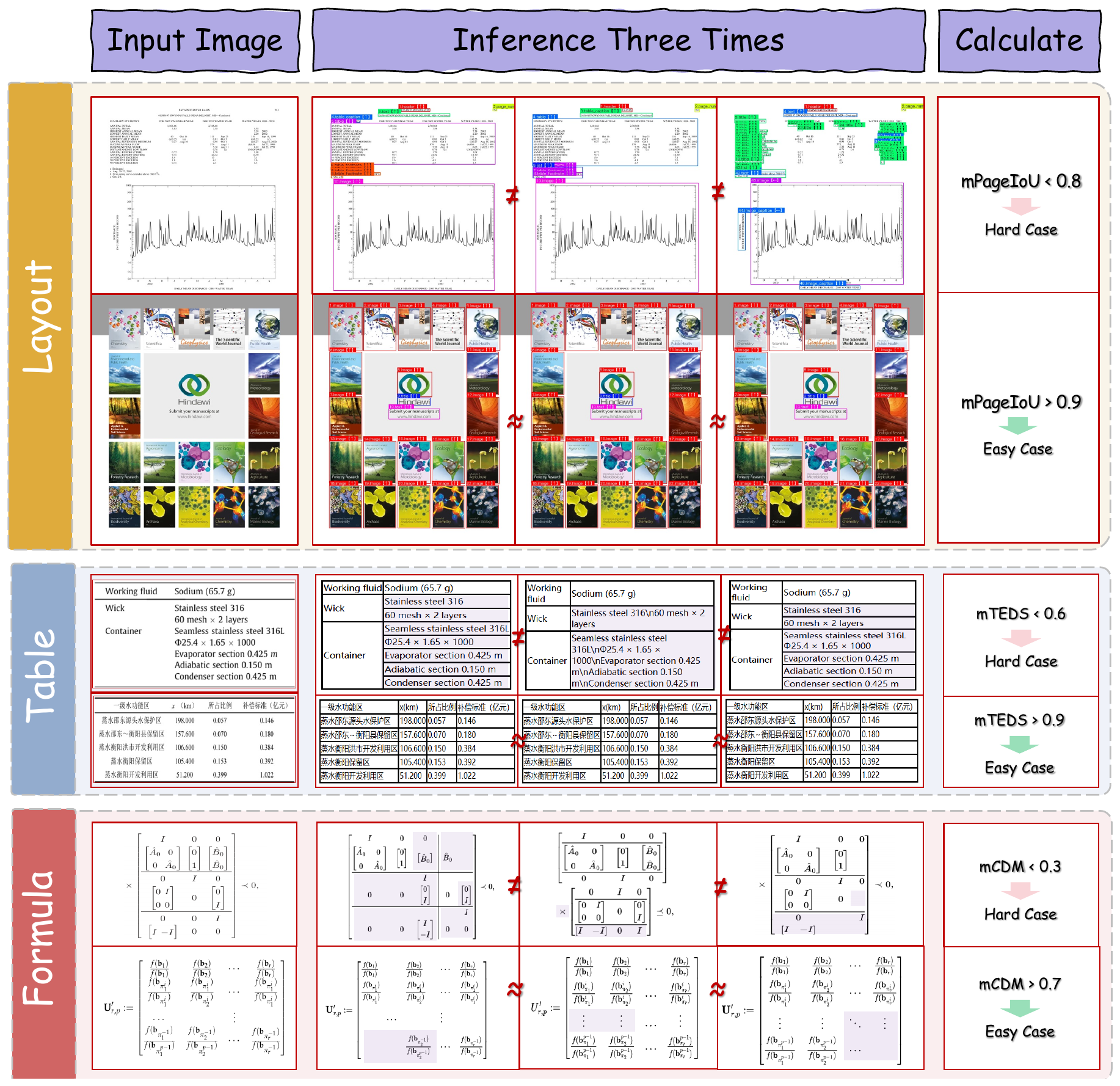
The model runs inference on the same image three times with random sampling on. For samples it has learned, the three results should be nearly identical; samples where the three runs disagree are the hard cases sitting on the model's decision boundary. Consistency is measured with each task's own metric, PageIoU for layout, TEDS for tables, and CDM for formulas, with the thresholds shown on the right of the figure.
The selected hard cases are pre-labeled by Gemini-2.5-Pro (complex tables, for example), corrected one by one by human experts, and finally mixed with a small batch of randomly sampled ordinary samples to form the fine-tuning data.
PageIoU
The PageIoU used above is a metric the authors proposed separately for evaluating layout analysis.
Ordinary detection metrics match box by box, and a box counts as correct only once its IoU passes 0.5. But document layout boxes have no single right answer: a paragraph can be boxed as one block or line by line, both are reasonable, yet IoU gives them completely different scores.
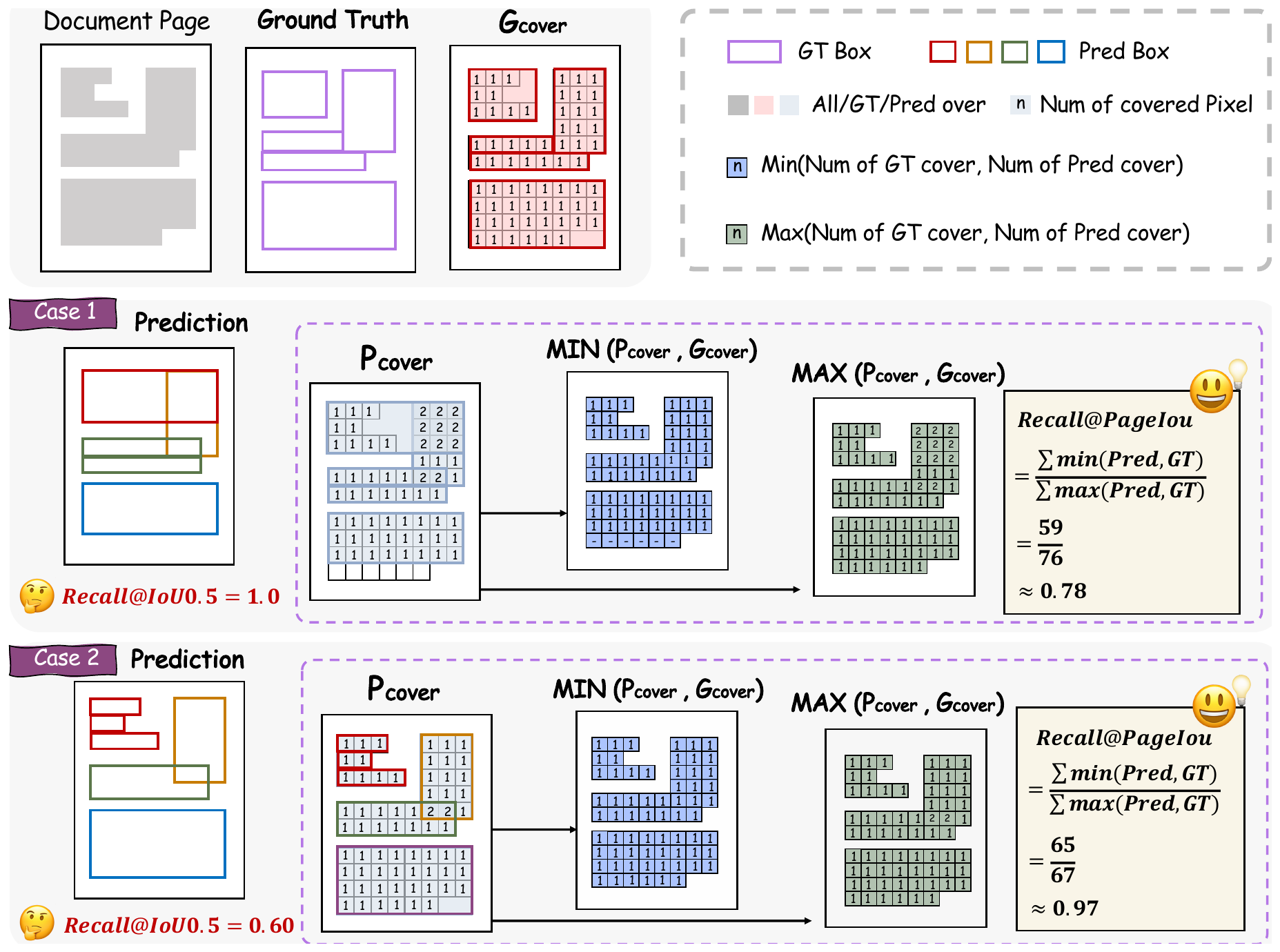
PageIoU doesn't match boxes; it looks at pixels instead. For each non-blank pixel on the page, count how many ground-truth boxes cover it, , and how many predicted boxes cover it, . Then:
is the page's non-blank region. If both sides cover the same, the ratio is 1; covering too much, too little, or covering twice all make the denominator larger or the numerator smaller.
In the figure, Case 1 roughly covers everything with three large boxes that also overlap one another, and gets a perfect box-level Recall of 1.0 but a PageIoU of only 0.78; Case 2's fine line-by-line boxes fit closely, with a Recall of only 0.60 but a PageIoU of 0.97. PageIoU's ranking agrees with human judgment.
Training
Training has three stages:
- Alignment: first train only the patch merger's MLP on LLaVA's 558,000 caption samples; then unfreeze all parameters and train on 665,000 VQA samples. The authors say that skipping this step leaves the loss noticeably higher later on.
- Document parsing pretraining: 6.9 million samples per epoch, of which 2.3 million are layout, 2.4 million text blocks, 1.1 million formulas, and 1.1 million tables, trained for 2 epochs with a sequence length of 8192.
- Fine-tuning: 630,000 samples per epoch, mainly hard cases selected by IMIC, trained for 3 epochs with a sequence length of 16384.
Both of the last two stages use data augmentation that simulates common disturbances in scanned documents, including rotation, textures, watermarks, shadows, blur, and stroke erosion. Layout samples get no spatial transforms, so the box coordinates don't go wrong along with them.
Discussion
OmniDocBench
OmniDocBench's overall score combines three components:
TextEdit is the normalized edit distance for text, where lower is better; TEDS is the tree-edit-distance similarity for tables and CDM the character detection matching score for formulas, both higher-is-better. The paper uses the newer 1,355-page version, which raises the image resolution of handwritten notes and newspapers from 72 DPI to 200 DPI and adds pages with Chinese and with math formulas.
Overall scores (compiled from Table 5 of the paper):
| Model | Params | Overall |
|---|---|---|
| MinerU2-VLM | 0.9B | 85.56 |
| PP-StructureV3 | – | 86.73 |
| Qwen2.5-VL-72B | 72B | 87.02 |
| Gemini-2.5 Pro | – | 88.03 |
| dots.ocr | 3B | 88.41 |
| MonkeyOCR-pro-3B | 3.7B | 88.85 |
| MinerU2.5 | 1.2B | 90.67 |
Per component (lower is better for TextEdit and reading order):
| Model | Text | Formula | Table | Reading order |
|---|---|---|---|---|
| Qwen2.5-VL-72B | 0.094 | 88.27 | 82.15 | 0.102 |
| dots.ocr | 0.048 | 83.22 | 86.78 | 0.053 |
| MonkeyOCR-pro-3B | 0.075 | 87.25 | 86.78 | 0.128 |
| MinerU2.5 | 0.047 | 88.46 | 88.22 | 0.044 |
A quick check with the formula: ; add 88.22 and 88.46 and divide by 3, and you get 90.66, which differs from the table's 90.67 only by rounding.
Overall, it leads the runner-up, MonkeyOCR-pro-3B, by 1.82 points. Component by component, the biggest gaps are in tables and reading order; on text it's only 0.001 better than dots.ocr, and on formulas only 0.19 above the 72-billion-parameter Qwen2.5-VL, essentially a tie. A 1.2-billion-parameter model ranks first on all four components.
On olmOCR-Bench, MinerU2.5 scores 75.2 to dots.ocr's 73.6; however, the authors replaced the scoring of two math categories with CDM, which compares rendered results, unlike olmOCR's original scoring.
Speed
Parsing OmniDocBench's 1,355 pages on a single A100 80G, MinerU2.5 does 2.12 pages per second, and 4.47 on an H200. The authors stress that this is 4 times MonkeyOCR-pro-3B and 7 times dots.ocr.
In the same table, the previous MinerU2-VLM (0.9B) does 2.84 pages per second, faster than 2.5; but its OmniDocBench overall score is 85.56, 5 points below 2.5. Also, the models use different inference backends (SGLang for MinerU2-VLM, vLLM for the rest), and parameter counts range from 0.9B to 3.7B. What this table compares is “each model's official setup,” not the same model split into two passes or not.
This is also the paper's most obvious gap. Nowhere does it ablate the same model run end to end versus in two passes. For the two claims that the design “reduces computational cost by an order of magnitude” and “mitigates the common hallucination problem,” the paper has no direct measurement; they can only be inferred indirectly from cross-model throughput and scores.
Layout, Tables, Formulas
Looking at each subtask separately:
- Layout: in zero-shot comparisons on three datasets, OmniDocBench, D4LA, and DocLayNet, full-page F1 is 95.9, 90.2, and 94.6, first on all three, with the closest competitors, PP-StructureV3 or DocLayout-YOLO, 1 to 3 points behind. This comparison uses the authors' own PageIoU, and every model's classes were mapped into 5 broad categories, so it can't be compared directly with each dataset's original mAP.
- Tables: TEDS of 95.97 on FinTabNet, a wide lead; 89.07 on PubTabNet, slightly behind dots.ocr's 90.65; on the table subsets of two OCR benchmarks, Gemini-2.5 Pro has the higher TEDS.
- Formulas: first on 4 of 7 datasets and second on 1. On the three printed and handwritten subsets CPE, HWE, and SPE, it trails specialized formula recognition models slightly.
Feedback on GitHub
Several issues filed after the model's release line up neatly against the paper's claims.
Section 1 of the paper lists version 2.5's improvements, and the point about tables reads, “Effortlessly handles challenging cases, including rotated tables.” Two months later, issue #4072 reported that a table rotated 90 degrees clockwise came out as garbled characters. The maintainer first said the image was too blurry and the orientation had been judged backward; the reporter tried a perfectly clear table and got the same result. The maintainer's eventual conclusion after investigating was that the model had judged the rotation angle of both tables to be 0 and sent the rotated tables straight to recognition. Another user reported in the same thread that the rotation check returned 90 degrees whether the table was turned clockwise or counterclockwise, which left the user no choice but to add an OCR confidence check that rotates another 180 degrees when confidence comes out too low (Effortlessly).
Issue #3525 ran into the language scope. After one user switched to 2.5, repeated output in English disappeared, but Japanese documents now had whole sentences repeating over and over. The maintainer replied that 2.5's training data was mainly Chinese and English and lacked other languages, and added that 2.5 splits paragraphs more finely to improve accuracy but hasn't yet learned to join the pieces back together. The data engine's “roughly equal Chinese and English” mentioned earlier, seen from another angle, means Chinese and English only.
Then there's issue #3682. Deployed on Huawei Ascend NPUs, the model gave results that differed from the official demo. The maintainer explained that the custom logits processor that adjusts repetition penalties by block type is enabled only on qualifying NVIDIA GPUs. The optimization the paper describes in its deployment section disappears when you change hardware.
Finally, the license. MinerU's code was originally AGPL-3.0. On March 20, 2026 it changed to Apache 2.0, on March 28 back to AGPLv3, on April 14 to Apache 2.0 again, and on April 17 to a custom “MinerU Open Source License,” which adds two clauses to Apache 2.0: users with more than 100 million monthly active users or more than 20 million US dollars in monthly revenue must obtain a separate commercial license, and online services must state that they use MinerU (four changes in four weeks; the legal department's IMIC probably flagged this one as a hard case too). As for the license field of the MinerU2.5 model weights on Hugging Face, it still says AGPL-3.0.
Conclusion
MinerU2.5's approach is to have the same small model read twice. The first time, it looks at a thumbnail and decides what is on the page, where, and in what order; the second time, it crops only the blocks with content from the original and recognizes them at native resolution. Blank space no longer takes up attention, and small text isn't shrunk away. Add rewrites like OTSL and ADR that make outputs shorter and simpler, plus a data engine that picks hard cases by inference consistency, and 1.2 billion parameters reach 90.67 on OmniDocBench, first on all four components.
Its weaknesses show up outside the paper, too. The benefit of the two-pass design was never measured on its own; rotated tables, languages other than Chinese and English, and non-NVIDIA hardware have all been exposed in the issues.
This “layout first, then recognition” route soon had followers. Less than three weeks later, Baidu's PaddleOCR-VL, with a layout detection model plus a 0.9B recognition model, scored 92.86 on the same version of OmniDocBench with 50% higher throughput; OpenDataLab itself released MinerU2.5-Pro in April 2026.
Before putting MinerU2.5 into production, run it on the hardest kinds of documents you have, such as tables rotated 90 degrees, Japanese, and blurry scans, and read the license terms while you're at it. The pitfalls the score tables leave out, someone in the issues has most likely already stepped in.