Original paper
On the Benefits of 3D Pose and Tracking for Human Action Recognition
- Publication
- CVPR 2023Conference
- First submitted to arXiv
- arXiv:2304.01199
Cite this paper · BibTeX
The citation identifies the linked source version. It cites the original paper and its authors.
@misc{actionrecognitionlart2023,
  title = {{On the Benefits of 3D Pose and Tracking for Human Action Recognition}},
  author = {Jathushan Rajasegaran and Georgios Pavlakos and Angjoo Kanazawa and Christoph Feichtenhofer and Jitendra Malik},
  year = {2023},
  eprint = {2304.01199},
  archivePrefix = {arXiv},
  url = {https://arxiv.org/abs/2304.01199}
}
Fluid mechanics has two ways of describing flowing water.
One is called the Eulerian view. You sit on the riverbank, fix your eyes on one spot and watch the water flow past. The other is called the Lagrangian view. You get into a small boat and drift downstream with the same parcel of water.
Jathushan Rajasegaran, Georgios Pavlakos, Angjoo Kanazawa, Christoph Feichtenhofer and Jitendra Malik of UC Berkeley and Meta FAIR open with this analogy. They say that ever since 3D convolution appeared, video action recognition has almost always taken the Eulerian view. SlowFast convolves at fixed spatio-temporal positions; with Transformers, the video is cut into spatio-temporal cubes used as tokens, which is still essentially sitting on the bank.
Early action recognition actually often took the Lagrangian view, tracking the person first and then looking at their trajectory. This paper wants to bring that view back, using two tools that have improved a great deal in recent years: 3D human reconstruction and 3D tracking.
Defining the problem
Datasets like AVA require labeling the action of every person in the frame. The mainstream approach at the time was to take the person box in the middle frame and crop that box out of the features of the whole clip for classification.
The authors point out that this approach doesn't "connect" the person. When someone runs from the left of the frame to the right, the features cropped from their box in the middle frame can't hold their whole movement. And without knowing who is who, it's hard to reason about interactions between people.
On the other hand, a large part of a person's action is written on their body. Psychologists found long ago that people can recognize walking, running and crawling just from a few moving points of light on a body. Yet the pose-based action detection methods of the time mostly used only 2D keypoints and did poorly on AVA; the best managed only 14.1 mAP.
So the authors want to answer two questions. How far can you get with 3D pose and tracking alone? And how much more can they add on top of the strongest appearance model?
Solving the problem
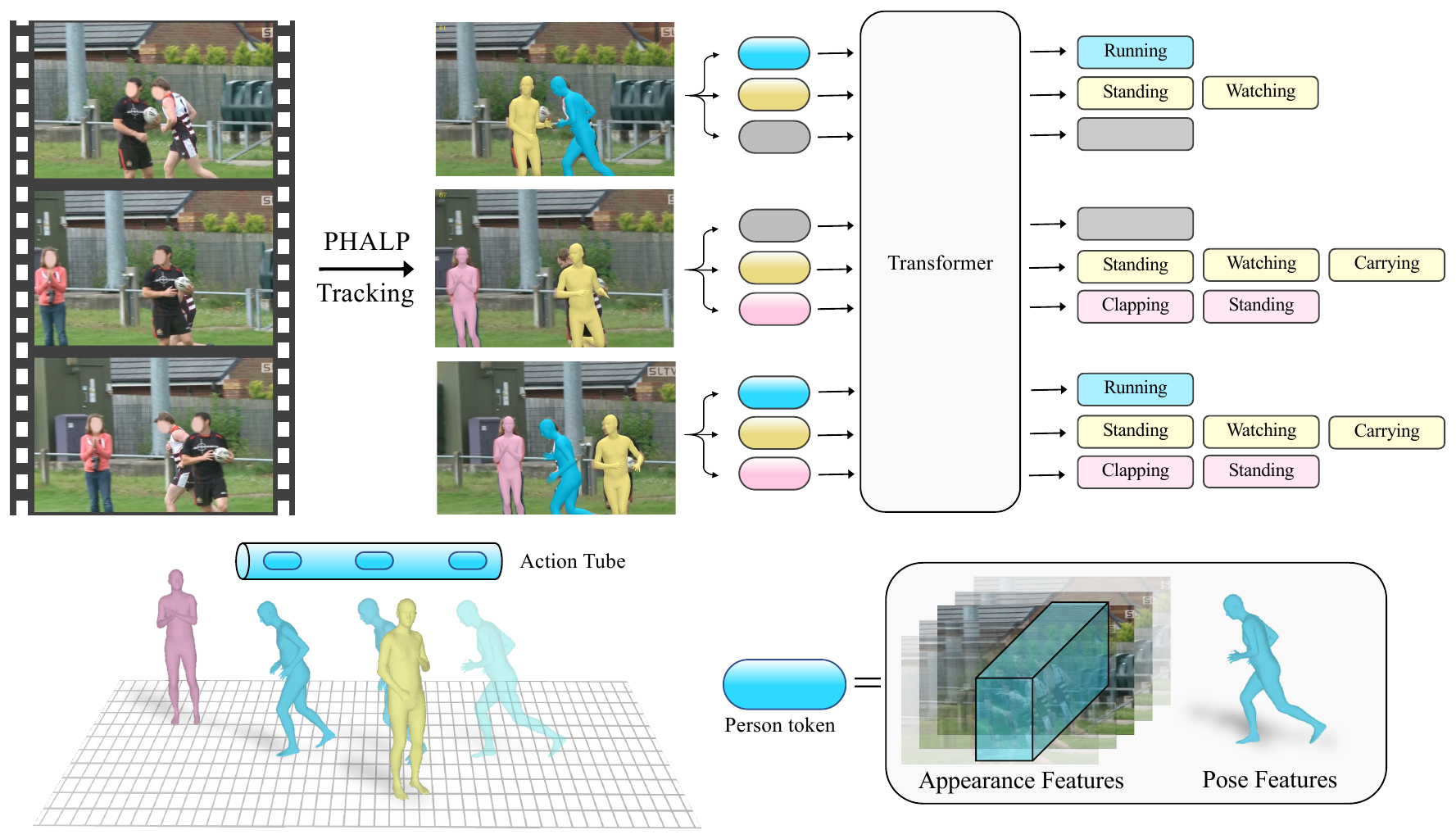
Track first, then reconstruct
The first step is to track every person in the video with PHALP. PHALP is the authors' own 3D tracking method. It detects people with Mask R-CNN, reconstructs each person as an SMPL 3D body model, and associates across frames using 3D pose, location and appearance, which makes it less likely to mix people up than using 2D boxes alone.
After tracking, every person has an identity, a set of 3D pose parameters and a 3D location in every frame. Strung together over time, one person's entries form an action tube.
AVA's person box annotations cover only one frame per second. For training, the authors fill in the frames between annotations with Mask R-CNN detections, and use a ground-truth box again every 30 frames. They ran PHALP on both AVA and Kinetics-400, getting about 1 million tracks and more than 100 million person boxes in total, over 900 hours altogether, with an average track of 3.4 seconds, about 40 times the data earlier work had used.
One person, one token
Every person in every frame becomes a token. The pose-only version is called LART-pose, and its token holds:
- the rotations of 23 joints, each a 3×3 rotation matrix;
- the global orientation of the body;
- the body shape parameters;
- the person's 3D location in camera coordinates.
That makes 229 numbers in all, projected into a vector by an MLP. SMPL represents pose and global orientation separately, so the pose itself is independent of the camera angle; it is also amodal, so occluded hands and feet get estimated too.
The full LART adds appearance on top. Along each track, the authors run action recognition with an MViT pretrained with MaskFeat, take the features before the classification layer and append them to the pose. These features look at the whole frame, so they carry information about the scene and objects.
Several people at once
The tokens get two sets of positional encodings, one for time and one for which track they belong to. To judge a person's action, that person is treated as track 0, and tracks of other people are randomly sampled from the same clip and sent in together; in the paper, .
The model itself is an ordinary Transformer with 16 layers, 16 heads and 512 dimensions. Every token outputs a set of action predictions, trained with binary cross-entropy. AVA is annotated once per second, and the authors assume the action doesn't change within a second, so tokens before and after an annotated frame are all supervised with the same set of labels, and almost every token on a track gets a training signal. Frames where the person isn't detected are filled in with a learnable mask token; during pretraining on Kinetics, 40% of the tokens are also masked at random.
Training has two stages. First, 30 epochs of pretraining on Kinetics-400 tracks, with pseudo-labels predicted by MViT once per second; then fine-tuning on AVA's ground-truth annotations. At inference, the predictions for 6 frames on either side of the middle frame are averaged.
Discussion
Pose alone
| Method | Pose | Object | Interaction | Body | mAP |
|---|---|---|---|---|---|
| JMRN | 2D | 7.1 | 17.2 | 27.6 | 14.1 |
| LART-pose, 1 person | 3D | 12.0 | 22.0 | 46.6 | 22.9 |
| LART-pose, 5 people | 3D | 13.3 | 25.9 | 48.7 | 24.1 |
AVA's actions fall into three groups: object manipulation, person-to-person interaction and body movement.
Without looking at the image at all, from 3D pose alone, LART-pose reaches 24.1 mAP, 10 points above the previous best pose method and also above the 15.6 baseline from the original AVA dataset paper. On body movement, such as running, standing and sitting, it scores 48.7, about 80% of the 58.6 of a strong appearance model like MaskFeat.
With 5 people as input at once, person-to-person interaction rises from 22.0 to 25.9. Dancing is nearly 40 points higher than with the 2D pose method, and actions that take two people, such as fighting, lifting someone up and shaking hands, improve especially clearly.
Object manipulation is the lowest, at only 13.3. The model has no information about objects at all and can only guess from posture, which works for actions with a fixed posture such as talking on the phone or carrying something.
Adding appearance
| Method | Object | Interaction | Body | mAP |
|---|---|---|---|---|
| MViT (MaskFeat) | 32.2 | 41.1 | 58.6 | 40.2 |
| + tracking | 33.4 | 43.0 | 59.3 | 41.4 |
| + tracking + 3D pose | 34.4 | 43.9 | 59.9 | 42.3 |
This ablation table uses the same set of detection boxes throughout. Just stringing MViT's features together along the tracks adds 1.2 points; adding 3D pose adds another 0.9. All three groups of actions improve, with person-to-person interaction gaining the most.
The authors' explanation is that with a track, the model can see how the same person's joint angles change over time, which amounts to an extra layer of signal, the change itself; and knowing who is who also makes it easier to learn the back-and-forth of interactions between people.
Against other methods, LART with MViT reaches 42.3 mAP, 2.8 points above the best at the time, VideoMAE (39.5). With the stronger Hiera backbone, it goes from 42.6 to 45.1. LART beats MaskFeat on 56 of the 60 classes, with fighting, hugging and climbing all up by more than 5 points. On AVA-Kinetics it is also 1.5 points above the previous best method.
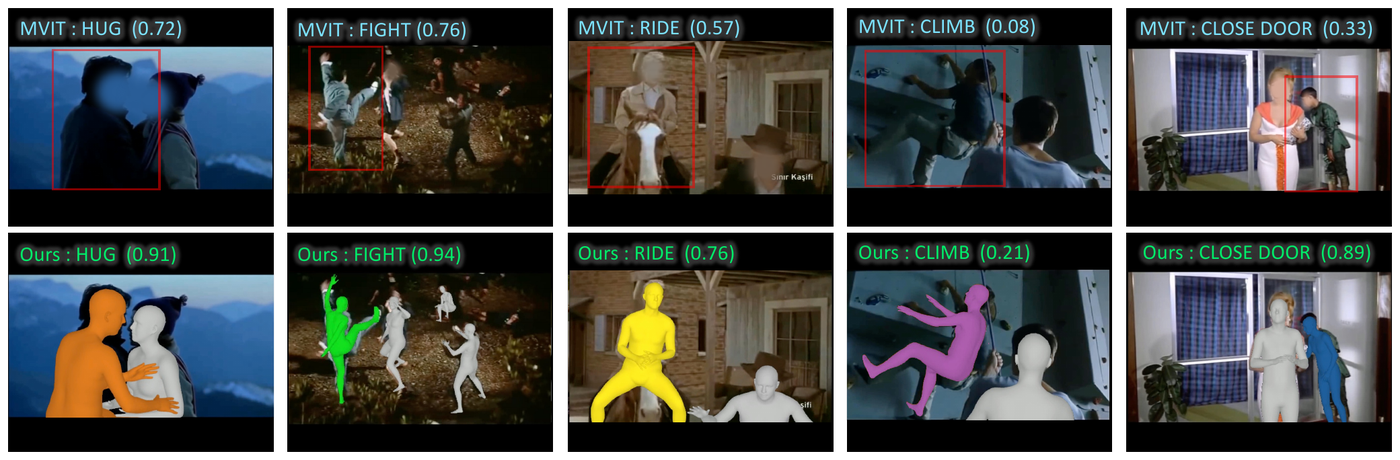
These examples line up neatly with the two ideas above. Hugging and fighting improve because the model can see the track of the person next to them; riding and climbing because the 3D posture itself is very distinctive; and in the close-door panel, the hand is occluded, but 3D human reconstruction still fills it in.
The cost
LART's results rest on a very long preprocessing pipeline. Every video first goes through Mask R-CNN detection, 3D human reconstruction and PHALP tracking, then MViT or Hiera is run once along each track to extract appearance features, and only then does LART itself get its turn. The paper doesn't report the inference speed of the whole pipeline.
The authors explained in an issue that in practice, tracking is run to completion first and the tracks are saved, and then LART is run over each track with a sliding window; part of the code even lives in the PHALP repository. The repository itself has no license file, and someone asked about it without getting a reply; the weights of the pose-only LART-pose were never released; and in 2026 someone reported that the download link for the SMPL model files was dead.
Conclusion
LART's claim is a simple one. To see what a person is doing, follow that person and watch. Track first, describe them with 3D pose, and finally hand that person's whole track, together with the other people around them, to a Transformer.
Reaching 24.1 mAP on AVA from 3D pose alone shows that the shape and movement of the body carry a lot of information on their own. Added to the strongest appearance model, tracking and pose can still squeeze out another 2 to 3 points.
Upstream techniques such as tracking and 3D human reconstruction have all improved a great deal in recent years. The authors also say in the ablations that 3D pose currently adds only 0.9 points, and that once 3D pose estimation becomes more accurate and more stable, this number should go up further.