Original paper
Holistic Interaction Transformer Network for Action Detection
- Publication
- WACV 2023Conference
- First submitted to arXiv
- arXiv:2210.12686
Cite this paper · BibTeX
The citation identifies the linked source version. It cites the original paper and its authors.
@misc{actionrecognitionhit2022,
  title = {{Holistic Interaction Transformer Network for Action Detection}},
  author = {Gueter Josmy Faure and Min-Hung Chen and Shang-Hong Lai},
  year = {2022},
  eprint = {2210.12686},
  archivePrefix = {arXiv},
  url = {https://arxiv.org/abs/2210.12686}
}
Spatio-temporal action detection has to mark, for every person in the frame, what they are doing at that moment. This is different from video classification, which gives the whole video a single label; here, one frame may hold several people each doing their own thing, and in the next frame it changes again.
The common approach at the time was to use a 3D CNN to extract features from the whole video, then take the detected person boxes and crop each person's region out of the feature map for classification. That throws away information outside the person. Later methods began to model the relationships between people, and between people and objects. For example, two people standing in the same frame are quite likely interacting; someone holding a racket is quite likely playing tennis.
Gueter Josmy Faure of National Tsing Hua University in Taiwan, Min-Hung Chen of Microsoft's AI R&D Center in Taiwan, and Shang-Hong Lai, who is affiliated with both, argue that these methods still miss two things, human pose and the hands.
Defining the problem
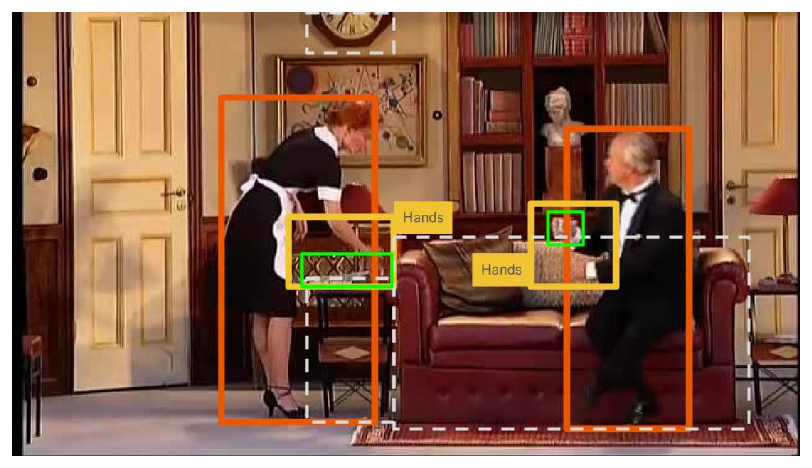
The authors use this figure to illustrate the problem. Both people are interacting with objects. The person on the left is picking something up, and the person on the right is holding a cup. Yet the object detector found neither of these things, which the authors guess is because the cup is too small or nearly transparent; what it found instead were the clock on the wall and the sofa, which have nothing whatsoever to do with the actions.
Methods that depend on object detection have two weaknesses. First, they use only objects with high confidence scores, so objects that are too small, too rare or never learned by the detector get missed. Second, for some actions the target isn't in the frame at all, for example "pointing at something."
The authors' observation is that most human actions have to do with the hands and with body posture. The person on the left is bent at the waist, and that posture alone looks a lot like picking something up; the region around the hands of the person on the right, even though the detector didn't recognize the cup, carries the information "holding something."
Solving the problem
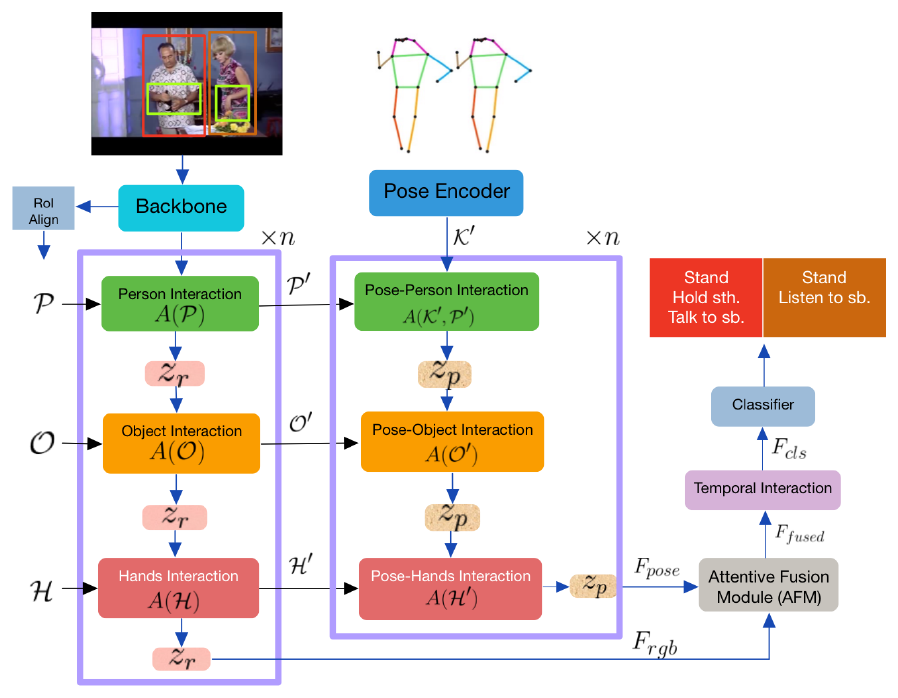
First, four kinds of entities
Besides the video, HIT takes four kinds of entities as input.
Person boxes, at inference on J-HMDB and UCF101-24, are taken directly from YOWO's detections. Object boxes come from Faster R-CNN, keeping only objects with a score of at least 0.25 that also overlap some person box; the authors' intent is to keep only things someone is directly touching. Human pose comes from Detectron's keypoint model, with 17 COCO keypoints per person.
The hand boxes are the most distinctive part of this paper. The authors take just two keypoints, the left and right wrists, and draw a box around them, so the box contains both hands and everything between them. A cup held in the hands falls inside this box even if the detector didn't recognize it.
Video features come from a SlowFast backbone with a 32-frame input. The features for people, objects and hands are all cropped from the video features with RoIAlign.
RGB branch
The RGB branch is a chain of three interaction units, all built around cross-attention.
The first is the person interaction unit, where the query, key and value all come from the people in the frame, learning the relationships between people; when there is only one person in the frame, that person interacts with themselves. The second is the object interaction unit, where the query is the previous step's output and the key and value come from the object features; the question it asks is "can these objects help work out what this person is doing?" The third is the hand interaction unit, where the key and value are switched to the hand features.
Each unit is followed by an aggregation module, which the authors call IMA (intra-modality aggregator). It sums the outputs of all the interaction units so far, plus the temporal memory, with learnable weights:
stands in turn for the person, object and hand interaction outputs and the temporal memory. lets the network decide for itself how much to listen to each kind of interaction. The supplementary material notes that these weights all start at the same very small value, so every kind of feature starts on equal footing.
Pose branch
The pose branch mirrors the RGB branch's structure. The keypoints are first encoded by a lightweight spatial Transformer and then pass in the same order through three interaction units for people, objects and hands. The difference is that the key and value here are the outputs of the corresponding units in the RGB branch. In the pose–person interaction, for example, the query is the pose features and the key and value are the RGB branch's person interaction results.
Each branch stacks two layers and outputs RGB features and pose features.
Fusion and time
The two kinds of features are concatenated, passed through one round of self-attention and then projected; the authors call this AFM (attentive fusion module).
Last comes the temporal interaction unit. Following AIA, the authors cache each person's features from a few neighboring frames, and the fused features serve as the query to look for useful information in this memory. Actions are continuous. Opening a door is usually followed by closing it, and throwing and catching a ball can only be told apart by looking at the frames before and after.
Discussion
Four datasets
J-HMDB and UCF101-24 are evaluated with frame-level mAP and video-level mAP, with a SlowFast-R50 backbone.
| Dataset | Method | Frame mAP | Video [email protected] |
|---|---|---|---|
| J-HMDB | TubeR | — | 82.3 |
| J-HMDB | HIT | 83.8 | 88.1 |
| UCF101-24 | ACAR | 84.3 | — |
| UCF101-24 | PCSC | 79.2 | 61.0 |
| UCF101-24 | HIT | 84.8 | 74.3 |
Most methods in the comparison table use both RGB and optical flow; HIT uses RGB alone. On UCF101-24's video-level [email protected], it jumps 13 points past the previous best.
MultiSports has 66 fine-grained sports actions. HIT's frame-level mAP is 33.3, 5.6 points above the dataset authors' baseline; but its video-level [email protected] is 8.8, slightly below the baseline's 9.6.
On AVA, with SlowFast-R101, its frame-level mAP is 32.6, a little above AIA's 32.3 but below ACAR's 33.3, MeMViT's 33.5 and TubeR's 33.6. The authors also note among the limitations that AVA's frames are often crowded and of poor quality, and once the detector or the pose estimator makes a mistake, HIT goes wrong with it.
Ablations
All ablations are run on J-HMDB.
| Setting | Frame mAP |
|---|---|
| Backbone only | 58.85 |
| Backbone + AIA | 77.25 |
| Backbone + pose encoder, direct fusion | 80.44 |
| HIT | 83.81 |
The third row is the most convincing. Without any interaction unit, just fusing the pose encoder's output directly with the video features already beats the full AIA by 3 points. Human posture by itself carries a great deal of information about the action.
The hands' contribution shows too. The RGB branch alone scores 79.11, and adding hands gives 80.82; the pose branch alone scores 80.19, and adding hands gives 80.90. The pose already includes the wrist keypoints, so hands help the pose branch less.
Some of the numbers don't move consistently, though. RGB plus pose without hands is 79.62, lower than pose alone at 80.19. The interaction-unit ablation is even more striking. Adding only hand interaction gives 81.44, adding hands and objects actually drops to 80.23, adding hands and temporal memory drops to 79.36, and adding all three jumps back up to 83.81. The paper's guess is that when only some of the units are switched on, IMA doesn't have enough features to work with, and these swings are a byproduct of that.
J-HMDB is very small, with 21 classes and at most 55 videos per class. The authors later said in an issue that because the dataset is so small, results vary from one training run to the next, and the model converges very quickly on J-HMDB and then starts to overfit. A fair amount of the one- or two-point swings in this ablation table may be that kind of fluctuation.
Speed and reproduction
The supplementary material has a small experiment. The backbone alone runs at 15.97 frames per second, adding AIA gives 13.66 and HIT 12.37; the paper doesn't say which GPU was used. Someone asked in an issue whether it can run in real time, and the authors' entire answer was one sentence, "This work cannot run in real time."
The code is released under the MIT license, and the authors replied to most of the issues between 2023 and 2024. There are a few pitfalls, though. No annotation or config files are provided for UCF101-24; the authors consider it very similar to J-HMDB and don't plan to prepare them separately, and people were still asking in 2026. The links to the trained weights broke several times, and two issues in 2025 asking for the weights got no reply. Someone retrained on J-HMDB with the official code and got a video-level [email protected] of 84.8, more than 3 points below the paper's 88.1.
Conclusion
HIT's starting point is easy to understand. Most actions are interactions between a person and their surroundings, and the interaction often happens in the hands; what the object detector misses can be picked back up with a box drawn around the wrists, and a person's posture spells out directly what they are doing.
Architecturally, it computes the person, object and hand interactions once in each of the RGB and pose branches, fuses them, and then looks at the frames before and after. It does very well on small datasets, setting new records on both J-HMDB and UCF101-24; on AVA it is about level with methods of its time. In crowded movie frames, after all, even where the wrists are can't always be estimated accurately.