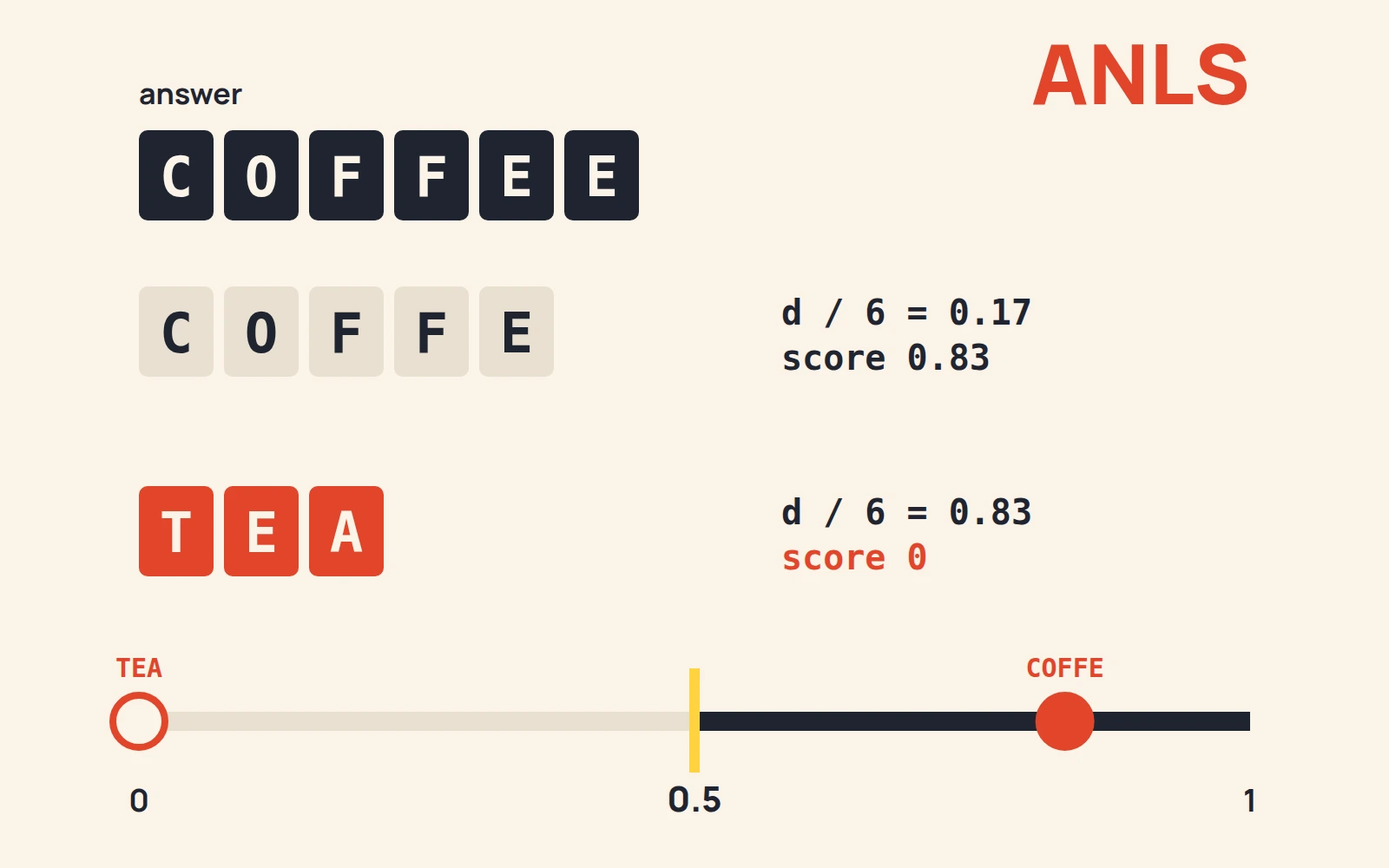
L’Average Normalized Levenshtein Similarity (ANLS) mesure la proximité entre une chaîne prédite et une réponse acceptée. La distance d’édition de Levenshtein est divisée par la longueur de la chaîne la plus longue, puis transformée en score de similarité.
L’article ST-VQA original applique un seuil de 0,5 : si la distance normalisée dépasse ce seuil, le score vaut zéro ; sinon, il vaut 1 - distance. Les scores sont ensuite moyennés. Sans ce seuil, la moyenne NLS peut différer de l’ANLS. Le code ci-dessous évalue des paires de chaînes. Si plusieurs réponses sont admises pour une question, il faut aussi suivre la règle de sélection du jeu de données.
Références
Bibliothèques nécessaires à l'importation
Importer torchmetrics et sa métrique EditDistance :
from typing import Any, Literal, Optional, Sequence, Union

import torch
from torch import Tensor
from torchmetrics.metric import Metric
from torchmetrics.text import EditDistance
from torchmetrics.utilities.data import dim_zero_cat
EditDistance renvoie la distance d’édition de chaque paire. Le code la divise par la longueur de la chaîne la plus longue, puis applique le seuil ANLS.
Mettre en œuvre la fonctionnalité de normalisation
La classe hérite de torchmetrics.metric.Metric et implémente update et compute :
class NormalizedLevenshteinSimilarity(Metric):

    def __init__(
        self,
        substitution_cost: int = 1,
        reduction: Optional[Literal["mean", "sum", "none"]] = "mean",
        **kwargs: Any
    ) -> None:
        super().__init__(**kwargs)
        self.edit_distance = EditDistance(
            substitution_cost=substitution_cost,
            reduction=None  # Set to None to get distances for all string pairs
        )

        # ...
Voici quelques points clés :
- Convertir
predsettargeten listes de chaînes pour éviter un calcul caractère par caractère. - Utiliser la longueur de la chaîne la plus longue pour normaliser chaque distance.
def update(self, preds: Union[str, Sequence[str]], target: Union[str, Sequence[str]]) -> None:
    """Update state with predictions and targets."""

    if isinstance(preds, str):
        preds = [preds]
    if isinstance(target, str):
        target = [target]
    if len(preds) != len(target):
        raise ValueError("preds and target must have the same length")

    distances = self.edit_distance(preds, target)
    max_lengths = torch.tensor([
        max(len(p), len(t))
        for p, t in zip(preds, target)
    ], dtype=torch.float, device=distances.device)

    ratio = torch.where(
        max_lengths == 0,
        torch.zeros_like(distances).float(),
        distances.float() / max_lengths
    )

    nls_values = torch.where(
        ratio <= 0.5,
        1 - ratio,
        torch.zeros_like(ratio),
    )

    # ...
Mettre en œuvre reduction Paramètre
Avec reduction="mean", les scores sont moyennés après application du seuil. sum renvoie leur somme ; none renvoie un score par paire de chaînes.
def _compute(
    self,
    nls_score: Tensor,
    num_elements: Union[Tensor, int],
) -> Tensor:
    """Compute the ANLS over state."""
    if nls_score.numel() == 0 or num_elements == 0:
        return torch.tensor(0, dtype=torch.int32)
    if self.reduction == "mean":
        return nls_score.sum() / num_elements
    if self.reduction == "sum":
        return nls_score.sum()
    if self.reduction is None or self.reduction == "none":
        return nls_score

def compute(self) -> torch.Tensor:
    """Compute the NLS over state."""
    if self.reduction == "none" or self.reduction is None:
        return self._compute(dim_zero_cat(self.nls_values_list), 1)
    return self._compute(self.nls_score, self.num_elements)
Avec reduction="none", retournez chaque score seuil au lieu d'une moyenne. dim_zero_cat combine les valeurs stockées dans un tenseur.
Mise en œuvre
La mise en œuvre complète est la suivante :
from typing import Any, Literal, Optional, Sequence, Union

import torch
from torch import Tensor
from torchmetrics.metric import Metric
from torchmetrics.text import EditDistance
from torchmetrics.utilities.data import dim_zero_cat

class NormalizedLevenshteinSimilarity(Metric):
    """
    Normalized Levenshtein Similarity (NLS) is a metric that computes the
    normalized Levenshtein similarity between two sequences.
    This metric is 1 - normalized edit distance when the distance is at most 0.5,
    where `levenshtein_distance` is the Levenshtein distance between the two
    sequences and `max_length` is the maximum length of the two sequences.

    NLS aims to provide a similarity measure for character sequences
    (such as text), making it useful in areas like text similarity analysis,
    Optical Character Recognition (OCR), and Natural Language Processing (NLP).

    This class inherits from `Metric` and uses the `EditDistance` class to
    compute the Levenshtein distance.

    Inputs to the ``update`` and ``compute`` methods are as follows:

    - ``preds`` (:class:`~Union[str, Sequence[str]]`):
        Predicted text sequences or a collection of sequences.
    - ``target`` (:class:`~Union[str, Sequence[str]]`):
        Target text sequences or a collection of sequences.

    Output from the ``compute`` method is as follows:

    - ``nls`` (:class:`~torch.Tensor`): A tensor containing the NLS value.
        Returns 0.0 when there are no samples; otherwise, it returns the NLS.

    Args:
        substitution_cost:
            The cost of substituting one character for another. Default is 1.
        reduction:
            Method to aggregate metric scores.
            Default is 'mean', options are 'sum' or None.

            - ``'mean'``: takes the mean over samples, which is ANLS.
            - ``'sum'``: takes the sum over samples
            - ``None`` or ``'none'``: returns the score per sample

        kwargs: Additional keyword arguments.

    Example::
        Multiple strings example:

        >>> metric = NormalizedLevenshteinSimilarity(reduction=None)
        >>> preds = ["rain", "lnaguaeg"]
        >>> target = ["shine", "language"]
        >>> metric(preds, target)
        tensor([0.0000, 0.5000])
        >>> metric = NormalizedLevenshteinSimilarity(reduction="mean")
        >>> metric(preds, target)
        tensor(0.2500)
    """

    def __init__(
        self,
        substitution_cost: int = 1,
        reduction: Optional[Literal["mean", "sum", "none"]] = "mean",
        **kwargs: Any
    ) -> None:
        super().__init__(**kwargs)
        self.edit_distance = EditDistance(
            substitution_cost=substitution_cost,
            reduction=None  # Set to None to get distances for all string pairs
        )

        allowed_reduction = (None, "mean", "sum", "none")
        if reduction not in allowed_reduction:
            raise ValueError(
                f"Expected argument `reduction` to be one of {allowed_reduction}, but got {reduction}")
        self.reduction = reduction

        if self.reduction == "none" or self.reduction is None:
            self.add_state(
                "nls_values_list",
                default=[],
                dist_reduce_fx="cat"
            )
        else:
            self.add_state(
                "nls_score",
                default=torch.tensor(0.0),
                dist_reduce_fx="sum"
            )
            self.add_state(
                "num_elements",
                default=torch.tensor(0),
                dist_reduce_fx="sum"
            )

    def update(self, preds: Union[str, Sequence[str]], target: Union[str, Sequence[str]]) -> None:
        """Update state with predictions and targets."""
        if isinstance(preds, str):
            preds = [preds]
        if isinstance(target, str):
            target = [target]
        if len(preds) != len(target):
            raise ValueError("preds and target must have the same length")

        distances = self.edit_distance(preds, target)
        max_lengths = torch.tensor([
            max(len(p), len(t))
            for p, t in zip(preds, target)
        ], dtype=torch.float, device=distances.device)

        ratio = torch.where(
            max_lengths == 0,
            torch.zeros_like(distances).float(),
            distances.float() / max_lengths
        )

        nls_values = torch.where(
        ratio <= 0.5,
        1 - ratio,
        torch.zeros_like(ratio),
    )

        if self.reduction == "none" or self.reduction is None:
            self.nls_values_list.append(nls_values)
        else:
            self.nls_score += nls_values.sum()
            self.num_elements += nls_values.shape[0]

    def _compute(
        self,
        nls_score: Tensor,
        num_elements: Union[Tensor, int],
    ) -> Tensor:
        """Compute the ANLS over state."""
        if nls_score.numel() == 0 or num_elements == 0:
            return torch.tensor(0, dtype=torch.int32)
        if self.reduction == "mean":
            return nls_score.sum() / num_elements
        if self.reduction == "sum":
            return nls_score.sum()
        if self.reduction is None or self.reduction == "none":
            return nls_score

    def compute(self) -> torch.Tensor:
        """Compute the NLS over state."""
        if self.reduction == "none" or self.reduction is None:
            return self._compute(dim_zero_cat(self.nls_values_list), 1)
        return self._compute(self.nls_score, self.num_elements)

if __name__ == "__main__":
    anls = NormalizedLevenshteinSimilarity(reduction='mean')
    preds = ["rain", "lnaguaeg"]
    target = ["shine", "language"]
    print(anls(preds, target))
Notes finales
Cet exemple donne une réponse pour chaque prédiction. Pour correspondre à un évaluateur officiel de dataset, vérifiez également sa normalisation de cas et d'espaces blancs, la sélection de réponses multiples et les règles de chaîne vide.