Original paper
Exploring Fine-grained Retail Product Discrimination with Zero-shot Object Classification Using Vision-Language Models
- Publication
- IEEE RTSI 2024Conference
- First submitted to arXiv
- arXiv:2409.14963
Cite this paper · BibTeX
The citation identifies the linked source version. It cites the original paper and its authors.
@misc{retailproductmimex2024,
  title = {{Exploring Fine-grained Retail Product Discrimination with Zero-shot Object Classification Using Vision-Language Models}},
  author = {Anil Osman Tur and Alessandro Conti and Cigdem Beyan and Davide Boscaini and Roberto Larcher and Stefano Messelodi and Fabio Poiesi and Elisa Ricci},
  year = {2024},
  eprint = {2409.14963},
  archivePrefix = {arXiv},
  url = {https://arxiv.org/abs/2409.14963}
}
After CLIP arrived, "zero-shot classification" became a very tempting promise. No annotations to collect for new classes: write down the class names and the model recognizes them.
For unmanned stores, that's exactly the capability they need most. The products on the shelves keep changing, and every new batch means relabeling data and retraining, which is expensive. If typing "Kinder Bueno" were enough to recognize a Kinder Bueno, life would be much simpler.
This paper comes from the University of Trento, the Fondazione Bruno Kessler (FBK) and other institutions, as part of the EU's MIMEX (Micro Market Experience) project. The authors collected a dataset of customers holding products and tested how far vision-language models like CLIP can go on fine-grained retail classification.
Dataset
The MIMEX dataset has 28 product classes, including several Rocher, Milka and Kinder chocolates, different Toblerone variants, Lay's and Pringles chips, bottled water, energy drinks, condiments, pasta sauces, shampoo, soap, toothpaste, mouthwash and deodorant.
The images are cropped from footage of customers holding products. The authors first detect the hand and then crop a region centered on it, so the frame focuses on the product being held. That brings several difficulties. The hand often covers part of the product, products are held at arbitrary angles, and store lighting puts glare on the packaging. On top of that, chip cans in different flavors from the same brand and several chocolates with similar packaging make the classes look alike to begin with.
The training set has 10,357 images from several people; the test set has 4,920 images, all from one person who isn't in the training set. The split is meant to test whether the model generalizes to a new customer's hands and new ways of holding things.
The authors also made a "cleaned" version, removing by eye the samples that are completely covered by the hand or overexposed by glare. The paper doesn't say how many images were removed. Evaluation uses two-fold cross-validation, with the training and test sets swapped and tested again.
The dataset is available on request by email to the authors. The code link given in the paper returned a 404 in November 2026.
Method and Results
The paper's experiments move step by step from "true zero-shot" to "nearest neighbor over labeled images", and this note follows the same path.
Names Only
The first step is standard CLIP zero-shot classification, using a ViT-B/32 CLIP pretrained on LAION-2B. Each class name goes into a template such as "A photo of a [c]" to get a text embedding, and an image is assigned to whichever class embedding it is closest to:
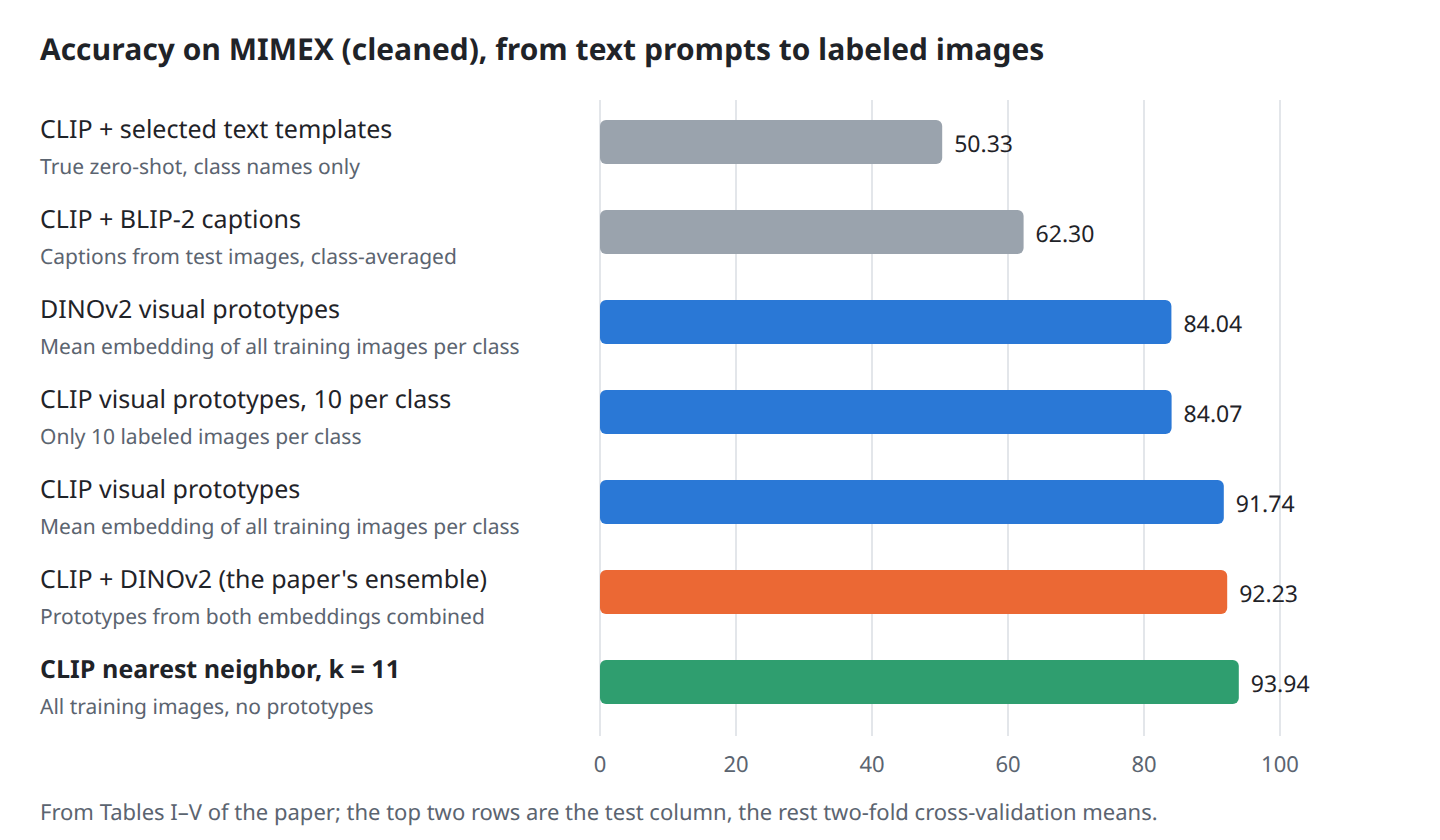
With one basic template, accuracy on the cleaned test set is 48.96%; with 44 templates and the best few of them kept, it's 50.33%. With 28 product classes, it picks the wrong one half the time.
This is the only setting in the whole paper that truly fits the definition of "zero-shot", and the result shows that plain CLIP, looking only at class names, can't tell these look-alike retail products apart.
Letting the Model Write Descriptions
Class names are too short, so the authors switch to BLIP-2 to generate captions for the images. For a given set of images, they caption each image, then average the text embeddings of the captions per class and use the result as that class's text representative.
Using captions of the test images gives 62.30% on the cleaned test set, 12 points more than class names alone.
But labels are already in use here. To "average per class", you have to know which class each image belongs to; and the best number uses captions of the very test images being evaluated. That is closer to a transductive setting and can no longer count as zero-shot.
Comparing Images Directly
With the text route topping out at 62%, the authors turn to purely visual approaches. One averages the CLIP image embeddings of all the training images of each class into a prototype for that class and assigns a test image to the nearest prototype; the other skips prototypes altogether and lets k nearest neighbors vote.
On the cleaned data, the prototype method scores 91.74% and nearest neighbor with scores 93.94%. From 50% straight to over 90%.
Both approaches use every labeled training image of each class, several hundred per class on average. As for nearest neighbor goes from 1 to 11, accuracy keeps rising, from 91.78% to 93.94% on the cleaned data; on the uncleaned version it goes from 86.65% to 89.02%, nearly five points lower.
The authors also tested prototypes built from just a few images per class, which is closer to how retail actually works, since a new product usually gets only a few photos when it goes on the shelf:
| Images per class | Accuracy |
|---|---|
| All | 91.74 |
| 50 | 89.90 |
| 25 | 88.26 |
| 15 | 86.34 |
| 10 | 84.07 |
Source: Tables III and IV of the paper, cleaned version, CLIP prototypes.
Going from all the images down to 10, accuracy drops by less than 8 points. With 10 reference images per class, it's already more than 20 points above any text-prompt approach.
Ensemble
The method the paper proposes combines CLIP and DINOv2 image embeddings into prototypes and then reduces the dimensionality with PCA.
On the cleaned data, CLIP prototypes score 91.74% and adding DINOv2 gives 92.23%, 0.49 more; applying PCA down to 1024 or 512 dimensions actually dips slightly, to 91.97 and 91.96. On the uncleaned version, CLIP gets 87.53 and the ensemble 87.75, and PCA changes almost nothing.
DINOv2 on its own scores 84.04%, nearly 8 points below CLIP. The paper doesn't explain the gap. One possible reason is that CLIP learned the text and brands on packaging from huge numbers of image-text pairs, and these products are told apart precisely by text and brand. That points the same way as Unitail's observation that products have to be read to be told apart, but it's only this note's speculation.
Discussion
Line these numbers up and a gap opens between the paper's title and its results.
The abstract says the proposed ensemble "outperforms VLMs", and the introduction claims "a classification accuracy improvement of 15% over the baseline models". Yet in the paper's own tables, the ensemble adds only 0.2 to 0.5 points over plain CLIP prototypes, and nearest neighbor with the same CLIP at reaches 93.94%, higher than the ensemble's 92.23%. PCA brings no benefit either.
The big jump from 50% to 90% comes from switching from "class names only" to "several hundred labeled images per class", which is already a supervised setting. The "zero-shot" in the title means that no model was fine-tuned on MIMEX; classification still used every last labeled image.
Even so, the paper leaves a few useful reference points.
First, true zero-shot CLIP gets only about 50% on fine-grained retail products, which is a very practical reminder.
Second, on this dataset image embeddings are far more reliable than text embeddings. Even with only 10 reference images, CLIP prototypes reach 84%, well above any text prompt.
Third, removing the samples covered by hands or overexposed adds several points, with nearest neighbor () going from 89.02% to 93.94%. In a real unmanned-store system, picking out clear frames before recognition may do more than switching models.
Conclusion
MIMEX offers a dataset very close to the unmanned-store setting: customers' hands holding products at arbitrary angles, often occluded, with quite a few of the 28 classes being same-brand products that differ only in flavor. The baselines it sets are clear too. CLIP looking only at class names gets about 50%, and with several hundred reference images it reaches over 90%.
If you're actually building this for a store, CLIP image embeddings plus nearest neighbor are enough. Take a few more reference photos of each product, and filter out the frames where a hand blocks the product.
As for the paper's headline CLIP plus DINOv2 ensemble, in its own experiments it adds at most half a point. If you'd like to check for yourself, the code link is already a 404 (at least that saves you a git clone).