Original paper
Bridging the Catalog-to-Real Gap: Scalable Product Recognition via Multi-Stage Contrastive Learning
- Publication
- Publication venue not yet verified
- First submitted to arXiv
- arXiv:2607.09888
Cite this paper · BibTeX
The citation identifies the linked source version. It cites the original paper and its authors.
@misc{retailproductcatalogtoreal2026,
  title = {{Bridging the Catalog-to-Real Gap: Scalable Product Recognition via Multi-Stage Contrastive Learning}},
  author = {Anyi Zhang and Joy Mazumder and Kiril Lomakin},
  year = {2026},
  eprint = {2607.09888},
  archivePrefix = {arXiv},
  url = {https://arxiv.org/abs/2607.09888}
}
Photos in a product catalog all look great. White background, shot from the front, evenly lit, every word on the package legible.
The same product on the shelf is another story. A store associate shoots a whole stretch of shelving with a phone, a detector crops out each product, and the crops come out low-resolution, maybe tilted, half hidden behind the product in front, glaring through the glass of a refrigerated case, and blurred the moment the hand shakes.
Anyi Zhang, Joy Mazumder and Kiril Lomakin of Walmart Global Tech set out to close exactly this gap, matching products photographed on the shelf back to the right item in the catalog.
Defining the problem
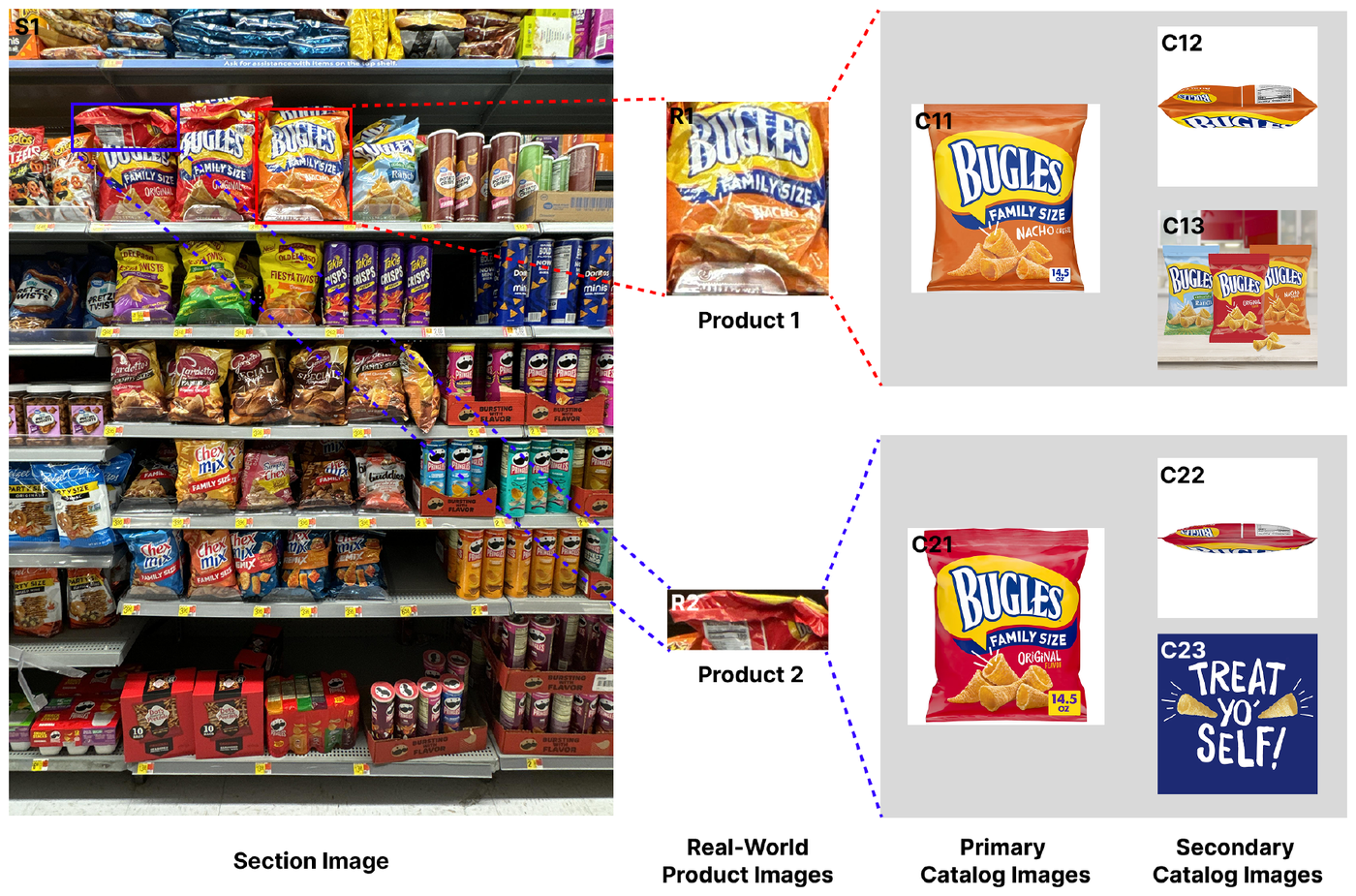
The authors list three difficulties.
The first is scale and churn. A big-box store carries millions of items on its shelves, new products arrive every day, and packaging is often redesigned, so a classifier with fixed classes quickly goes stale.
The second is fine granularity. Products in the same line may differ only in flavor, size or a line of small print on the package.
The third is environmental noise. Low resolution, occlusion, rotation, motion blur and glare from glass often leave even the text on the package unreadable.
So the authors set two conditions for a system that can go into production. New products must be recognized from existing catalog images alone, without sending someone into the store to photograph and label every new arrival; and changes in inventory must not require retraining the model.
These two conditions turn the problem from closed-set classification into open-set retrieval. Shelf crops and catalog images are both turned into vectors by the same image encoder, the nearest catalog image is found in vector space, and whichever product it belongs to is the answer:
When a new product arrives, you just encode its catalog images and add them to the vector store.
The catalog itself isn't clean either. Each product has one front-on studio packshot as its primary image, plus possibly a few images from other angles, ad images, or even images that don't belong there. Some products lack a primary image; some have only one angle.
Solving the problem
Off-the-shelf models fall short
The most direct approach is to use an off-the-shelf vision foundation model as the encoder. The authors tested DINOv2 and DINOv3, as well as two of Google's commercial embedding APIs.
| Model | Res. | Top-1 | Top-5 |
|---|---|---|---|
| DINOv2 ViT-L/14 | 224 | 35.53 | 61.39 |
| DINOv3 ViT-L/16 | 384 | 53.83 | 78.12 |
| Multimodalembedding@001 | 512 | 63.51 | 84.39 |
| Gemini-Embedding-2 | — | 68.71 | 89.34 |
Even the best of them, Gemini-Embedding-2, stays below 70% Top-1. General-purpose models can tell potato chips from laundry detergent, but two packs of the same brand that differ only in size or flavor easily trip them up.
Picking the right positives and negatives
The authors fine-tune DINOv3 ViT-L with a triplet loss. The query is a real image cropped from the shelf, the positive is a catalog image of the same product, and the negative is a catalog image of a different product:
Each query gets only one positive and one negative per epoch, so which image gets picked matters a lot.
In the authors' example, the shelf shot shows the side of a snack bag. If the positive is this product's front-on primary image while the negative is a side view of another product, the model is asked to push "side" away from "side" and pull it toward "front," two goals fighting each other. On the other hand, most products in the catalog look nothing like the query, so a negative drawn at random teaches the model very little.
Three stages
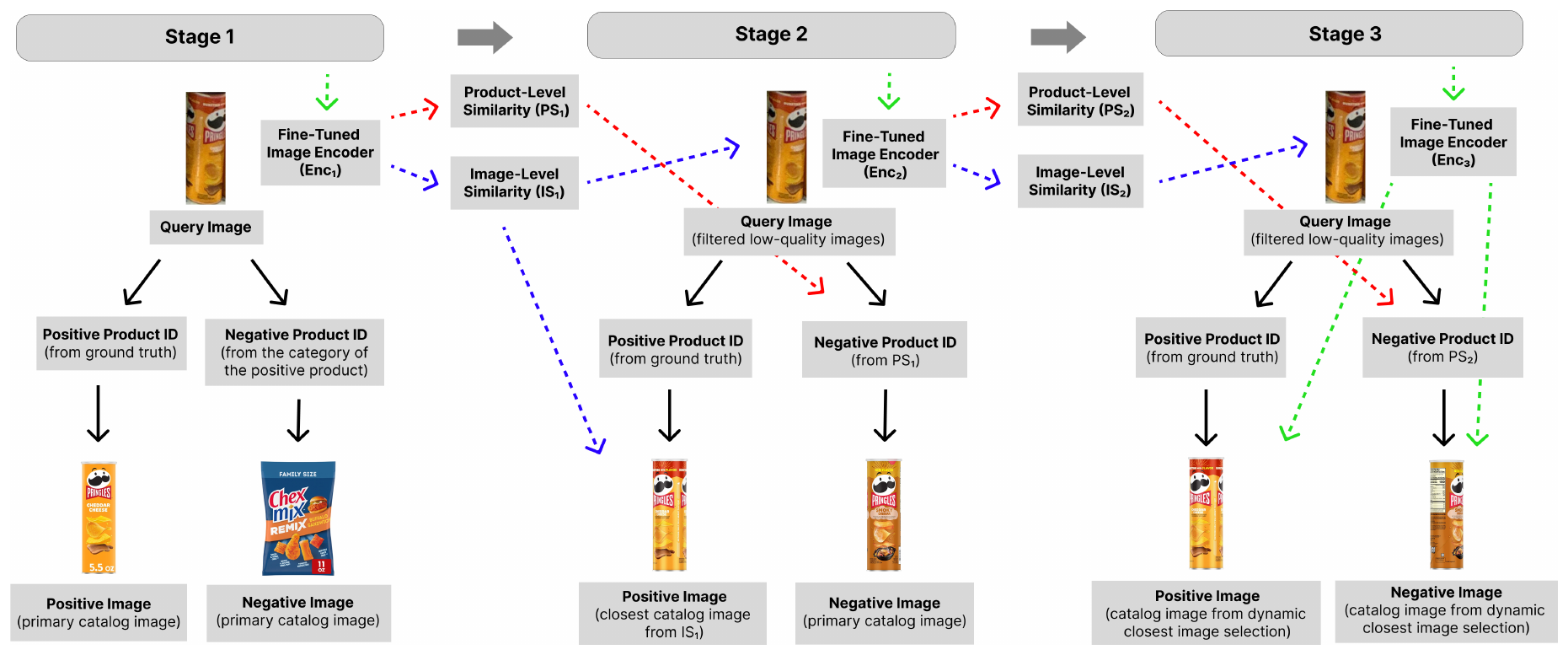
The authors fine-tune in three stages, each using the previous stage's model to pick samples.
Stage 1 uses the simplest setup. The positive is the correct product's primary image, and the negative is the primary image of another product picked at random from the same category. The trained encoder is then used to compute two similarity tables, one between products (compared by their primary images) and one between each query and every catalog image of its correct product.
Stage 2 starts picking. If a query's similarity to every catalog image of its correct product is below 0.85, the query is judged too blurry, or the catalog simply has no matching angle, and it's dropped. For the queries that remain, the positive becomes the catalog image with the highest similarity, so the angles naturally line up. The negative product is drawn from the 50 most similar products, with higher-ranked ones more likely to be drawn:
Stage 3 makes the image picking happen on the fly. Every mini-batch recomputes with the current model, taking as the positive the correct product's catalog image closest to the query and as the negative the closest image from the drawn product. It costs much more compute, but the picked samples get harder as the model gets stronger.
As for other details, only the last 12 of ViT-L's 24 layers are trained, with the first 12 frozen; the learning rate decays layer by layer with a ratio of 0.75; training runs on a single A100 with an effective batch size of 128. Catalog images, after rotation, cropping, blur and contrast perturbation, also serve as queries to simulate shelf shooting conditions.
Discussion
Main results
The training data is nearly 200,000 real images labeled with product IDs, covering 26,910 products; some were boxed and labeled by hand on shelf photos, and some were paired automatically by an app that scans the barcode while taking a photo. The "no in-store annotation" condition from earlier applies to new products after launch.
The evaluation set is internal Walmart data, 5,043 product crops from shelf photos, covering 1,865 products in 43 categories, with a candidate pool of 2,155 products.
| Model | Top-1 | Top-5 |
|---|---|---|
| DINOv3 ViT-L/16 (not fine-tuned) | 53.83 | 78.12 |
| Gemini-Embedding-2 | 68.71 | 89.34 |
| Cat2Real-DINOv2 | 76.34 | 93.13 |
| Cat2Real-DINOv3-224 | 78.80 | 94.41 |
| Cat2Real-DINOv3-384 | 80.73 | 94.70 |
Fine-tuned DINOv3 is nearly 27 points above the original and 12 points above Gemini-Embedding-2.
In the appendix's per-category table, the average in the last row is exactly these two numbers, so the main table reports the mean of the 43 categories' individual accuracies, not the overall accuracy over the 5,043 images. The biggest gaps are in medicines and health products, with 61 vs. 15 for pain relievers, 68.5 vs. 34 for vitamins and 69 vs. 35.5 for cold medicine; products with boxes covered in small print and very similar looks are exactly where general-purpose models are weak. There are also categories where Gemini does better, such as frozen pizza, where Gemini scores 94.7 and Cat2Real only 78.7. Cat2Real's weakest category is motor oil, at only 51.5.
Ablations
| Setting | Top-1 |
|---|---|
| Stage 1 only | 73.77 |
| Up to Stage 2 | 78.45 |
| All three stages | 80.73 |
| One fully random negative | 73.78 |
| Negative product not from similar ones | 74.81 |
| Pos./neg. not the closest catalog image | 77.42 |
| Closest image, not updated on the fly | 78.65 |
| No low-quality query filtering | 79.52 |
| 4 negatives per query | 76.37 |
How well the negatives are picked matters most. A single fully random negative gets only 73.78, and drawing the negative product from outside the similar products gets 74.81, both 6 to 7 points below the full version. More surprisingly, giving 4 picked negatives at once is 4 points worse than giving 1. The authors' explanation is that concentrating on pushing away the single hardest negative works better than pushing away several at the same time.
Products it hasn't seen
The authors removed every product that appears in the evaluation set from the training set and retrained; Top-1 fell only from 80.73 to 80.23. This supports the "no retraining for new products" design.
They also tried training on only part of the categories. Trained on just 6 categories with a little over 10,000 products, Top-1 is 75.77; with 31 categories, 78.89; with all 52, 80.73. From this the paper says the model generalizes zero-shot to unseen categories.
Each setting in that table, though, reports only one overall number. With only 6 training categories, most of the evaluation set's 43 categories are unseen, yet the paper doesn't break out how the seen and the unseen categories each perform. Seen from another angle, the original DINOv3 scores only 53.83, and fine-tuning on just 6 categories reaches 75.77; most of the gain comes from the step of fine-tuning at all, and the 46 additional categories add another 5 points.
A broken image
The paper uses Figure 4 to compare the retrieval results of Cat2Real and Gemini-Embedding-2.
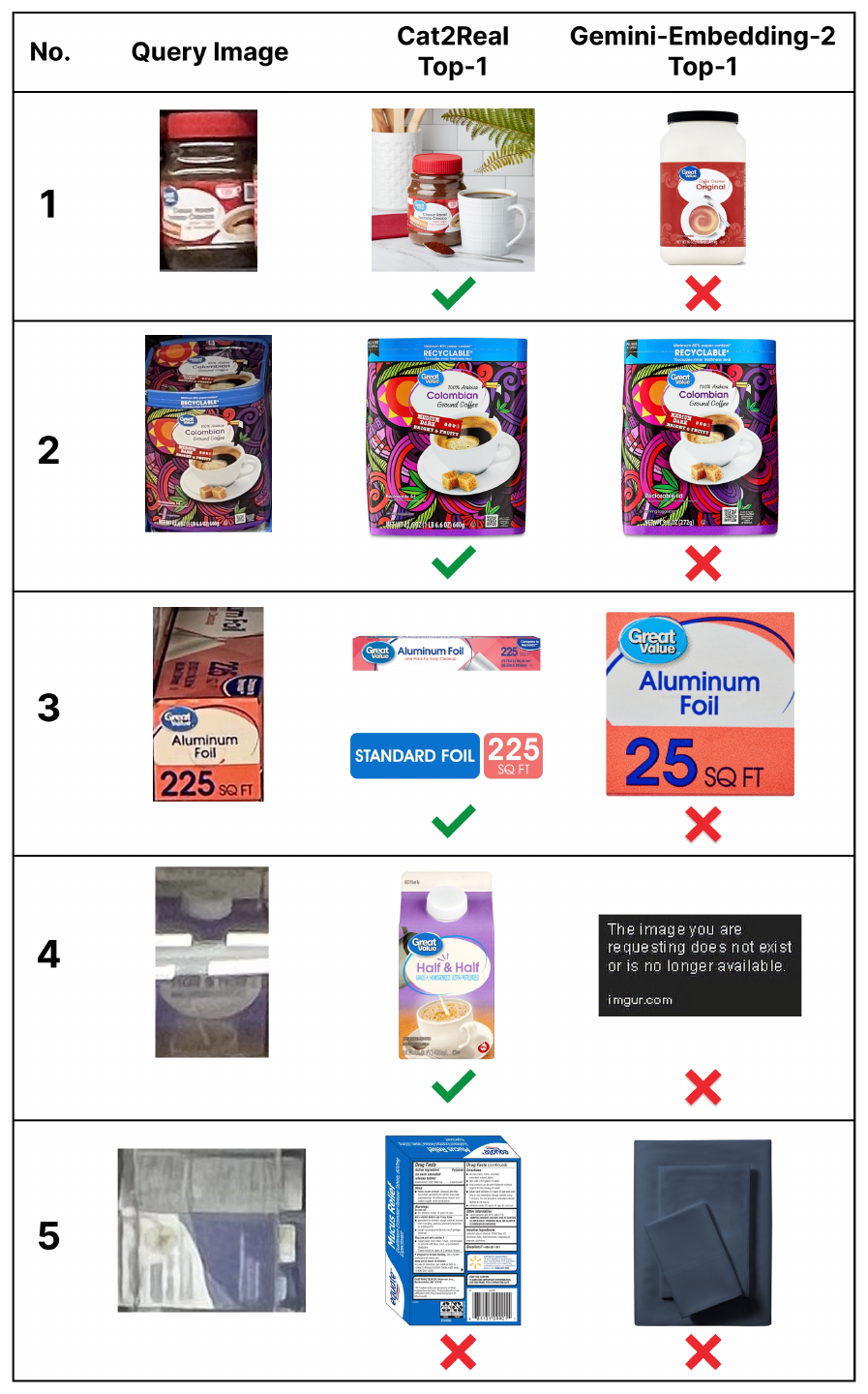
The text describes row 4 as the baseline returning "an entirely unrelated product class." Look at the figure, and the "catalog image" Gemini returned is actually imgur's broken-image placeholder, reading "The image you are requesting does not exist or is no longer available."
Matching a blurry query to an all-black error screen isn't that outlandish for a general-purpose model. What the figure shows is less how bad Gemini is than what the authors said when defining the problem, that the catalog itself isn't clean (even the placeholder for a dead link got a spot in the product catalog). That's also why Stage 2 filters with a similarity threshold and Stage 3 picks images on the fly.
Release and limits
The fine-tuned Cat2Real-DINOv3-384 weights are on Hugging Face, tagged Apache 2.0. The base model is Meta's DINOv3, whose weights come with a custom license of their own, so for commercial use you need to read both. Neither the training code nor the data is public, the evaluation set is internal too, and the paper has no results on any public dataset; outsiders can only try the weights on their own data.
The comparison with Google's two embedding APIs also needs its conditions read carefully. On one side is a model fine-tuned on nearly 200,000 of Walmart's own real product images, on the other general-purpose embedding APIs that have never seen this data; winning on an internal evaluation set is hardly surprising.
Conclusion
Cat2Real's method is plain. One DINOv3, one triplet loss, and all the effort goes into picking samples. Queries too blurry to recognize are filtered out first, then positives are picked to match the angle and negatives to look as alike as possible, and the picks are updated as the model gets stronger.
The most useful part is how the problem is defined. A new product can be added as long as it has catalog images, with no retraining, which is very practical for retail, where the stock changes every day. As for "generalizing to unseen categories," the paper's evidence isn't fine-grained enough yet; that broken imgur image, meanwhile, is an honest reminder of what real-world catalogs look like.