Original paper
CLIMB-ReID: A Hybrid CLIP-Mamba Framework for Person Re-identification
- Publication
- AAAI 2025Conference
Cite this paper · BibTeX
The citation identifies the linked source version. It cites the original paper and its authors.
@inproceedings{personreidclimbreid2025,
  title = {{CLIMB-ReID: A Hybrid CLIP-Mamba Framework for Person Re-identification}},
  author = {Chenyang Yu and Xuehu Liu and Jiawen Zhu and Yuhao Wang and Pingping Zhang and Huchuan Lu},
  year = {2025},
  booktitle = {AAAI},
  url = {https://ojs.aaai.org/index.php/AAAI/article/view/33039}
}
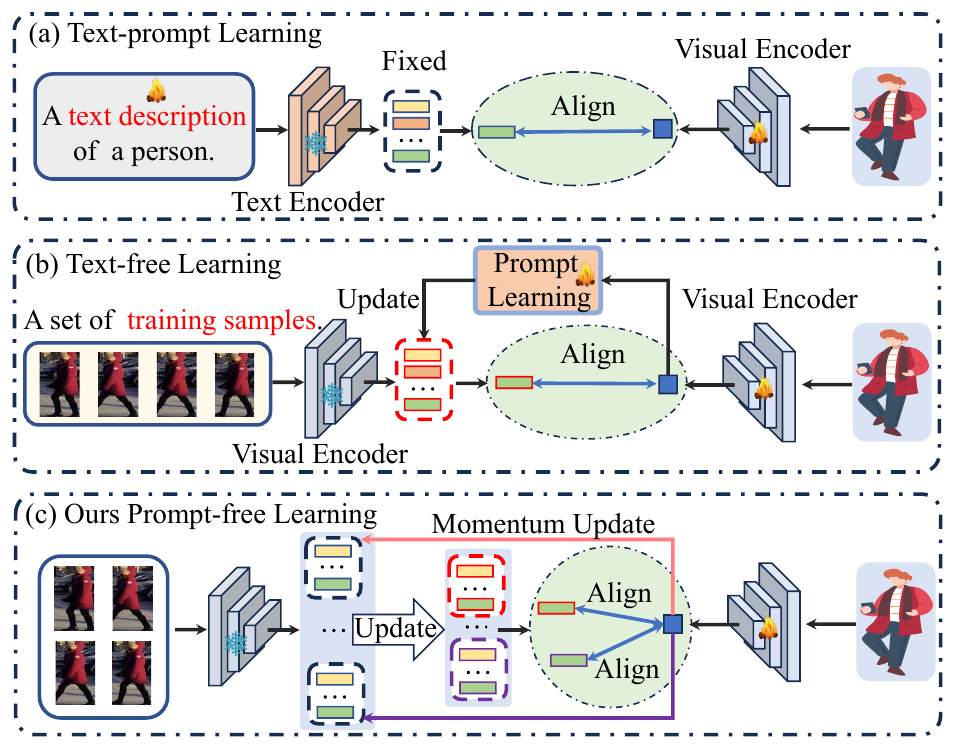
The most awkward part of applying CLIP to person re-identification is that ReID has no text. [22.11] CLIP-ReID: Give It a Name got around it by learning a text vector for each person and using it to constrain the image encoder, at the cost of an extra training stage.
Later someone took a more direct route. CLIP's text and images are already aligned in the same space, so you might as well skip the text and use the average image feature directly as each person's anchor. This is TF-CLIP's approach, which its authors call CLIP-Memory. But to keep this memory updating during training, TF-CLIP added a prompt-learning module, which still means extra parameters to train.
The other problem lies in video. Video ReID gets a tracklet, several frames stacked together, and the common approach is to model it globally across time and space with self-attention, whose computation grows with the square of the sequence length.
Chenyang Yu, Jiawen Zhu, Yuhao Wang, Pingping Zhang and Huchuan Lu of Dalian University of Technology, together with Xuehu Liu of Wuhan University of Technology, wanted to handle both at once. Chenyang Yu is also the first author of TF-CLIP.
Defining the problem
The authors split the problem into two halves.
First, how to carry CLIP's knowledge over to ReID without adding an extra training stage or a prompt network.
Second, how to extract information at different time scales from video without the computation growing with the square of the length. Their choice is [23.12] Mamba: Who is the Successor, whose complexity is linear in the sequence length. The paper also says this is the first time Mamba has been used for person re-identification.
Solving the problem
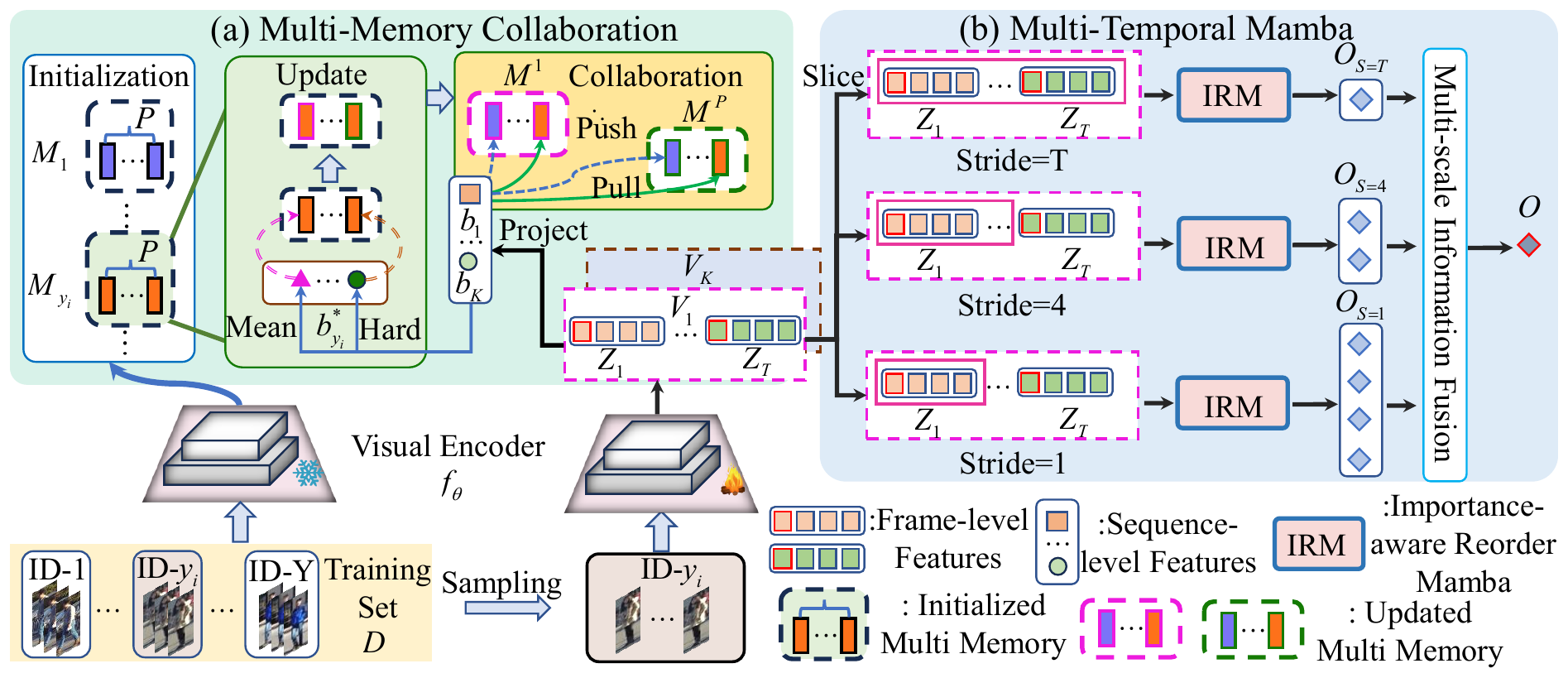
The image encoder is CLIP's ViT-B/16. Each frame passes through 12 Transformer layers to give one [CLS] token and a set of patch tokens; the [CLS] is projected into CLIP's joint space, and averaging over time across the whole video gives this tracklet's sequence feature .
Multiple memories
TF-CLIP's CLIP-Memory comes about like this. Run the pretrained image encoder over the whole training set, average the features of all of an identity's videos as that person's anchor , then use a contrastive loss to pull sequence features toward their own anchors.
CLIMB-ReID makes two changes on top of this.
First, each identity has not one memory but of them, all with the same initial value.
Second, the memories are updated by momentum instead of prompt learning. After each update of the image encoder, a feature of this person is picked from the current batch, and the memory moves toward it:
is set to 0.2, so in each update the new feature makes up 80%. There are three ways to pick : this person's average feature in the batch, the sample least like the memory, or one at random. Memories that use different picks gradually grow into different shapes. The final setting is two memories, one using the mean and one using the hardest sample.
The loss computes a contrastive loss for each memory separately and takes the average:
is the probability that, in memory , this video is assigned to its own identity. is cosine similarity, and in the denominator is the number of people in the current batch. The authors' argument is that representing the same person from different angles with several different memories shrinks intra-class variation.
The whole mechanism has no parameters to train and doesn't need the text encoder at all, which is what the paper means by prompt-free and text-free.
Reordering by importance

Mamba is a recurrent model, and the order in which tokens are fed in affects the result. Cut an image into patches and scan them row by row by position, and the patches on the person end up with background sandwiched between them, which the authors believe disturbs Mamba's local modeling.
Their answer is IRM (Importance-aware Reorder Mamba). First compute the cosine similarity between [CLS] and each patch as that patch's importance:
Then sort the patches by importance once from high to low and once from low to high, put [CLS] in front, send each order into Mamba, and add the two outputs. Patches with similar semantics end up next to each other, and the background gets chased to one end of the queue.
On a single frame, IRM uses no temporal information, so it works for image ReID as is. Mamba uses just one layer; going from 1 to 4 layers barely moves the results.
Multiple time scales
For video, the authors cut an 8-frame tracklet into segments with different strides, . Stride 1 is frame by frame, stride 4 makes a segment of every 4 frames, and stride 8 looks at the whole tracklet at once.
When the stride is greater than 1, the [CLS] tokens of the frames in a segment are first averaged into a segment [CLS], which is then scored for importance against the patches of all frames in the segment; the patches are sorted and sent into IRM. The outputs of the three scales are added and fused through a linear layer.
The training loss is the multi-memory , plus a triplet loss and a cross-entropy with label smoothing. At inference, video concatenates the original sequence feature with the multi-scale temporal feature, and images concatenate the original frame feature with the IRM feature.
Discussion
Video ReID
| Method | MARS | LS-VID | iLIDS-VID |
|---|---|---|---|
| TF-CLIP | 89.4/93.0 | 83.8/90.4 | 94.5/99.1 |
| CLIMB-ReID | 89.7/93.3 | 85.0/91.3 | 96.7/99.9 |
MARS and LS-VID are mAP/rank-1; iLIDS-VID is rank-1/rank-5.
Compared with its predecessor TF-CLIP, it gains only 0.3 on MARS, and the gap is mainly on LS-VID and iLIDS-VID. Compared with the attention-based PSTA, its MARS mAP is 3.9 higher.
Image ReID
| Method | Market-1501 | MSMT17 |
|---|---|---|
| TransReID | 89.5/95.2 | 69.4/86.2 |
| CLIP-ReID (as listed) | 90.4/95.5 | 73.2/88.0 |
| TF-CLIP | 90.4/95.7 | 73.9/88.5 |
| PCL | 91.4/95.9 | 76.1/89.8 |
| CLIMB-ReID | 92.6/96.8 | 77.8/90.5 |
Numbers are mAP/rank-1. CLIMB-ReID is the highest in the table on both datasets.
The CLIP-ReID row in the table doesn't match the numbers the CLIP-ReID paper reports for itself. CLIP-ReID's ViT version scores 89.6/95.5 and 73.4/88.7, and with SIE and OLP 90.5/95.4 and 75.8/89.7, identical across all four arXiv versions; the set 90.4/95.5, 73.2/88.0 is nowhere to be found. The TransReID row, meanwhile, is the version from the TransReID paper that uses larger-resolution input.
The text also says "our method achieves 92.6% Rank-1 accuracy on Market1501, which surpasses PCL by 1.2%". The 92.6 in the table is actually mAP; rank-1 is 96.8.
What each module contributes
| Setting | LS-VID | MSMT17 |
|---|---|---|
| Baseline (TF-CLIP's CLIP-Memory) | 80.3/87.7 | 73.9/88.5 |
| + multi-memory | 82.0/90.1 | 76.7/90.1 |
| + multi-memory + IRM | 83.2/90.7 | 77.8/90.5 |
| + multi-memory + multi-scale | 84.4/91.0 | — |
| All | 85.0/91.3 | — |
On the image dataset MSMT17, multi-memory contributes the most, adding 2.8 mAP, and IRM adds another 1.1. On video, the multiple time scales add a further 1.8 to 2.4.
When the text walks through this table, it says multi-memory brings "an improvement of 0.5% in mAP and 0.4% in Rank-1" on LS-VID. The table shows 1.7 and 2.4 (the authors managed to undersell even their own results).
How the memories are updated makes a more visible difference on LS-VID. A single picking method gives 78.7 to 79.8, mean plus hardest sample gives 82.0, and using all three actually drops to 80.4. On MARS, all seven combinations land between 88.1 and 88.6 mAP.
Scan orders were compared too. IRM's reordering beats one-directional scanning by 0.7 mAP on both LS-VID and MSMT17, and beats bidirectional or four-direction scanning by 0.4 to 0.6.
As for time scales, a single stride gives 83.2 to 83.5 mAP on LS-VID, pairs of strides give 84.3 to 84.5, and all three give 85.0.
Wouldn't pure Mamba do?
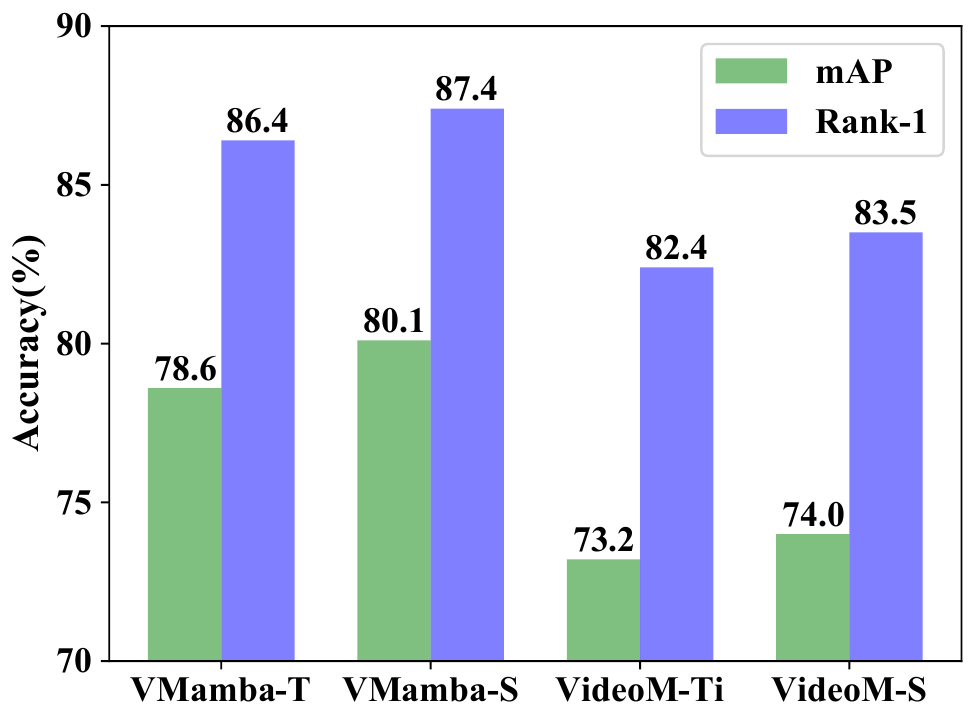
The authors also tried pure-Mamba backbones directly. On MARS, the two VMamba sizes reach 78.6 and 80.1 mAP and VideoMamba only 73.2 and 74.0, far behind CLIMB-ReID's 89.7. The paper's explanation is that ReID may need specialized pretraining.
So in this "Hybrid CLIP-Mamba Framework", the backbone is still the 12-layer CLIP ViT-B/16, and Mamba is a single layer attached after it.
Efficiency
The abstract and introduction both play up Mamba's computational efficiency, yet the paper contains no FLOPs, parameter counts, speeds or memory figures anywhere. The introduction calls self-attention's complexity exponential, and by the method section it has become quadratic; the latter is correct.
Code
The code on GitHub is MIT-licensed. The config files cover only the two image datasets, Market-1501 and MSMT17; the video code and all the weights sit behind a Baidu Netdisk link in the README, under the heading "Model&Code", with "Wait a moment." on the line below. In July 2025 someone asked the authors to put the weights on Google Drive or Dropbox, and there has been no reply to this day.
The public code differs from the paper in two places. The Market-1501 config uses batches of 8 images per person, 64 in all, while the paper says 16 people, 128 images in all. Also, the IRM branch of the image version takes detach()-ed CLIP features, so gradients don't flow back into the image encoder. IRM works more like a separate head trained on top of the CLIP features, with the features from both sides concatenated at inference.
The paper twice refers readers to the supplementary material. In April 2026 someone said in an issue that they could find neither the supplementary material on the AAAI site nor an arXiv version, and again got no reply. The README does have a badge reading Arxiv_2312.17448, which leads to a PDF inside the repo (look that number up on arXiv and you get a paper called "Tracking with Human-Intent Reasoning").
Conclusion
CLIMB-ReID does two things. One is turning TF-CLIP's single memory into several, updated by momentum, with no text and no prompt learning; the other is attaching a Mamba layer after the CLIP features, which rearranges the patches by importance and then looks at time with different strides.
Judging by the ablation table, multi-memory contributes the most on images, the multiple time scales contribute the most on video, and IRM's reordering adds another 0.6 to 1.2 on top of both.
From CLIP-ReID learning a piece of text for each person, to TF-CLIP switching to the average image feature, to the several memories here, the role of CLIP's text encoder in ReID keeps shrinking. By CLIMB-ReID, neither training nor inference uses it, and all that's left of CLIP is the image encoder.