Original paper
LocateAnything: Fast and High-Quality Vision-Language Grounding with Parallel Box Decoding
- Publication
- ECCV 2026Conference
- First submitted to arXiv
- arXiv:2605.27365
Cite this paper · BibTeX
The citation identifies the linked source version. It cites the original paper and its authors.
@misc{objectdetectionlocateanything2026,
  title = {{LocateAnything: Fast and High-Quality Vision-Language Grounding with Parallel Box Decoding}},
  author = {Shihao Wang and Shilong Liu and Yuanguo Kuang and Xinyu Wei and Yangzhou Liu and Zhiqi Li and Yunze Man and Guo Chen and Andrew Tao and Guilin Liu and Jan Kautz and Lei Zhang and Zhiding Yu},
  year = {2026},
  eprint = {2605.27365},
  archivePrefix = {arXiv},
  url = {https://arxiv.org/abs/2605.27365}
}
Give Qwen-VL a photo and ask it to "box the person wearing a white hat," and it will reply with a string of coordinates.
Vision-language models (VLMs) such as Qwen-VL and InternVL can read images as well as long instructions, and for them detection and grounding simply mean emitting coordinates as text, one piece at a time. This is a different road from detection models like Grounding DINO and YOLOE, which come with their own decoders and box regression heads. In 2025, the T-Rex2 team also released Rex-Omni, which recasts detection entirely in this token-by-token generation form.
The problem is the "one piece at a time."
This paper comes from NVIDIA. The first author, Shihao Wang, is from the Hong Kong Polytechnic University, and the second author is Shilong Liu of Grounding DINO; both did this work during internships at NVIDIA, and the corresponding author is Zhiding Yu of NVIDIA. They want a VLM to emit a whole box at once.
Defining the Problem
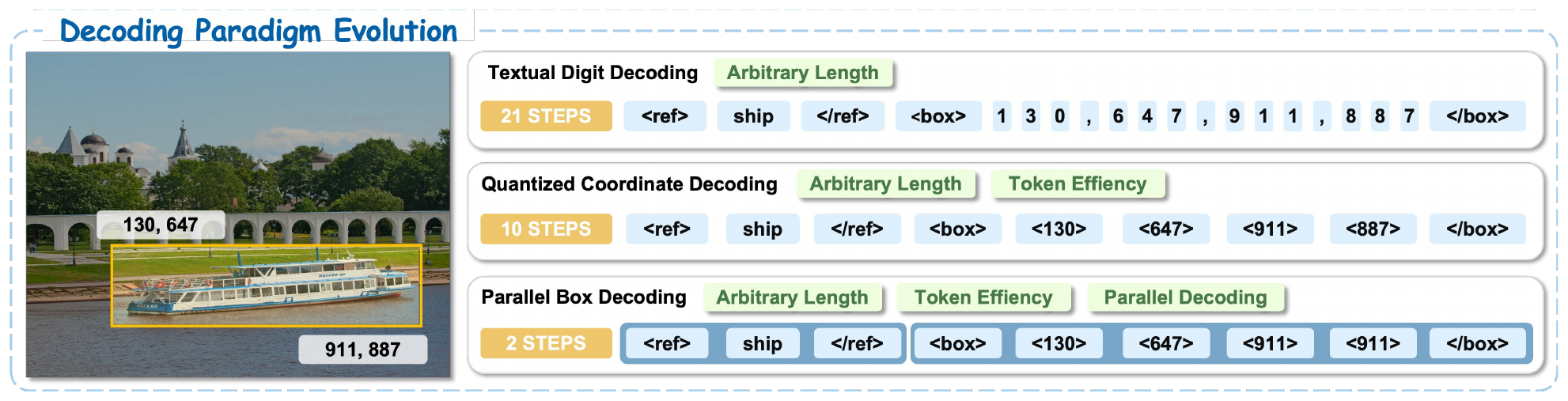
The figure above uses a boat to show how things stand. The box's two corners are (130, 647) and (911, 887), and VLMs commonly write it in one of two ways:
- Digit by digit. "130" is split into three tokens, "1", "3" and "0", and with commas and the label added, one box takes 21 steps.
- Quantized into coordinate tokens. Coordinates are normalized to 0 to 1000 and each integer is a dedicated token, so a box becomes 4 coordinates plus a label, 10 steps.
Both write first, then , then and . With 300 objects in an image, that means generating over a thousand steps, one token at a time.
Slowness is only one of the problems. The four numbers of a box are highly correlated; is always greater than , and the size of the box depends on the object. Split them into a string of independently predicted tokens, and the model can't consider them together.
The language-model field already has a way to speed this up, called multi-token prediction (MTP), which predicts several tokens in one step. The usual approach is to cut a random span out of the sequence for the model to predict in parallel, or, as diffusion language models do, to mask out some tokens at random and restore them.
The authors argue that this is a poor fit for boxes. Random spans ignore box boundaries entirely; one span might hold the last two coordinates of one box plus the first two of the next, or even cross into the next category. The model has to learn these odd, cobbled-together combinations, and what it learns ends up being spurious correlations.
Solving the Problem
One Box, One Block
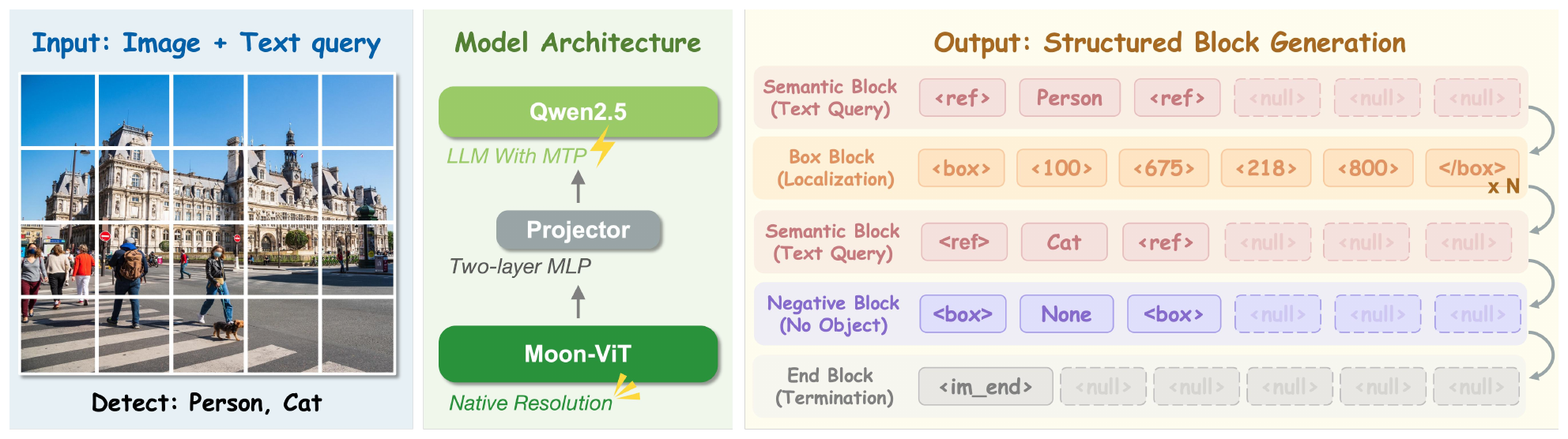
The model itself is nothing special. The image encoder is Kimi's Moon-ViT, which processes images at native resolution to keep the detail that localization needs; the language model is Qwen2.5, with a two-layer MLP in between, and the released version is labeled 3B.
What changes is the output format. The authors cut the output into blocks of fixed length , each just big enough to hold <box>, four coordinates and </box>. There are four kinds of block:
- Semantic Block: holds the object's name, such as
<ref> Person </ref>, with empty slots padded with<null>. A name that is too long is split across several blocks. - Box Block: the four coordinates of one box.
- Negative Block:
<box> None <box>, meaning the thing being searched for is not in the image. - End Block: the end.
In the figure's example, the model is asked to detect people and cats. The output is, in order, a semantic block reading Person, followed by one box block per person; then a semantic block reading Cat, and since there is no cat in the image, a negative block after it; and finally an end block.
This way, each step of the language model generates a whole block, with all 6 tokens coming out together:
Between blocks it is still autoregressive, one after another; the 6 tokens within a block are predicted simultaneously. Back in the boat example, the name takes one step and the box another, 2 steps in all.
The Same Answer, Written Twice
To predict within a block in parallel, the model has to practice "filling in 6 blanks at once" during training. But the authors didn't want this to damage the VLM's original token-by-token reasoning, so they write the same ground-truth answer twice, in two formats, joined into a single sequence:
and are the image and the query, shared by both formats; is the ordinary token-by-token sequence; is the block version, in which each block keeps only its first token and the other 5 are replaced by [mask], which the model has to fill back in at one go.
If the block size is set to 1, this format reduces to ordinary token-by-token prediction.
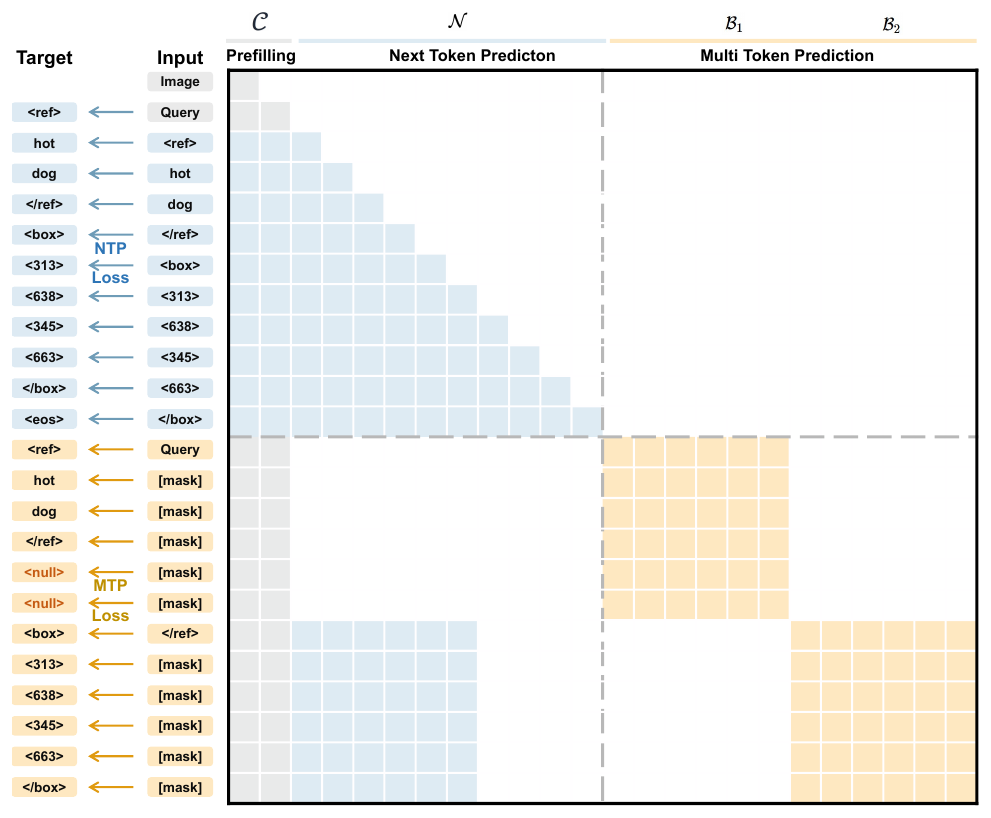
With two copies of the answer squeezed into one sequence, everything hinges on the attention mask. Take the "hot dog" example in the figure:
- The image, the query and the NTP segment use ordinary causal attention. Each token sees only the tokens before it, exactly as in the original VLM; and they can't see the MTP segment, or that would amount to peeking at the answer.
- The MTP blocks are causal with respect to each other too. The second block can see the shared context and the answer committed so far, and can't see . In the figure, reads the first few tokens of the NTP segment, because during training 's positions are still [mask]. This lets the model know which boxes it has already drawn when it generates the next one, reducing duplicate and missed boxes.
- Within a block, attention is bidirectional. The 6 positions in the same block can all see each other, so the four coordinates can refer to one another.
The training objective is simply the sum of the two segments' cross-entropies, .
When Parallel Goes Wrong, Fall Back and Write Slowly
Fill in 6 blanks at once, and sometimes you'll get them wrong.
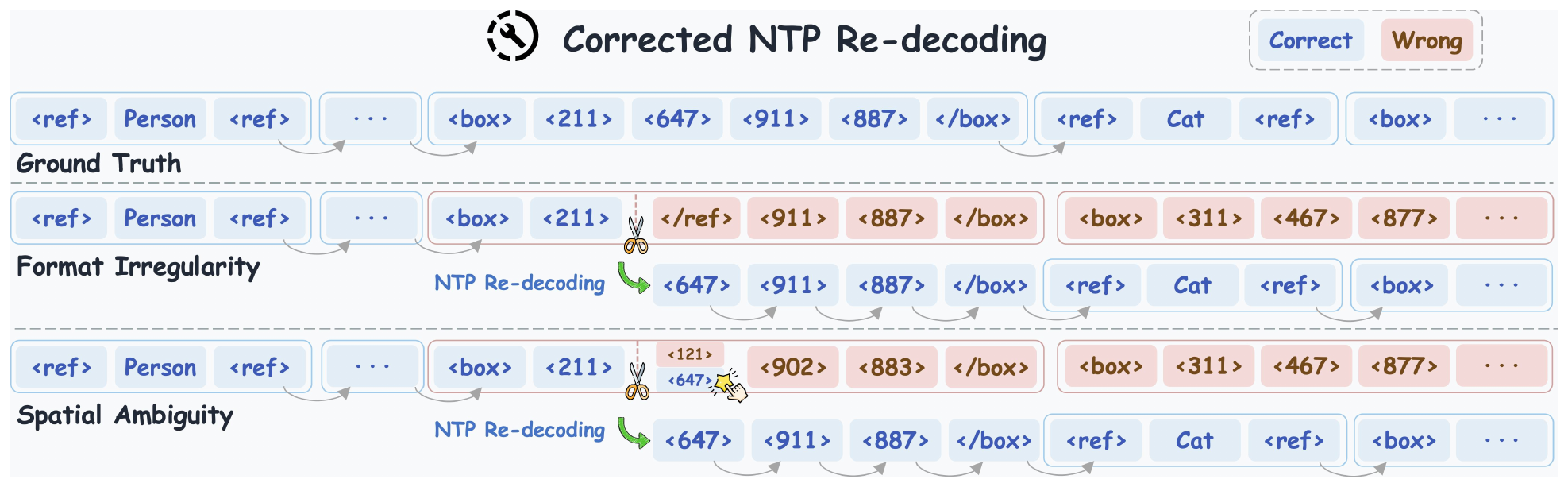
The authors identify two typical failures:
- Format irregularity. When an image holds several categories of objects, the model can't make up its mind at the boundary between categories. Should it keep boxing this category or move on to the next? The result is a block with a structural token like
</ref>mixed in, as in the second row of the figure,<box><211></ref><911><887></box>. - Spatial ambiguity. When objects are lined up neatly in a row or a grid, parallel prediction may mix up the coordinates of two objects and emit a position that falls between them.
When either situation is detected, that block is thrown away, decoding goes back to the last confirmed position, and this one block is regenerated token by token before switching back to parallel mode.
Format irregularity can be caught with a syntax check. Spatial ambiguity is judged from the probability distribution over coordinates; it triggers only when the most likely coordinate token has a probability below 0.7 and, at the same time, the largest and smallest of the top five candidate coordinates differ by more than 80 (in the 0 to 1000 coordinate space). In other words, the model is unsure, and the candidate answers are far apart.
This gives three inference modes to choose from:
- Slow: token by token throughout; the most accurate.
- Fast: parallel throughout; the fastest.
- Hybrid: parallel by default, switching to token by token only for blocks that go wrong. The paper's main results all use this mode.
Data
Besides the decoding method, the authors also put a great deal of effort into data. LocateAnything-Data has 12 million images, 138 million queries and 785 million boxes, across six kinds of task:
| Task | Queries | Share |
|---|---|---|
| General object detection | 93M | 66.9% |
| User interface (UI) element grounding | 23M | 16.5% |
| Referring expression comprehension | 10M | 7.3% |
| Text grounding (OCR) | 5M | 3.6% |
| Document layout | 5M | 3.5% |
| Pointing | 3M | 2.2% |
Compiled from Figure 6 of the paper.
Existing detection and grounding data are almost all positives, so whatever the model is asked about, it boxes something. The authors deliberately built a set of queries that "ask about things not in the image," whose answer is a negative block, so that the model learns to say "there isn't one."
The data engine reads almost like a list of 2025's open-source models. For detection data, Qwen3-VL first writes detailed descriptions with attributes and spatial relations from the category names, then Molmo predicts points, and only the points that fall inside the annotated boxes are kept; for unannotated images, Qwen3-VL writes descriptions directly, and boxes come either from Molmo plus SAM 3 or directly from Rex-Omni, with Qwen3-VL checking everything over at the end.
Training has four stages. The first two train the base VLM on caption and question-answering data only, without touching detection data at all; the third stage brings in the 138 million queries and trains for 25,000 steps on 256 GPUs; the fourth cuts general data to 20% and gives more weight to data like MOT20Det and SKU110K, with many objects per image, to strengthen dense scenes.
Discussion
Evaluation follows Rex-Omni's framework. The metric is the F1 score, computed once at each of the IoU thresholds 0.5 and 0.95, plus an average over multiple thresholds. IoU 0.95 requires the predicted box to nearly coincide with the annotated one, which shows how precise the boxes are. Speed is expressed as boxes output per second (BPS), measured on a single H100 with batch size 1.
COCO and LVIS
| Method | BPS | LVIS @0.5 | LVIS @0.95 | LVIS mean |
|---|---|---|---|---|
| Grounding DINO (Swin-T) | – | 47.7 | 22.7 | 38.8 |
| Qwen3-VL-8B | 1.0 | 61.5 | 20.2 | 44.8 |
| SEED1.5-VL | – | 65.6 | 19.5 | 46.7 |
| Rex-Omni-3B | 5.0 | 64.3 | 20.7 | 46.9 |
| LocateAnything-3B | 12.7 | 62.3 | 31.1 | 50.7 |
| Method | COCO @0.5 | COCO @0.95 | COCO mean |
|---|---|---|---|
| Grounding DINO (Swin-T) | 69.8 | 23.0 | 56.6 |
| DINO (Swin-L, closed-set) | 75.6 | 25.4 | 62.1 |
| Qwen3-VL-8B | 62.8 | 14.0 | 45.7 |
| SEED1.5-VL | 71.3 | 14.3 | 51.4 |
| Rex-Omni-3B | 72.0 | 15.9 | 52.9 |
| LocateAnything-3B | 70.1 | 19.3 | 54.7 |
Compiled from Table 1 of the paper, F1@IoU; BPS is the number of boxes output per second.
Start with the comparison among VLMs. At the loose IoU 0.5, LocateAnything actually loses to Rex-Omni and SEED1.5-VL; but at the strict IoU 0.95, LVIS jumps from 20.7 to 31.1 and COCO rises from 15.9 to 19.3. It doesn't necessarily find more objects, but its boxes are far more precise. Its speed is 2.5 times Rex-Omni's and more than ten times Qwen3-VL's.
Now compare with dedicated detectors. On COCO, the closed-set DINO averages 62.1, and even the open-set Grounding DINO (Swin-T) gets 56.6, both higher than LocateAnything. In scenes of common objects like COCO, dedicated detectors are still stronger. LVIS's long-tail categories go the other way, with Grounding DINO at only 38.8 and LocateAnything at 50.7.
Other Tasks
Results on the other tasks are mixed:
- Dense objects. VisDrone averages 39.9, above Rex-Omni's 35.8; Dense200 is 58.7, about the same as Rex-Omni's 58.3, but at IoU 0.95 it rises from 10.3 to 18.5.
- UI grounding. ScreenSpot-Pro averages 60.3, above the 32B GUI-Owl (58.0); this is the second-largest category in the training data, making up 16.5%.
- Document layout. DocLayNet is 76.8, behind the specialized DocLayout-YOLO (81.1); M6Doc is 70.1, far above Rex-Omni's 55.6.
- Referring expressions. RefCOCOg is 76.7 and 77.6, while DeepSeek-VL2-Small gets 81.4 and 81.6; HumanRef is 78.7, against 81.6 for SEED1.5-VL. It doesn't lead on this one.
Ablation: Decoding Method
To rule out the influence of the 138 million queries, the ablations are all trained on COCO only:
| Method | BPS | F1 |
|---|---|---|
| Digit by digit (Textual) | 1.3 | 49.1 |
| Quantized coordinates (Quantized) | 3.9 | 50.1 |
| SDLM, block size 4/6/8 | 5.2/5.5/6.7 | 46.5/46.1/45.8 |
| Block Diffusion, block size 6 | 4.7 | 44.8 |
| PBD (Slow) | 3.9 | 52.1 |
| PBD (Fast) | 16.9 | 49.6 |
| PBD (Hybrid) | 13.2 | 51.6 |
Compiled from Table 6 (a)(b) of the paper, trained on COCO only.
Three observations from the table:
- PBD's Slow mode is the most accurate. It also decodes token by token, at the same speed, yet scores 2.0 higher than quantized coordinates. The only difference is the block version of the answer added during training, and the authors believe the structured supervision of boxes helps in itself.
- Generic MTP methods are both slow and inaccurate. SDLM and Block Diffusion are only slightly faster, yet their F1 is lower than token by token, and the larger the block, the worse. PBD's Fast mode is more than 4 times as fast, with F1 still slightly below quantized coordinates, by 0.5.
- Hybrid recovers most of the accuracy. Speed drops from 16.9 to 13.2, and F1 climbs back from 49.6 to 51.6.
Both losses are needed too. Training only the token-by-token part gives 50.1 in Slow mode; training only the block part gives 47.2 in Fast mode; training both together raises these to 52.1 and 49.6 respectively.
Ablation: Box Order
Since blocks are autoregressive with respect to one another, multiple boxes always need some order. The authors tried four orderings, and the gaps in F1 are startlingly large:
- By the top-left corner's x, then y: 52.1
- By the distance from the box center to the origin: 35
- By area, from large to small: 28
- Random: 25.1
The best is double the worst. When generating the next box, the model relies on "how far the earlier boxes have gotten," and once the order is scrambled, that cue is gone.
Speed and Box Count
The more boxes there are, the clearer the advantage of parallel decoding. As the authors raised the number of boxes to output from 20 to 300, the generation time of token-by-token methods shot up, while the throughput of parallel decoding rose from 12 boxes per second to about 25, a speedup of 2 to 6 times.
The Cost of the Three Modes
The appendix lists the three modes separately for each task:
| Task | Fast (15.3 BPS) | Hybrid (12.7 BPS) | Slow (4.3 BPS) |
|---|---|---|---|
| COCO | 52.2 | 54.7 | 55.1 |
| Dense200 | 46.8 | 61.3 | 61.5 |
| HierText (text) | 28.8 | 29.1 | 43.2 |
| SROIE (receipts) | 38.8 | 39.3 | 64.4 |
| DocLayNet | 67.2 | 77.7 | 80.4 |
Compiled from Table 12 of the paper, F1@mIoU.
On dense objects, Hybrid's fallback works well, pulling Dense200 back from 46.8 to 61.3, nearly matching Slow. On text grounding, though, Hybrid barely helps; on SROIE receipts it drops from Slow's 64.4 to 39.3. Hybrid and Fast score almost the same, so on this kind of data the fallback either rarely triggers or can't rescue things when it does; the paper doesn't analyze why. For OCR, just stick with Slow mode.
The authors also carried the same approach over to Qwen3-VL-4B, trained on COCO only. Token by token, it originally gets 50.8 F1 at 2.8 BPS; with PBD in Hybrid mode, it gets 52.0 F1 at 9.4 BPS, so the effect doesn't depend on a particular backbone.
Limitations
The authors give only one limitation. The model is currently trained with supervised fine-tuning alone, and reinforcement learning could be added in the future to improve the block-level decoding policy and reduce how often it has to fall back to token by token.
The model weights are on Hugging Face (nvidia/LocateAnything-3B), for research use only; the LocateAnything-Data dataset was released later as well.
Conclusion
A box's four coordinates come as one package anyway, so the authors simply have the model generate a whole box at once. That brings two gains, a speed 2.5 times Rex-Omni's and better accuracy than other VLMs at the demanding IoU 0.95; the costs are that it still can't catch dedicated detectors on common objects, and Fast mode loses a lot on text and dense scenes.
If you use it, pick the mode by task. For dense objects, Hybrid is enough and nearly matches Slow; for neatly arranged things like text and receipts, go straight to Slow. When fine-tuning on your own data, remember to fix the box order from top-left to bottom-right; in the paper, random ordering keeps only half the score.
GroundAnything, from September 2026, argues instead that grounding output has no inherent left-to-right order to begin with, and switches to a bidirectional diffusion model that denoises everything together. It averages 61.75% across 30 grounding benchmarks, and the baseline it compares against is none other than LocateAnything's Fast mode, at 53.32%.