Original paper
SigLIP 2: Multilingual Vision-Language Encoders with Improved Semantic Understanding, Localization, and Dense Features
- Publication
- Publication venue not yet verified
- First submitted to arXiv
- arXiv:2502.14786
Cite this paper · BibTeX
The citation identifies the linked source version. It cites the original paper and its authors.
@misc{multimodalitysiglip22025,
  title = {{SigLIP 2: Multilingual Vision-Language Encoders with Improved Semantic Understanding, Localization, and Dense Features}},
  author = {Michael Tschannen and Alexey Gritsenko and Xiao Wang and Muhammad Ferjad Naeem and Ibrahim Alabdulmohsin and Nikhil Parthasarathy and Talfan Evans and Lucas Beyer and Ye Xia and Basil Mustafa and Olivier Hénaff and Jeremiah Harmsen and Andreas Steiner and Xiaohua Zhai},
  year = {2025},
  eprint = {2502.14786},
  archivePrefix = {arXiv},
  url = {https://arxiv.org/abs/2502.14786}
}
After CLIP, image–text contrastive learning became the standard way to train vision encoders. Its image encoder can be used directly for zero-shot classification and image–text retrieval, and attached to a large language model it serves as the eyes of most of today's vision-language models.
In 2023, Google's SigLIP replaced CLIP's softmax contrastive loss with a sigmoid loss, which made training cheaper and the results better, and many open-source vision-language models adopted it as their image encoder.
Over the next two years, researchers proposed a stream of improvements: regenerating image captions, adding self-supervised image losses, attaching a small decoder during training for caption generation and object localization. Each of them worked. But these improvements were scattered across different papers and models, and most open-source weights still followed CLIP's original recipe.
Michael Tschannen, Alexey Gritsenko, Xiao Wang, Xiaohua Zhai and colleagues at Google DeepMind took the direct route, combining these proven tricks into one recipe, training a whole family of new models with it, and open-sourcing all of them.
Defining the problem
The strength of CLIP-style models is high-level semantics; they can tell you what's in an image. Their weaknesses are just as clear.
The first is localization. Image–text contrast aligns only at the level of the whole image, so the model doesn't really know where "the dog on the left" is in the frame. The second is dense features. Using CLIP's patch features for segmentation or depth estimation works far worse than self-supervised models like DINO. The third is language and culture. Most models are trained only on English data, perform poorly on other languages and on images from other regions, and pick up the social biases in the data along the way.
SigLIP 2 aims to fill in these gaps without giving up the core capabilities, while staying fully compatible with the first generation. The architecture is unchanged, so existing users can upgrade directly by just swapping the weights and the tokenizer.
Solving the problem
The starting point: the sigmoid loss
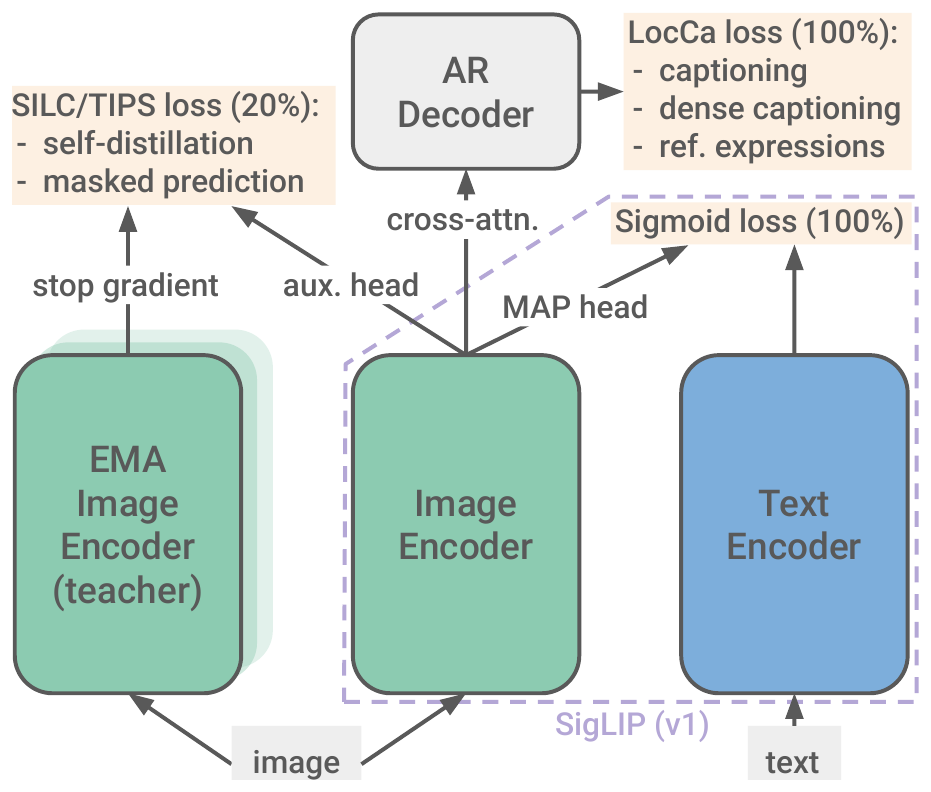
SigLIP and CLIP differ in the loss function. CLIP applies a softmax over a batch's similarity matrix, so each image has to pick out the one correct sentence from all the texts. SigLIP instead treats every image–text pair as its own binary classification, labeling matched pairs 1 and unmatched pairs 0, and trains with a sigmoid and logistic regression. There's no need to normalize over the whole batch, so very large batches are also cheaper.
SigLIP 2 keeps this loss and uses it throughout training.
Adding a decoder
The first addition is LocCa. On the image encoder's patch features before pooling, a Transformer decoder with cross-attention is attached and trained on three things:
- generating a caption for the whole image;
- given a referring expression, such as "the person in red on the left," predicting its box;
- given a box, generating a caption for that region.
The pairs of regions and captions are generated automatically. Phrases are first extracted from the alt-text, and then an open-vocabulary detector boxes them. When generating a full caption, half the time it switches to parallel prediction, where all the words are predicted at once from mask tokens instead of being generated one word after another. This decoder is only a training aid and isn't released with the model. It forces the image encoder's patch features to carry location and text information, which helps localization and OCR in particular.
The last 20%: self-supervision
The second addition is self-supervised losses, borrowed from two works, SILC and TIPS, and conceptually the same as the DINO series.
One is local-to-global self-distillation. The student sees only a small crop of the image, and its representation is made to align with the representation of the teacher, which sees the whole image. The other is masked prediction. Half of the patches in the student's input are replaced with masks, and the student has to predict the teacher's features at the masked positions. The teacher is an exponential moving average of the student's parameters.
These two losses are added only after training reaches 80%, and they use images that have gone through extra data augmentation; the sigmoid and LocCa losses still use the original images, so that augmentation doesn't break the image–text alignment. The authors say this is to keep the extra computation and memory cost under control.
Data and training
The training data is Google's WebLI, with 10 billion images and 12 billion alt-texts covering 109 languages. The authors draw 90% of the image–text pairs from English web pages and 10% from non-English ones, balancing English benchmarks against multilingual ability; they also apply a set of debiasing filters that reduce spurious associations between sensitive attributes such as gender and objects. The tokenizer is switched to Gemma's multilingual tokenizer, with a vocabulary of 256k.
The batch size is 32k, the model sees 40 billion samples in total, and up to 2048 TPUv5e chips are used. The models come in four sizes: ViT-B (86 million parameters), L (300 million), So400m (400 million) and g (1 billion).
Different resolutions and NaFlex
The fixed-resolution versions are made by adjusting the positional embeddings to the target resolution at 95% of training and then training to completion.
There is also a NaFlex version. It combines FlexiViT's "one model supporting multiple sequence lengths" with NaViT's "keeping the original aspect ratio," resizing the image to the grid size that is closest to the original proportions without exceeding the specified number of tokens. A single checkpoint handles inputs from 128 to 1024 tokens, which is especially useful for images with unusual aspect ratios such as documents and screenshots. To keep complexity down, the NaFlex version doesn't include self-distillation or masked prediction. The authors also warn that it interpolates well between the sequence lengths used in training, but doesn't do so well outside that range.
The two smallest models, the B sizes, finally also go through "distillation via data" with a method called ACID. At each step, from a candidate batch twice the size, it picks the samples the teacher finds easy and the student finds hard to train on; the teacher is a So400m fine-tuned on high-quality data.
Discussion
Core capabilities
| Model | ImageNet 0-shot | XM3600 T→I |
|---|---|---|
| SigLIP B/16 | 76.2 | 22.4 |
| SigLIP 2 B/16 | 78.2 | 40.3 |
| SigLIP L/16 | 80.5 | 30.9 |
| SigLIP 2 L/16 | 82.5 | 46.5 |
| mSigLIP So400m/16 | 80.8 | 50.0 |
| SigLIP 2 So400m/16 | 83.4 | 48.1 |
At the same size and resolution, ImageNet zero-shot goes up by 0.9 to 2.4 points. The B size improves the most, which the authors credit to the final ACID distillation.
On the multilingual side, Crossmodal-3600 covers 36 languages, and SigLIP 2's text-to-image retrieval recall rises sharply, nearly doubling for the B size. mSigLIP, trained only on multilingual data, is still slightly ahead here, but its English ability is clearly weaker, with 2.6 points less on ImageNet zero-shot.
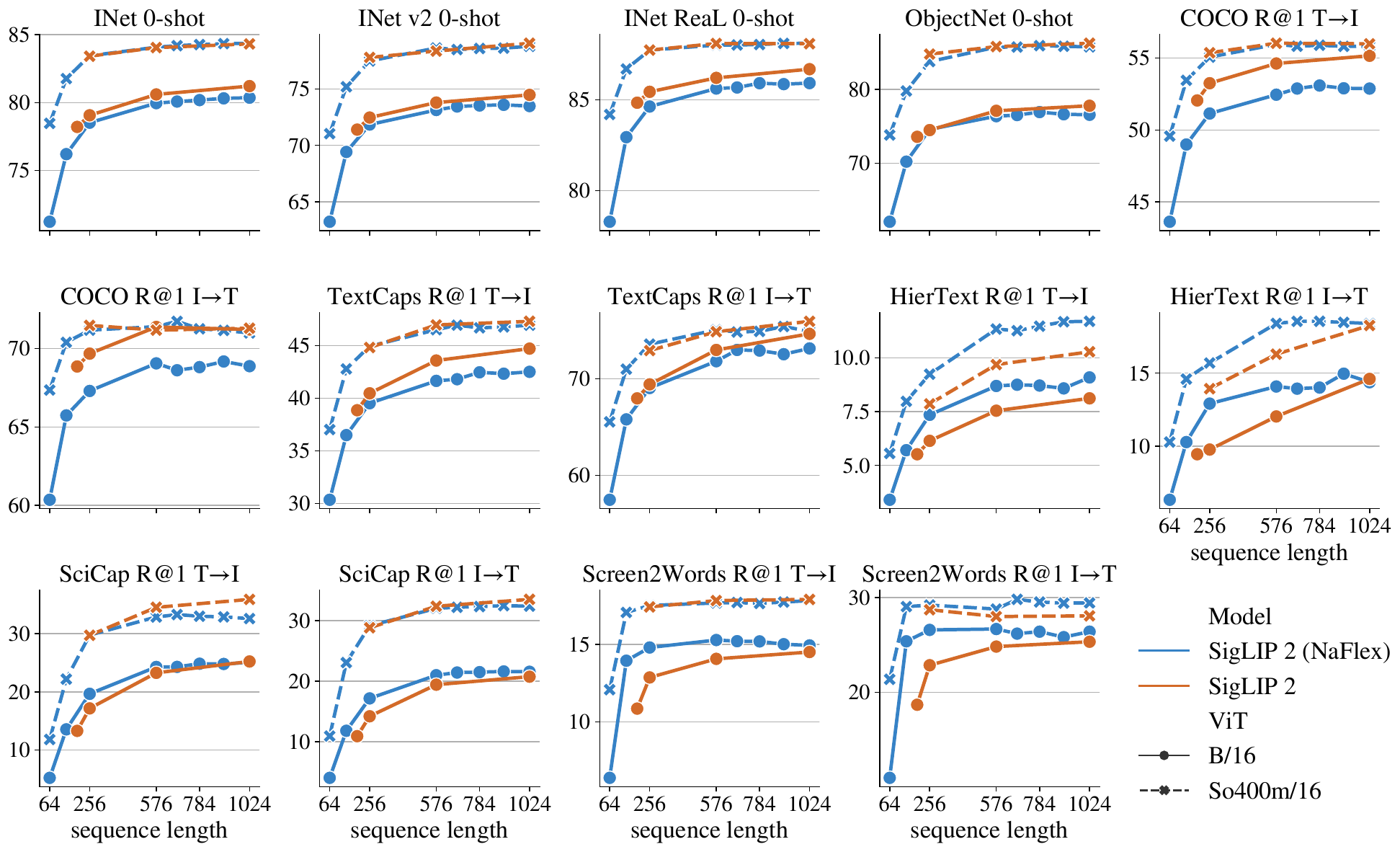
Compared with the standard version, NaFlex is mostly better on retrieval tasks involving documents and screenshots, and the shorter the sequence, the clearer the gap, because squashing the aspect ratio hurts more. On natural images, the standard B-size version is actually better, while for So400m the two are about equal.
Attached to Gemma 2 2B to build a vision-language model, SigLIP 2 beats SigLIP almost across the board on more than twenty downstream tasks, and the L size also beats Apple's AIMv2.
Localization and dense features
| Task | SigLIP | SigLIP 2 |
|---|---|---|
| RefCOCO val, L/16, 256 tokens | 67.33 | 86.04 |
| ADE20k linear seg., So400m/14, 224px | 37.6 | 41.8 |
| NYUv2 depth RMSE ↓, So400m/14, 224px | 0.576 | 0.493 |
| LVIS rare-class AP, So400m/14 | 40.9 | 42.3 |
The biggest improvement is in referring expression comprehension, nearly 19 points, almost entirely thanks to the LocCa decoder. Only LocCa itself, which uses the same decoder but is trained on English data alone, is still slightly higher.
Dense features improve too. Linear segmentation on ADE20k gains 4 points, and the depth estimation error goes down. That's against the CLIP family, though. Half a year later, in [25.08] DINOv3: Trained into a Blur, the largest SigLIP 2 model, g, scores 42.7 on ADE20k linear segmentation against DINOv3's 55.9; the dense features of image–text models still can't catch up with dedicated self-supervised models.
Culture and bias
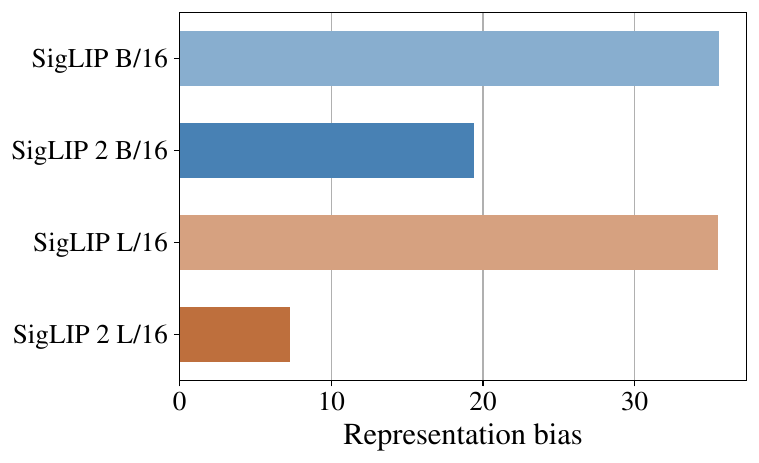
The multilingual and debiased data also show up in fairness. The authors test on datasets such as Dollar Street and GeoDE, with images collected from households of different incomes around the world. Taking L/16 as an example, region geolocalization accuracy on GeoDE rises from 36.2% to 44.4%, and zero-shot classification on Dollar Street from 52.1% to 55.2%.
The improvement in representation bias is even more pronounced. The first-generation SigLIP L/16 has a bias of about 35.5%, meaning that given a photo of a random object unrelated to gender, it associates the photo with "men" more than 85% of the time; SigLIP 2 at the same size is down to just 7.3%.
Conclusion
SigLIP 2 proposes no new loss or architecture. It brings the sigmoid image–text loss, LocCa's captioning and localization decoder, SILC's and TIPS's self-supervision, ACID's data distillation and NaFlex's variable resolution, plus multilingual data and debiasing filters, into a single training pipeline.
The result is a set of open-source encoders that are fully compatible with the first generation and better in every respect. From 86 million to 1 billion parameters, fixed-resolution and NaFlex, there are more than thirty official versions on Hugging Face alone, ready to use once you swap in the weights and the tokenizer. This kind of work, gathering the good ideas scattered across separate papers and turning them into a set of models everyone can pick up and use directly, often takes more effort than proposing a new idea.