Original paper
MOTIP2: Spatial Priors for End-to-End Multi-Object Tracking
- Publication
- Publication venue not yet verified
- First submitted to arXiv
- arXiv:2610.10391
Cite this paper · BibTeX
The citation identifies the linked source version. It cites the original paper and its authors.
@misc{multiobjecttrackingmotip22026,
  title = {{MOTIP2: Spatial Priors for End-to-End Multi-Object Tracking}},
  author = {Benoît Roussel and Damien Bouet and Liming Chen and Pierre Perrault},
  year = {2026},
  eprint = {2610.10391},
  archivePrefix = {arXiv},
  url = {https://arxiv.org/abs/2610.10391}
}
MOTIP rewrote multi-object tracking as a classification problem. A detector finds everyone in each frame, and an ID decoder looks back over the trajectories of the past few dozen frames to pick a number for each detection from an "ID dictionary." No Kalman filter, no IoU matching; association is left entirely to attention to learn.
On datasets like DanceTrack, where a crowd of people dress identically and move unpredictably, end-to-end trackers of this kind have caught up with, and even overtaken, traditional tracking-by-detection. But now and then they make a kind of mistake that traditional trackers almost never make.
A person standing on the left of the image in one frame is given the same number as someone on the right in the next. Nobody is occluded, and the two people are half the image apart.
Benoît Roussel, Damien Bouet, Liming Chen and Pierre Perrault of École Centrale de Lyon and IDEMIA in France argue that the problem lies in association having no spatial constraint at all.
Defining the problem
In traditional tracking-by-detection, the spatial constraint is built in. A Kalman filter predicts roughly where each track will be in the next frame, the IoU cost makes matches that travel too far expensive, and appearance features are only compared within a plausible range of positions. These rules need no training data at all, and they block an implausible match the moment it appears.
End-to-end trackers strip out all of these handcrafted rules and expect attention to learn them on its own. But annotated tracking data is scarce, the learning is incomplete, and so you get errors like the one above, a jump halfway across the image.
The authors divide these errors into two kinds with the same cause.
The first is the long-range jump, like the example at the start. The cross-entropy loss used for classification penalizes "mistaking someone at the other end of the image" exactly as hard as "mistaking the person right next to you," and the gradient carries no geometric information at all.
The second is an identity swap when people cross paths or occlude each other. This is the genuinely hard case, yet MOTIP's training rarely gives the model practice at it.
MOTIP's training has a data augmentation that randomly picks some objects and shuffles their identities, so the ID decoder learns to recover from a faulty history. The trouble is that random shuffling ignores position completely, and the pairs it picks are almost always two people far apart. The people who actually get confused at inference are those close together, crossing paths.
Solving the problem
The authors propose three spatial priors, placed at three stages, in the data, the loss and the representation. All three rest on the same assumption, that the closer two people are in space, the more likely they are to be confused, and the more they should be compared.
Data: swap only people who are close
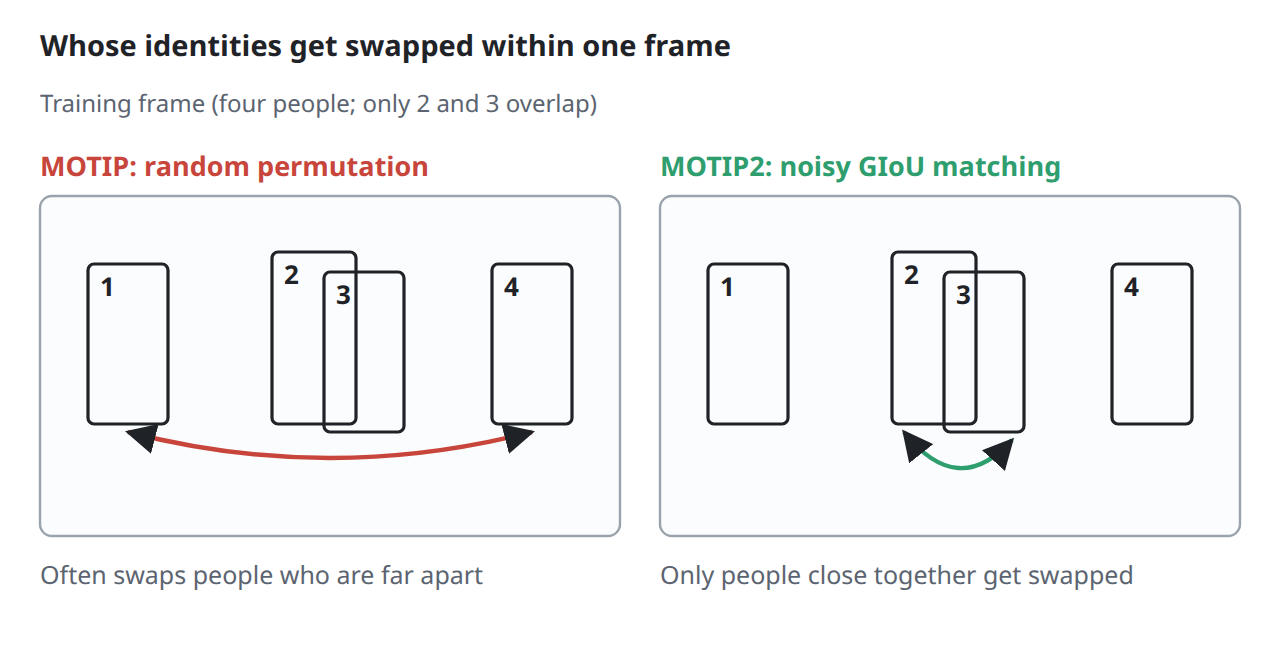
MOTIP2 keeps the step of picking objects at random and changes only "how to swap." GIoU is computed between every pair of picked objects to get an affinity matrix , Gaussian noise is added, and the Hungarian algorithm finds the permutation with the largest total affinity:
Every object's GIoU with itself is 1, so without noise the best permutation is to swap nobody. Only when a neighbor overlaps an object enough that, with the noise added, it has a chance of beating the object itself do the two get swapped. Two people far apart have a negative GIoU and almost never get swapped. decides "how close counts as confusable," and all three datasets use the same value, 0.5, with no per-dataset tuning.
As goes to infinity, the noise overwhelms everything, and the method degenerates back into MOTIP's original random permutation.
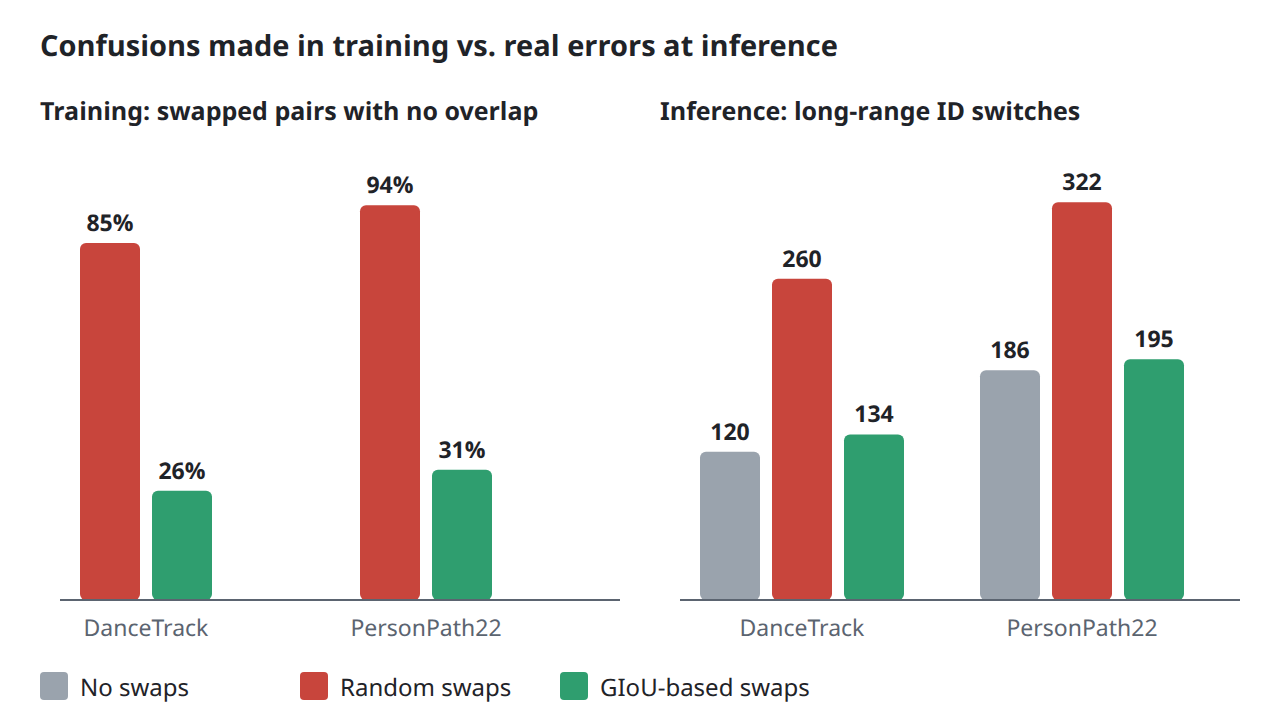
The appendix statistics are blunt. Of the swaps random permutation creates, 85% to 94% are between two people who don't overlap at all; with GIoU-based swapping, that falls to around 30%. As for long-range ID switches at inference, random permutation actually produces more than no augmentation at all, 2.2 times as many on DanceTrack and 1.7 times on PersonPath22.
Loss: mistaking someone far away costs more
The second prior goes into the loss. The ID decoder outputs a set of identity probabilities for each detection, and on top of cross-entropy, the authors add two distance-weighted losses:
is this detection's box, and is the ground-truth box of identity in this frame. The farther away the identity the model gives probability to, the larger the loss. The sum runs only over identities present in this frame plus the "newborn" class; the newborn class has no corresponding object, so the detection's own ground-truth box stands in. The cross-entropy, GIoU and L1 terms are weighted 1, 2 and 5, taken straight from DEIM's detection loss.
The gradient through is stopped, so these two terms affect only the identity prediction and don't reach back to interfere with the detector's box regression.
Representation: bring the position along
The third is the lightest. In DETR-style detectors, every query has a positional encoding computed from its box, which guides attention toward the corresponding region of the image. But when MOTIP hands detections to the ID decoder, it brings along only the content features, and the positional encoding is dropped.
MOTIP2 adds this positional encoding back onto every token entering the ID decoder. No added parameters and no new supervision; it simply keeps information the detector had already computed.
Other changes
The detector changes from Deformable DETR to the real-time detector DEIM. By the authors' measurements, more than 80% of MOTIP's inference time goes to the detector, and Deformable DETR's deformable attention has no standard TensorRT implementation, so it can't be deployed on inference GPUs. With DEIM, five sizes from N to X make up a whole model family.
The ID decoder gets two adjustments as well. The temporal positional encoding switches to RoPE, with the timescale doubled at inference to match the average interval of the random frame rates used in training. Inference also adds track confirmation, where a new track only becomes official after being assigned consistently for two consecutive frames; otherwise it's dropped and the ID slot it held is released.
Discussion
Three datasets
| Dataset | Metric | MOTIP | FDTA | MOTIP2-L |
|---|---|---|---|---|
| DanceTrack | HOTA | 69.6 | 71.7 | 73.4 |
| DanceTrack | AssA | 60.4 | 63.5 | 64.9 |
| SportsMOT | HOTA | 72.6 | 74.2 | 76.0 |
FDTA, another method built on MOTIP, is the authors' main point of comparison. The larger MOTIP2-X reaches 74.8 HOTA on DanceTrack, higher even than FDTA trained with extra data; trained on the validation set as well, it reaches 77.1.
The authors separate the contributions of DEIM and the three priors cleanly. With DEIM kept and only the three spatial priors switched off, MOTIP2-L drops to 71.5, below FDTA, and almost all of the drop is in association accuracy, with detection accuracy only 0.1 lower. In other words, the margin over earlier work comes mainly from the spatial priors, not from a stronger detector.
PersonPath22 is a large real-world dataset covering indoor and outdoor scenes, all kinds of weather and a range of crowd densities. There's no HOTA from other end-to-end methods to compare with here; MOTIP2-L's IDF1 is 71.1, above the best dedicated tracker's 69.4, and its MOTA is tied.
The appendix also has a MOT17 table. On this dataset, MOTIP2-L's HOTA is 60.4, a little above MOTIP but below another end-to-end method, FastTrackTr, at 62.4, and further still from the best tracking-by-detection method at 66.6. The "new state of the art" in the abstract refers to the three datasets in the main text.
Speed
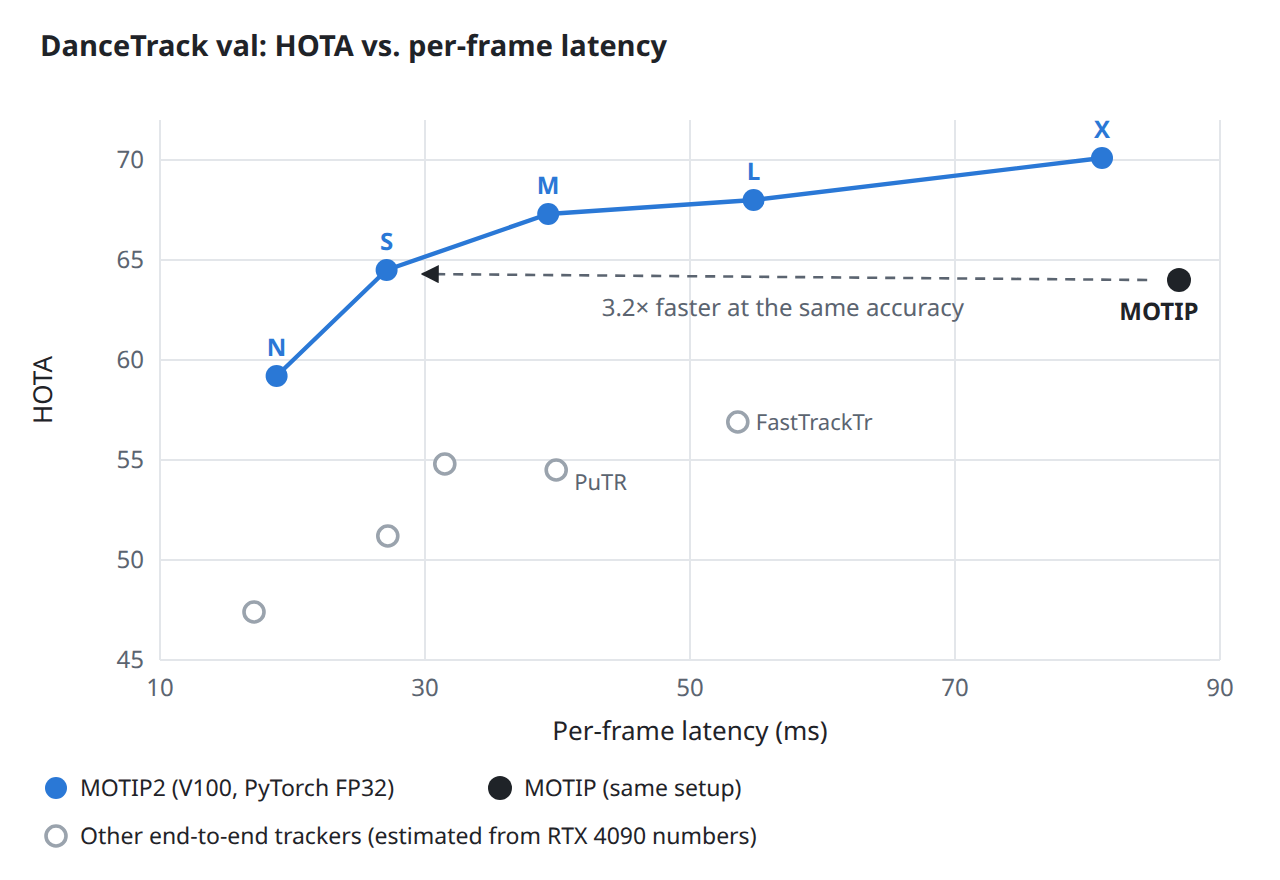
On the same V100 in PyTorch FP32, MOTIP2-S takes 27.1 ms per frame at 64.5 HOTA; MOTIP takes 86.9 ms at 64.0, so the accuracy is the same and the speed 3.2 times higher. Exported to TensorRT, MOTIP2-S needs only 10.1 ms on a T4, about 99 frames per second.
Note that the latencies of FastTrackTr and PuTR in the figure weren't measured by the authors. They're converted from numbers others measured on an RTX 4090, multiplied by MOTIP's speed ratio between the two cards, and the authors themselves say they're only indicative.
Ablations
| Setting | PersonPath22 HOTA | DanceTrack HOTA |
|---|---|---|
| Full MOTIP2-S | 61.6 | 64.5 |
| Swaps back to random permutation | 56.1 | 63.7 |
| No identity swaps at all | 59.5 | 60.1 |
| Without the spatial ID loss | 61.4 | 63.5 |
| Without the positional encoding | 61.6 | 64.0 |
The PersonPath22 column is a surprise. Switching the identity swaps back to MOTIP's random permutation drops HOTA to 56.1, 3.4 points below the 59.5 with no augmentation at all, and drags detection accuracy down with it. The training curves in the appendix show that random permutation makes joint training unstable. In PersonPath22, people are spread across the whole image, so random permutation creates almost nothing but long-range swaps that could never happen, and the model is trained to handle situations that never arise.
DanceTrack is a different story. The dancers are packed together, so two people picked at random are usually close already, and random permutation is only 0.8 behind GIoU-based swapping. Conversely, on DanceTrack the loss and positional-encoding priors are the more useful ones, because everyone looks the same, appearance can't help, and position becomes an important cue.
The positional encoding contributes very little and makes almost no difference on PersonPath22. Then again, it adds no parameters at all, and the authors expected its effect to be limited from the start.
Separately, raising the track confirmation threshold from 1 frame to 3 consecutive frames cuts ID switches on DanceTrack by 28%, with HOTA almost unchanged.
Limitations
The paper has no public code so far, nor any link to code.
In their conclusion, the authors point out a weakness of the method itself. All three priors assume that closer means more likely to be the same person, so when one person leaves the frame at some spot just as another walks in at the same spot, proximity will hand the departing person's identity to the newcomer.
Conclusion
MOTIP2 gives end-to-end trackers back, in three ways, the spatial common sense that traditional trackers get from handcrafted rules. The training data creates confusion only between nearby objects, the loss makes mistaking someone far away more costly, and the position the detector has already computed is carried all the way into the identity decoder. Inference still has no post-processing matching step of any kind.
The most convincing evidence is the comparison on PersonPath22. MOTIP's seemingly harmless random identity swapping turns out, in scenes where people are widely spread out, to be worse than doing nothing at all.
Add the speed that comes with switching to DEIM, and the smallest versions already run in real time; MOTIP2-S does nearly a hundred frames per second on a T4.