Original paper
YOWOv3: An Efficient and Generalized Framework for Human Action Detection and Recognition
- Publication
- IEEE Intelligent Systems 2026Journal
- First submitted to arXiv
- arXiv:2408.02623
Cite this paper · BibTeX
The citation identifies the linked source version. It cites the original paper and its authors.
@misc{actionrecognitionyowov32024,
  title = {{YOWOv3: An Efficient and Generalized Framework for Human Action Detection and Recognition}},
  author = {Nguyen Dang Duc Manh and Duong Viet Hang and Jia Ching Wang and Bui Duc Nhan},
  year = {2024},
  eprint = {2408.02623},
  archivePrefix = {arXiv},
  url = {https://arxiv.org/abs/2408.02623}
}
Spatio-temporal action detection (STAD) has to answer three questions at once: who in the frame is doing an action, marked with a box; in which frame; and what the action is.
In recent years the leaderboards for this task have been dominated by large Vision Transformers. The paper opens with two examples: Hiera has more than 600 million parameters, and VideoMAE V2 has a billion, with the latter taking 60 A100s two weeks to train. The results are very good, but running them in real time next to a surveillance camera is all but impossible.
The other line of work is the YOWO series. YOWO, from 2019, uses a 2D CNN to look at the key frame and a 3D CNN to look at the whole clip, fuses the two streams of features and outputs boxes and actions in one go, a single-stage architecture that can run in real time. YOWOv2, from 2023, added a feature pyramid and an anchor-free detection head; accuracy went up, but so did computation.
Nguyen Dang Duc Manh, Duong Viet Hang, Jia Ching Wang and Bui Duc Nhan, from the University of Information Technology in Ho Chi Minh City, Vietnam, and National Central University in Taiwan, propose YOWOv3. The paper says bluntly that the authors of YOWO and YOWOv2 no longer maintain their code, the many questions the community has raised go unanswered, and the field needs a new framework that someone actually looks after.
Defining the problem
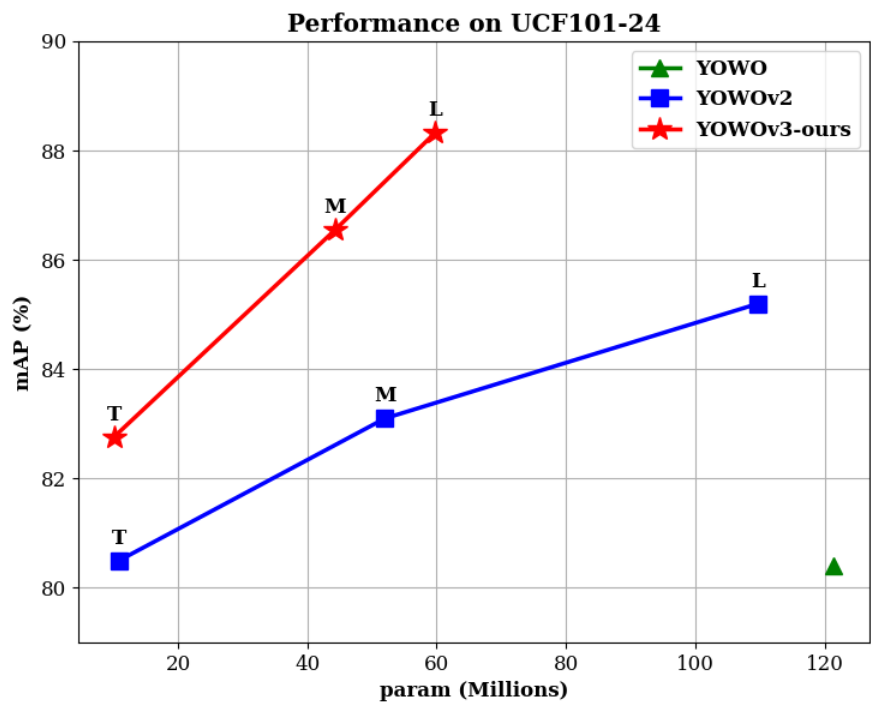
This is how the authors assess the previous two generations. YOWO pioneered single-stage STAD, but its architecture is too simple and the techniques it uses have aged. YOWOv2 brought the parameter count down, but the architecture got more complicated, and the GFLOPs of its large version are actually about 20% higher than YOWO's, which runs against the original aim of being "lightweight and real-time."
So YOWOv3 has two goals. One is to beat YOWOv2's accuracy with the same or less computation; the other is to build a framework where components are easy to swap and experiments easy to run, and to provide a range of pretrained weights that people can fine-tune directly.
Solving the problem
Two paths
The architecture is still two-stream.
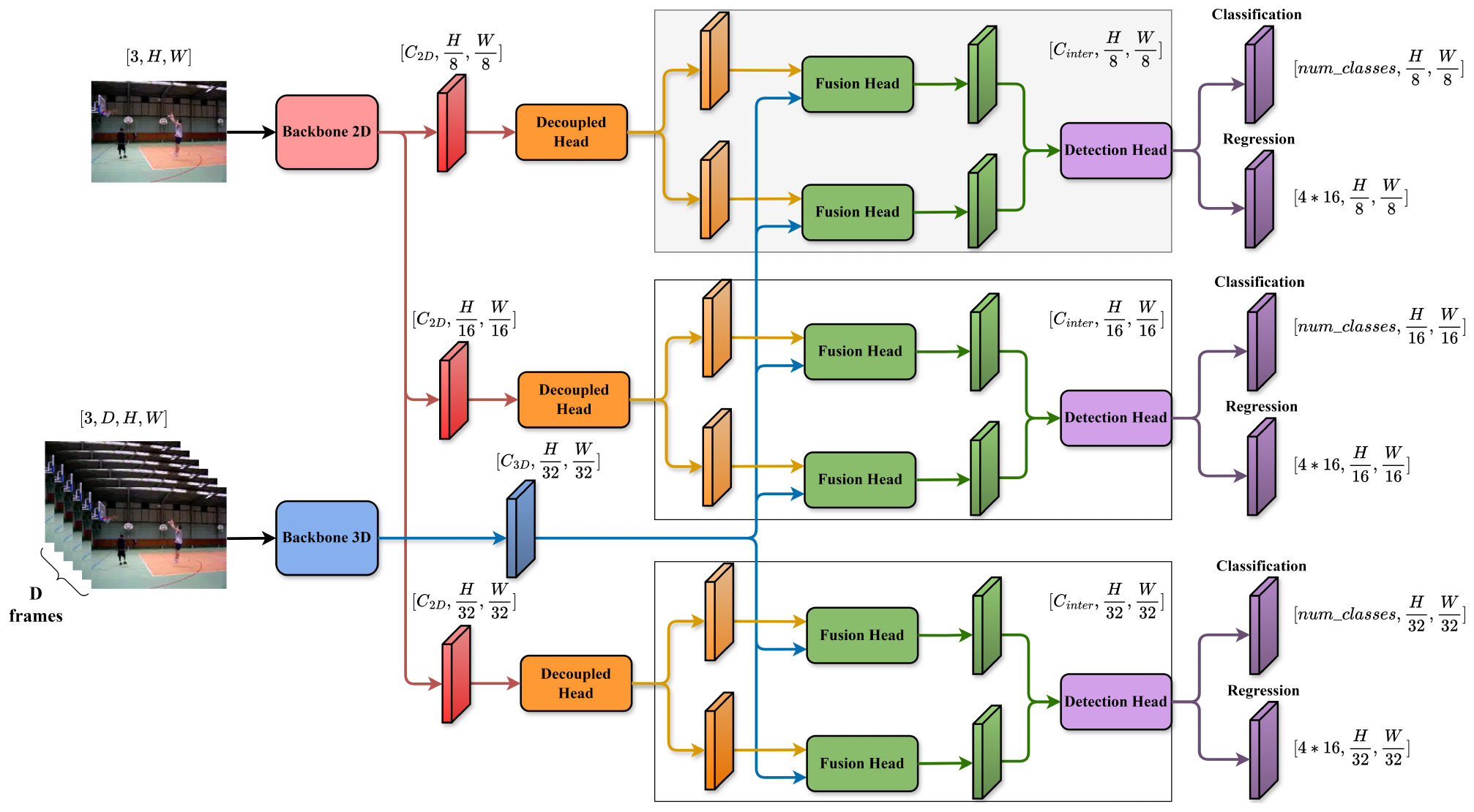
The spatial path uses YOLOv8 with its final detection layer removed. It looks only at the last frame of the clip and outputs a three-scale feature pyramid at 1/8, 1/16 and 1/32 of the input image. Each scale is followed by a decoupled head that, as in YOLOX, splits classification and box regression into two branches, each with two convolution layers.
The temporal path is a 3D CNN that looks at the whole 16-frame clip. The authors tried 3D versions of ShuffleNetV2, ResNet-101 and ResNeXt-101, as well as I3D; the output is just one feature map at 1/32 size with the time dimension squeezed to 1.
Fusion and detection
The 3D features are first upsampled to the size of each scale, concatenated separately with the 2D classification branch and regression branch, and then sent into CFAM, which YOWO already had. CFAM is a channel attention module that flattens the features and multiplies them by their own transpose to get a correlation matrix between channels, which after a softmax is used to reweight the fused features.
The detection head is anchor-free; each location predicts boxes and action classes directly. Box regression doesn't regress four numbers directly. Following GFL, each of the four edges, left, top, right and bottom, is represented as a probability distribution over 16 bins, so the regression branch outputs channels.
Label assignment and loss
During training, something has to decide which predictions are responsible for which ground-truth box. The authors prepared two schemes: TAL for UCF101-24 and SimOTA for AVA. Both compute a matching score from the classification error and the box CIoU, and each ground-truth box takes the best-scoring predictions.
Unlike the original SimOTA, the authors fix instead of estimating it dynamically. Dynamic estimation costs about 6% more training time, and accuracy is no better.
AVA is a severely imbalanced dataset. Listening, talking and watching each appear more than 100,000 times in the training set; fighting, giving and grabbing each appear fewer than 3,000 times. The authors multiply the classification loss by a class-balance term , which the official code defines as:
indicates whether class appears in the annotation, and is set from how often the class appears: close to 0.5 for common classes and close to 0 for rare ones. The effect is that missing a rare action is penalized heavily, while predicting a rare action that isn't there is penalized more lightly, so the model is pushed toward guessing rare classes more often. On top of that come soft labels, so that the better a prediction's match quality, the closer its classification target is to 1.
As for the training setup, the input is 16 frames of 224×224 each, with a batch size of 8 and 16 steps of gradient accumulation; UCF101-24 trains for 7 epochs and AVA for 9.
Discussion
Against the previous two generations
Evaluation uses frame-mAP at an IoU threshold of 0.5. UCF101-24 has 24 sports actions and uses the first split; AVA v2.2 follows the official protocol of evaluating only 60 classes, computed on the validation set.
The two datasets differ a lot in difficulty. Most UCF101-24 videos have only one or two people doing the same sport, and the action classes are easy to tell apart, such as basketball shooting, cycling and diving. AVA is taken from movie clips; there are often several people in the frame, and one person can carry several labels at the same time, for example standing, talking to someone and watching another person. That is why YOWOv3's classification output is an independent binary probability for each class rather than a softmax across classes.
| Model | UCF101-24 | AVA v2.2 | GFLOPs | Params (M) |
|---|---|---|---|---|
| YOWO | 80.4 | 17.9 | 43.7 | 121.4 |
| YOWOv2-T | 80.5 | 14.9 | 2.9 | 10.9 |
| YOWOv2-M | 83.1 | 18.4 | 12.0 | 52.0 |
| YOWOv2-L | 85.2 | 20.2 | 53.6 | 109.7 |
| YOWOv3-T | 82.76 | 15.06 | 2.8 | 10.1 |
| YOWOv3-M | 86.55 | 18.29 | 10.8 | 44.3 |
| YOWOv3-L | 88.33 | 20.31 | 39.8 | 59.8 |
On UCF101-24, all three sizes beat YOWOv2 by 2 to 3.5 points. On AVA they are about even, with the L version at 20.31 against 20.2 and the M version slightly behind. YOWOv3's main progress is in efficiency. The L version has only 54.5% of YOWOv2-L's parameters and about 26% fewer GFLOPs.
The three main models pair YOLOv8 nano with ShuffleNetV2, YOLOv8 medium with ShuffleNetV2, and YOLOv8 medium with I3D. The authors ran every combination of 2D and 3D backbones. The highest on UCF101-24 is ResNeXt-101 with the largest YOLOv8, at 89.16; but its computation is 61 GFLOPs, half again as much as the L version, for only 0.8 more points.
The 20 mAP on AVA needs to be read in context. The large ViTs the paper holds up for comparison at the start score far higher than this on AVA. YOWOv3 is competing against lightweight models of the same order of magnitude.
Ablations
| Setting | T | M | L |
|---|---|---|---|
| Full (AVA mAP) | 15.06 | 18.29 | 20.31 |
| No class balance | 13.82 | 16.80 | 18.43 |
| No soft labels | 15.16 | 17.70 | 20.07 |
The class-balance term is the most effective trick, adding 1.2 to 1.9 points across all three sizes. Soft labels matter much less; on the smallest, the T version, removing them is actually a little better.
The fixed- experiment looks similar. is best for the M and L versions, but the T version's 15.18 with dynamic estimation is in fact higher than the 15.06 with . The paper's conclusion that a fixed is "slightly better" applies to the medium and large models.
EMA weights mainly matter in the first few epochs; by the end of training the two are about the same.
Real-time, but how real-time?
The paper's title says "efficient," the text says several times that YOWOv3 meets the needs of real-time applications, and the section on experimental setup also says frames per second (FPS) were measured. Yet leaf through the version of the paper on arXiv from beginning to end and there is not a single FPS number.
Someone in the issues asked how FPS is calculated, since they couldn't find it in the code. The author's answer was to count how many images are processed in a fixed amount of time and divide by the time (everyone can do the division; the question was what number you got).
Also, the paper reports only frame-mAP, not video-mAP. The author's reason, given in an issue, is that the way YOWO and YOWOv2 compute video-mAP fills in missed frames, so comparing on it isn't fair.
A framework someone looks after
To be fair, YOWOv3 delivers on "someone maintains it." As of 2026 the author is still replying in the repository's issues, answering everything from custom datasets and ONNX export to the details of the loss function. One user reported getting only 9% to 11.6% on AVA with the official weights; the author stayed with them through the debugging, and in the end it turned out the user's own settings were wrong, after which the results were only slightly off from the paper. A community member has also put together a separate improved version with multi-GPU training and new data augmentation.
There are a few things to watch before using it. The author mentioned in an issue that the paper hasn't been updated yet, and that the current best-performing version uses SE as its fusion module, not the CFAM the paper describes. In the large table of backbone combinations in the appendix, the cell for I3D with the smallest YOLOv8 has AVA computation and parameter counts exactly identical to the ResNet-101 cell, and someone found the same problem in the table the author put on Hugging Face. The repository itself doesn't include a license file.
Conclusion
YOWOv3 has no big new idea. YOLOv8 as the spatial backbone, YOLOX's decoupled head, GFL's distribution-based box regression, and TAL and SimOTA for label assignment are all mature components accumulated in object detection over the past few years. On top of them comes a class-balance term designed for AVA's imbalance.
The result is a leaner YOWO. It is more accurate than YOWOv2 on UCF101-24 and level on AVA, with clearly lower parameter counts and computation, and it comes with a whole row of pretrained weights from small to large.
The paper's biggest selling point is real-time speed, yet the one FPS number it should have is missing. Luckily the author is still around; if you want to know, you can ask in the issues.