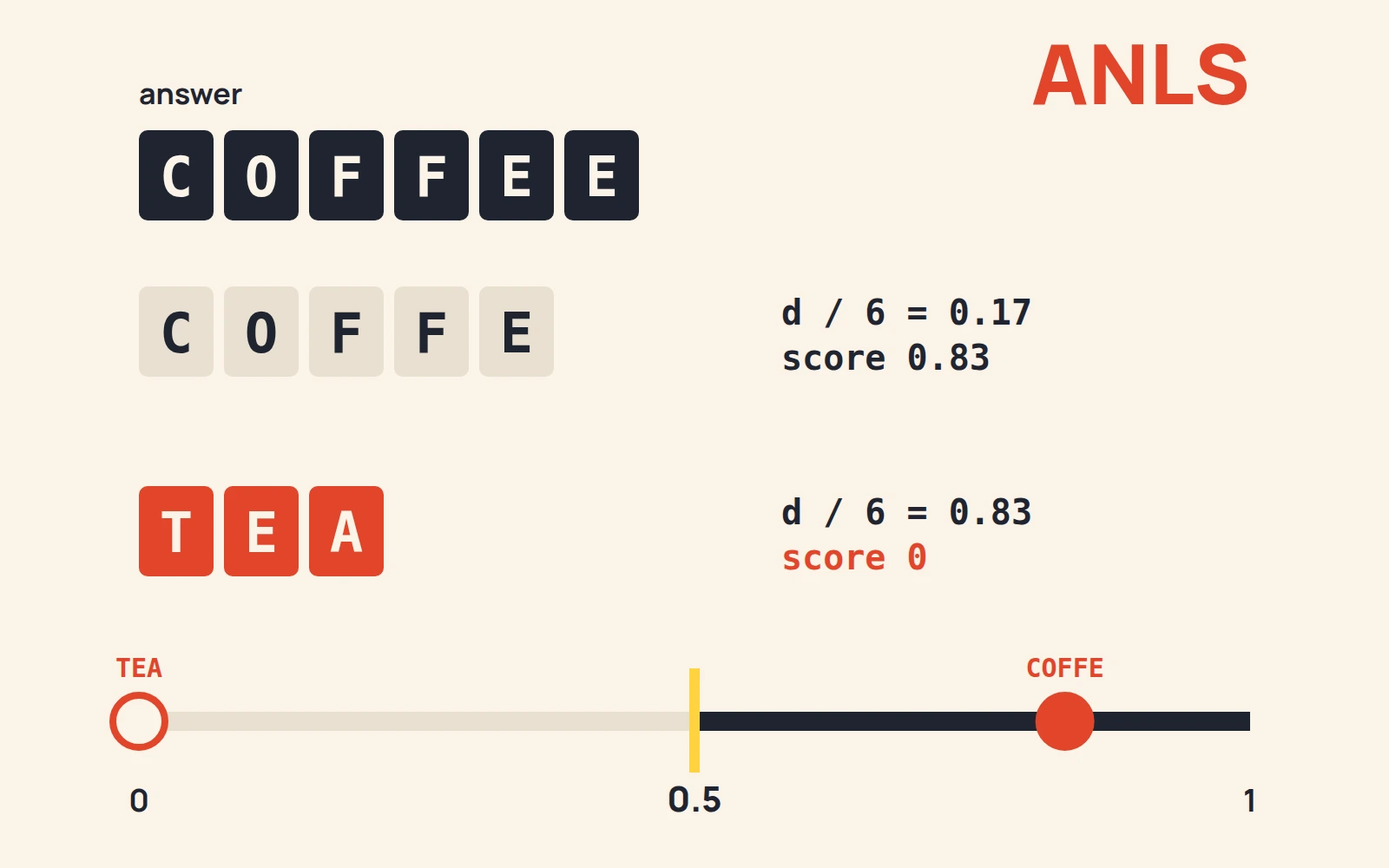
Average Normalized Levenshtein Similarity (ANLS) measures how close a predicted string is to an accepted answer. First divide the Levenshtein edit distance by the length of the longer string, then convert the normalized distance to a similarity score.
The original ST-VQA paper applies a threshold of 0.5: a normalized distance above 0.5 receives zero; otherwise the score is 1 - distance. Scores are then averaged across examples. Omitting the threshold produces an average NLS score, which can differ from ANLS. The code below scores paired strings. For tasks that accept multiple answers per question, the dataset's answer-selection rule must also be applied.
References
Import Necessary Libraries
Import torchmetrics and its EditDistance metric:
from typing import Any, Literal, Optional, Sequence, Union

import torch
from torch import Tensor
from torchmetrics.metric import Metric
from torchmetrics.text import EditDistance
from torchmetrics.utilities.data import dim_zero_cat
EditDistance returns the edit distance for each pair. The code then divides by the longer string length and applies the ANLS threshold.
Implement Normalization Functionality
The class inherits from torchmetrics.metric.Metric and implements update and compute:
class NormalizedLevenshteinSimilarity(Metric):

    def __init__(
        self,
        substitution_cost: int = 1,
        reduction: Optional[Literal["mean", "sum", "none"]] = "mean",
        **kwargs: Any
    ) -> None:
        super().__init__(**kwargs)
        self.edit_distance = EditDistance(
            substitution_cost=substitution_cost,
            reduction=None  # Set to None to get distances for all string pairs
        )

        # ...
Here are a few key points:
- Ensure that the input
predsandtargetare lists of strings, otherwise the function will calculate on a character level. - Use the longer string length to normalize each edit distance.
def update(self, preds: Union[str, Sequence[str]], target: Union[str, Sequence[str]]) -> None:
    """Update state with predictions and targets."""

    if isinstance(preds, str):
        preds = [preds]
    if isinstance(target, str):
        target = [target]
    if len(preds) != len(target):
        raise ValueError("preds and target must have the same length")

    distances = self.edit_distance(preds, target)
    max_lengths = torch.tensor([
        max(len(p), len(t))
        for p, t in zip(preds, target)
    ], dtype=torch.float, device=distances.device)

    ratio = torch.where(
        max_lengths == 0,
        torch.zeros_like(distances).float(),
        distances.float() / max_lengths
    )

    nls_values = torch.where(
        ratio <= 0.5,
        1 - ratio,
        torch.zeros_like(ratio),
    )

    # ...
Implement the reduction Parameter
With reduction="mean", average the scores after applying the threshold.
sum returns their total; none returns one score per string pair.
def _compute(
    self,
    nls_score: Tensor,
    num_elements: Union[Tensor, int],
) -> Tensor:
    """Compute the ANLS over state."""
    if nls_score.numel() == 0 or num_elements == 0:
        return torch.tensor(0, dtype=torch.int32)
    if self.reduction == "mean":
        return nls_score.sum() / num_elements
    if self.reduction == "sum":
        return nls_score.sum()
    if self.reduction is None or self.reduction == "none":
        return nls_score

def compute(self) -> torch.Tensor:
    """Compute the NLS over state."""
    if self.reduction == "none" or self.reduction is None:
        return self._compute(dim_zero_cat(self.nls_values_list), 1)
    return self._compute(self.nls_score, self.num_elements)
With reduction="none", return each thresholded score instead of an average. dim_zero_cat combines the stored values into a tensor.
Implementation
The complete implementation is as follows:
from typing import Any, Literal, Optional, Sequence, Union

import torch
from torch import Tensor
from torchmetrics.metric import Metric
from torchmetrics.text import EditDistance
from torchmetrics.utilities.data import dim_zero_cat

class NormalizedLevenshteinSimilarity(Metric):
    """
    Normalized Levenshtein Similarity (NLS) is a metric that computes the
    normalized Levenshtein similarity between two sequences.
    This metric is 1 - normalized edit distance when the distance is at most 0.5,
    where `levenshtein_distance` is the Levenshtein distance between the two
    sequences and `max_length` is the maximum length of the two sequences.

    NLS aims to provide a similarity measure for character sequences
    (such as text), making it useful in areas like text similarity analysis,
    Optical Character Recognition (OCR), and Natural Language Processing (NLP).

    This class inherits from `Metric` and uses the `EditDistance` class to
    compute the Levenshtein distance.

    Inputs to the ``update`` and ``compute`` methods are as follows:

    - ``preds`` (:class:`~Union[str, Sequence[str]]`):
        Predicted text sequences or a collection of sequences.
    - ``target`` (:class:`~Union[str, Sequence[str]]`):
        Target text sequences or a collection of sequences.

    Output from the ``compute`` method is as follows:

    - ``nls`` (:class:`~torch.Tensor`): A tensor containing the NLS value.
        Returns 0.0 when there are no samples; otherwise, it returns the NLS.

    Args:
        substitution_cost:
            The cost of substituting one character for another. Default is 1.
        reduction:
            Method to aggregate metric scores.
            Default is 'mean', options are 'sum' or None.

            - ``'mean'``: takes the mean over samples, which is ANLS.
            - ``'sum'``: takes the sum over samples
            - ``None`` or ``'none'``: returns the score per sample

        kwargs: Additional keyword arguments.

    Example::
        Multiple strings example:

        >>> metric = NormalizedLevenshteinSimilarity(reduction=None)
        >>> preds = ["rain", "lnaguaeg"]
        >>> target = ["shine", "language"]
        >>> metric(preds, target)
        tensor([0.0000, 0.5000])
        >>> metric = NormalizedLevenshteinSimilarity(reduction="mean")
        >>> metric(preds, target)
        tensor(0.2500)
    """

    def __init__(
        self,
        substitution_cost: int = 1,
        reduction: Optional[Literal["mean", "sum", "none"]] = "mean",
        **kwargs: Any
    ) -> None:
        super().__init__(**kwargs)
        self.edit_distance = EditDistance(
            substitution_cost=substitution_cost,
            reduction=None  # Set to None to get distances for all string pairs
        )

        allowed_reduction = (None, "mean", "sum", "none")
        if reduction not in allowed_reduction:
            raise ValueError(
                f"Expected argument `reduction` to be one of {allowed_reduction}, but got {reduction}")
        self.reduction = reduction

        if self.reduction == "none" or self.reduction is None:
            self.add_state(
                "nls_values_list",
                default=[],
                dist_reduce_fx="cat"
            )
        else:
            self.add_state(
                "nls_score",
                default=torch.tensor(0.0),
                dist_reduce_fx="sum"
            )
            self.add_state(
                "num_elements",
                default=torch.tensor(0),
                dist_reduce_fx="sum"
            )

    def update(self, preds: Union[str, Sequence[str]], target: Union[str, Sequence[str]]) -> None:
        """Update state with predictions and targets."""
        if isinstance(preds, str):
            preds = [preds]
        if isinstance(target, str):
            target = [target]
        if len(preds) != len(target):
            raise ValueError("preds and target must have the same length")

        distances = self.edit_distance(preds, target)
        max_lengths = torch.tensor([
            max(len(p), len(t))
            for p, t in zip(preds, target)
        ], dtype=torch.float, device=distances.device)

        ratio = torch.where(
            max_lengths == 0,
            torch.zeros_like(distances).float(),
            distances.float() / max_lengths
        )

        nls_values = torch.where(
        ratio <= 0.5,
        1 - ratio,
        torch.zeros_like(ratio),
    )

        if self.reduction == "none" or self.reduction is None:
            self.nls_values_list.append(nls_values)
        else:
            self.nls_score += nls_values.sum()
            self.num_elements += nls_values.shape[0]

    def _compute(
        self,
        nls_score: Tensor,
        num_elements: Union[Tensor, int],
    ) -> Tensor:
        """Compute the ANLS over state."""
        if nls_score.numel() == 0 or num_elements == 0:
            return torch.tensor(0, dtype=torch.int32)
        if self.reduction == "mean":
            return nls_score.sum() / num_elements
        if self.reduction == "sum":
            return nls_score.sum()
        if self.reduction is None or self.reduction == "none":
            return nls_score

    def compute(self) -> torch.Tensor:
        """Compute the NLS over state."""
        if self.reduction == "none" or self.reduction is None:
            return self._compute(dim_zero_cat(self.nls_values_list), 1)
        return self._compute(self.nls_score, self.num_elements)

if __name__ == "__main__":
    anls = NormalizedLevenshteinSimilarity(reduction='mean')
    preds = ["rain", "lnaguaeg"]
    target = ["shine", "language"]
    print(anls(preds, target))
Final notes
This example scores one answer for each prediction. To match a dataset’s official evaluator, also verify its case and whitespace normalization, multiple-answer selection, and empty-string rules.