{"notes":[{"id":"object-detection/yolov11","category":"object-detection","legacyPath":"object-detection/2410-yolov11","legacySlug":"2410-yolov11","legacyPaths":[],"title":"YOLOv11","subtitle":"Engineering-Optimized Edition","author":"Z. Yuan","paperDate":"2024-10-23","publishedOn":"2025-08-25","paperTitle":"YOLOv11: An Overview of the Key Architectural Enhancements","paperUrl":"https://arxiv.org/abs/2410.17725","bibliography":{"title":"YOLOv11: An Overview of the Key Architectural Enhancements","authors":["Rahima Khanam","Muhammad Hussain"],"url":"https://arxiv.org/abs/2410.17725","pdfUrl":"https://arxiv.org/pdf/2410.17725","codeUrl":null,"preprint":{"id":"2410.17725","submittedOn":"2024-10-23","url":"https://arxiv.org/abs/2410.17725"},"publication":null,"citation":"@misc{objectdetectionyolov112024,\n title = {{YOLOv11: An Overview of the Key Architectural Enhancements}},\n author = {Rahima Khanam and Muhammad Hussain},\n year = {2024},\n eprint = {2410.17725},\n archivePrefix = {arXiv},\n url = {https://arxiv.org/abs/2410.17725}\n}\n","citationPath":"/content/papers/citations/object-detection/yolov11.86c0b646ca66.bib"},"thumbnail":{"src":"/content/papers/assets/827cb0ee834fbc08f98f948852bd7d5bb1c53ecdc2339cb09f694a143cb5bfc2.jpg","width":1224,"height":536},"locale":"en","path":"/content/papers/en/object-detection/yolov11.202d78c727b0.md","headings":[{"id":"problem-definition","text":"Problem Definition","depth":2},{"id":"problem-solving","text":"Problem Solving","depth":2},{"id":"backbone-minor-replacement","text":"Backbone: Minor Replacement","depth":3},{"id":"c2f","text":"C2f","depth":4},{"id":"c3k2","text":"C3k2","depth":4},{"id":"c2psa","text":"C2‑PSA","depth":4},{"id":"psa-position-sensitive-attention","text":"PSA (Position-Sensitive Attention)","depth":4},{"id":"convattention-mhsa-inside-psa","text":"ConvAttention (MHSA inside PSA)","depth":4},{"id":"neck-minor-feature-fusion-tweaks","text":"Neck: Minor Feature Fusion Tweaks","depth":3},{"id":"head-extended-output-layer","text":"Head: Extended Output Layer","depth":3},{"id":"multi-task-integration","text":"Multi-Task Integration","depth":3},{"id":"discussion","text":"Discussion","depth":2},{"id":"conclusion","text":"Conclusion","depth":3}],"anchorAliases":{"results-and-discussion":"discussion"},"guide":null,"relatedReading":[{"id":"object-detection/yolov10","relation":"comparison","topic":"Recent designs for efficient real-time detection"},{"id":"object-detection/yolo-tiny","relation":"comparison","topic":"Recent designs for efficient real-time detection"}]},{"id":"object-detection/yolov10","category":"object-detection","legacyPath":"object-detection/2405-yolov10","legacySlug":"2405-yolov10","legacyPaths":[],"title":"YOLOv10","subtitle":"Goodbye NMS","author":"Z. Yuan","paperDate":"2024-05-23","publishedOn":"2025-07-19","paperTitle":"YOLOv10: Real-Time End-to-End Object Detection","paperUrl":"https://proceedings.neurips.cc/paper_files/paper/2024/hash/c34ddd05eb089991f06f3c5dc36836e0-Abstract-Conference.html","bibliography":{"title":"YOLOv10: Real-Time End-to-End Object Detection","authors":["Ao Wang","Hui Chen","Lihao Liu","Kai Chen","Zijia Lin","Jungong Han","Guiguang Ding"],"url":"https://proceedings.neurips.cc/paper_files/paper/2024/hash/c34ddd05eb089991f06f3c5dc36836e0-Abstract-Conference.html","pdfUrl":"https://proceedings.neurips.cc/paper_files/paper/2024/file/c34ddd05eb089991f06f3c5dc36836e0-Paper-Conference.pdf","codeUrl":"https://github.com/THU-MIG/yolov10","preprint":{"id":"2405.14458","submittedOn":"2024-05-23","url":"https://arxiv.org/abs/2405.14458"},"publication":{"venue":"NeurIPS","year":2024,"kind":"conference","url":"https://proceedings.neurips.cc/paper_files/paper/2024/hash/c34ddd05eb089991f06f3c5dc36836e0-Abstract-Conference.html"},"citation":"@misc{objectdetectionyolov102024,\n title = {{YOLOv10: Real-Time End-to-End Object Detection}},\n author = {Ao Wang and Hui Chen and Lihao Liu and Kai Chen and Zijia Lin and Jungong Han and Guiguang Ding},\n year = {2024},\n eprint = {2405.14458},\n archivePrefix = {arXiv},\n url = {https://arxiv.org/abs/2405.14458}\n}\n","citationPath":"/content/papers/citations/object-detection/yolov10.f624ec9e20b6.bib"},"thumbnail":{"src":"/content/papers/assets/43843817d1e6667933eb36b7b588db3ca318fe74e00d2d47095426923f3a5b44.jpg","width":1614,"height":536},"locale":"en","path":"/content/papers/en/object-detection/yolov10.0dbaf7fa020d.md","headings":[{"id":"problem-definition","text":"Problem Definition","depth":2},{"id":"solution","text":"Solution","depth":2},{"id":"dual-annotation-architecture","text":"Dual Annotation Architecture","depth":3},{"id":"efficiency-and-accuracy-optimization","text":"Efficiency and Accuracy Optimization","depth":3},{"id":"accuracy-oriented-enhancements","text":"Accuracy-Oriented Enhancements","depth":3},{"id":"implementation-details","text":"Implementation Details","depth":3},{"id":"discussion","text":"Discussion","depth":2},{"id":"comparison-with-sota-methods","text":"Comparison with SOTA Methods","depth":3},{"id":"ablation-study","text":"Ablation Study","depth":3},{"id":"can-nms-free-truly-replace-traditional-methods","text":"Can NMS-free Truly Replace Traditional Methods?","depth":3},{"id":"why-doesnt-simplification-drag-performance","text":"Why Doesn’t Simplification Drag Performance?","depth":3},{"id":"accuracy-improvements-with-nearly-no-latency-increase","text":"Accuracy Improvements with Nearly No Latency Increase?","depth":3},{"id":"conclusion","text":"Conclusion","depth":2}],"anchorAliases":{"experimental-results-and-discussion":"discussion"},"guide":null,"relatedReading":[{"id":"object-detection/yolov11","relation":"comparison","topic":"Recent designs for efficient real-time detection"},{"id":"object-detection/yolo-tiny","relation":"comparison","topic":"Recent designs for efficient real-time detection"}]},{"id":"object-detection/yolo-tiny","category":"object-detection","legacyPath":"object-detection/2412-yolo-tiny","legacySlug":"2412-yolo-tiny","legacyPaths":[],"title":"YOLO-Tiny","subtitle":"I Am a Little Bird","author":"Z. Yuan","paperDate":"2025","publishedOn":"2025-06-20","paperTitle":"YOLO-Tiny: A lightweight small object detection algorithm for UAV aerial imagery","paperUrl":"https://ietresearch.onlinelibrary.wiley.com/doi/10.1049/ipr2.13314","bibliography":{"title":"YOLO-Tiny: A lightweight small object detection algorithm for UAV aerial imagery","authors":["Fei Feng","Lu Yang","Quanxing Zhou","Weipeng Li"],"url":"https://ietresearch.onlinelibrary.wiley.com/doi/10.1049/ipr2.13314","pdfUrl":"https://ietresearch.onlinelibrary.wiley.com/doi/pdfdirect/10.1049/ipr2.13314","codeUrl":null,"preprint":null,"publication":{"venue":"IET Image Processing","year":2025,"kind":"journal","url":"https://ietresearch.onlinelibrary.wiley.com/doi/10.1049/ipr2.13314"},"citation":"@article{objectdetectionyolotiny2025,\n title = {{YOLO-Tiny: A lightweight small object detection algorithm for UAV aerial imagery}},\n author = {Fei Feng and Lu Yang and Quanxing Zhou and Weipeng Li},\n year = {2025},\n journal = {IET Image Processing},\n url = {https://ietresearch.onlinelibrary.wiley.com/doi/10.1049/ipr2.13314}\n}\n","citationPath":"/content/papers/citations/object-detection/yolo-tiny.526134c54500.bib"},"thumbnail":{"src":"/content/papers/assets/1094ebd50f340f6602b1a95680588cf90d248d403f3f4999b4367914bad9c7a9.jpg","width":1224,"height":456},"locale":"en","path":"/content/papers/en/object-detection/yolo-tiny.c865b4d91296.md","headings":[{"id":"problem-definition","text":"Problem Definition","depth":2},{"id":"solution","text":"Solution","depth":2},{"id":"reviewing-yolov5","text":"Reviewing YOLOv5","depth":3},{"id":"module-lightweighting","text":"Module Lightweighting","depth":3},{"id":"adaptive-multi-scale-fusion","text":"Adaptive Multi-Scale Fusion","depth":3},{"id":"experimental-setup","text":"Experimental Setup","depth":3},{"id":"discussion","text":"Discussion","depth":2},{"id":"comparative-experiments-on-network-architecture-adjustments","text":"Comparative Experiments on Network Architecture Adjustments","depth":3},{"id":"ablation-study","text":"Ablation Study","depth":3},{"id":"comparison-with-other-yolo-models","text":"Comparison with Other YOLO Models","depth":3},{"id":"visualization","text":"Visualization","depth":3},{"id":"conclusion","text":"Conclusion","depth":2}],"anchorAliases":{},"guide":null,"relatedReading":[{"id":"object-detection/yolov10","relation":"comparison","topic":"Recent designs for efficient real-time detection"},{"id":"object-detection/yolov11","relation":"comparison","topic":"Recent designs for efficient real-time detection"}]}],"text":"It's rare to see a paper appear when Ultralytics releases a new architecture. In this case, though, Khanam and Hussain wrote an independent overview of YOLO11; it is not an official Ultralytics paper.\n\nIn any case, we should give them some encouragement.\n\n## Problem Definition\n\nIn the realm of object detection, the name **YOLO** has been around for a decade.\n\nBack in 2015, Redmon came up with the slogan: \"**You Only Look Once**.\" He stepped away from the mainstream two-stage detector and boldly treated detection as a **regression problem**, predicting boxes and classes in one pass.\n\nSince then, each generation of YOLO has become synonymous with \"real-time detection.\"\n\nHowever, as the YOLO family evolved, two core issues have become apparent:\n\n1. **The Performance-Speed Dilemma:** Small models are fast but inaccurate; large models are accurate but slow.\n2. **Multi-task Integration:** Detection, segmentation, pose estimation, and rotated bounding boxes often coexist in practical applications. Earlier Ultralytics models already supported several of these tasks; the question is how the updated models can serve them through one consistent toolkit.\n\nSo, the Ultralytics team has tried to push YOLO forward into an **all-in-one vision system**.\n\nOh? Is that really possible? Let’s take a look.\n\n## Problem Solving\n\n\n\n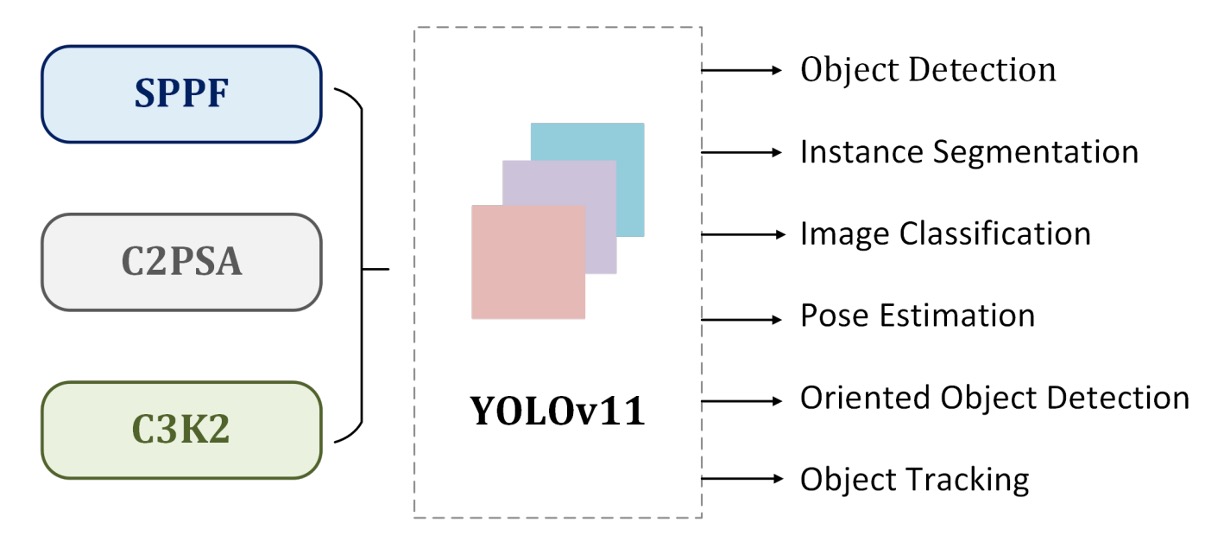\n\n\n\nThis paper is a third-party overview of YOLO11. For the module details below, we also check Ultralytics' [official model configuration](https://github.com/ultralytics/ultralytics/blob/main/ultralytics/cfg/models/11/yolo11.yaml) and implementation. Figure 1 is a conceptual module-and-task map, not the layer topology. The overall architecture still follows the classic three-stage structure:\n\n- **Backbone → Neck → Head**\n\nThere are no radical overhauls here, but with several local tweaks, they attempt to achieve more stable performance in both speed and accuracy.\n\n### Backbone: Minor Replacement\n\n- **C2f → C3k2**\n\n The previously common C2f block is now replaced by the new **C3k2 block**.\n\n C3k2 keeps C2f's outer split-and-concatenate structure. Its internal units use Bottleneck or C3k, depending on the model size and configuration; it does not simply break one large convolution into two small convolutions. Ultralytics' overall results show a useful latency-accuracy tradeoff, but this diagram alone cannot attribute the gain to C3k2.\n\n\n> [!TIP]\n> \n> Let’s visualize the architecture—the overall structure remains mostly the same.\n> \n> The stacked units can use Bottleneck or C3k, depending on the configuration; the right-hand sketch shows the alternatives together.\n> \n> \n> \n> \n> #### C2f\n> \n> ```mermaid\n> %%{init: {'theme':'base','themeVariables':{\n> 'fontFamily':'ui-sans-serif, system-ui, -apple-system, Segoe UI, Roboto, Noto Sans, Helvetica, Arial',\n> 'primaryColor':'#EEF2FF','primaryTextColor':'#0f172a','primaryBorderColor':'#4338ca',\n> 'lineColor':'#64748b','tertiaryColor':'#F1F5F9'\n> }}}%%\n> %% C2f: Fast Dual-Conv Bottleneck\n> flowchart TD\n> X[\"x
C_in × H × W\"]\n> C1[\"1×1 Conv
BN + Act
C_in → 2h\"]\n> SPLIT{{split
2h → h,h}}\n> Y0[\"y0
h × H × W\"]\n> Y1[\"y1
h × H × W\"]\n> \n> subgraph STACK[\"Bottleneck_f × n\"]\n> direction LR\n> Z1[\"z₁\"] --> Z2[\"z₂\"] --> Zn[\"zₙ\"]\n> end\n> \n> CAT[\"Concat
y0, y1, z₁…zₙ
(2+n)·h\"]\n> C2[\"1×1 Conv
BN + Act
(2+n)·h → C_out\"]\n> OUT[\"out
C_out × H × W\"]\n> \n> X --> C1 --> SPLIT\n> SPLIT -->|skip| Y0 --> CAT\n> SPLIT -->|stack| Y1 --> Z1\n> Zn --> CAT\n> CAT --> C2 --> OUT\n> \n> classDef tensor fill:#ffffff,stroke:#64748b,stroke-width:1px,rx:6,ry:6;\n> classDef op fill:#eef2ff,stroke:#4338ca,stroke-width:1px,rx:6,ry:6;\n> classDef fuse fill:#ecfccb,stroke:#65a30d,stroke-width:1px,rx:6,ry:6;\n> class X,Y0,Y1,Z1,Z2,Zn tensor\n> class C1,SPLIT,STACK,C2 op\n> class CAT fuse\n> ```\n> \n> \n> \n> #### C3k2\n> \n> ```mermaid\n> %%{init: {'theme':'base','themeVariables':{\n> 'fontFamily':'ui-sans-serif, system-ui, -apple-system, Segoe UI, Roboto, Noto Sans, Helvetica, Arial',\n> 'primaryColor':'#EEF2FF','primaryTextColor':'#0f172a','primaryBorderColor':'#4338ca',\n> 'lineColor':'#64748b','tertiaryColor':'#F1F5F9'\n> }}}%%\n> %% C3k2: C2f outer structure with configuration-dependent inner units\n> flowchart TD\n> X[\"x
C_in × H × W\"]\n> C1[\"1×1 Conv
BN + Act
C_in → 2h\"]\n> SPLIT{{split
2h → h,h}}\n> Y0[\"y0
h × H × W\"]\n> Y1[\"y1
h × H × W\"]\n> \n> subgraph STACK[\"Bottleneck or C3k × n\"]\n> direction LR\n> Z1[\"z₁\"] --> Z2[\"z₂\"] --> Zn[\"zₙ\"]\n> end\n> \n> CAT[\"Concat
y0, y1, z₁…zₙ
(2+n)·h\"]\n> C2[\"1×1 Conv
BN + Act
(2+n)·h → C_out\"]\n> OUT[\"out
C_out × H × W\"]\n> \n> X --> C1 --> SPLIT\n> SPLIT -->|skip| Y0 --> CAT\n> SPLIT -->|stack| Y1 --> Z1\n> Zn --> CAT\n> CAT --> C2 --> OUT\n> \n> classDef tensor fill:#ffffff,stroke:#64748b,stroke-width:1px,rx:6,ry:6;\n> classDef op fill:#eef2ff,stroke:#4338ca,stroke-width:1px,rx:6,ry:6;\n> classDef fuse fill:#ecfccb,stroke:#65a30d,stroke-width:1px,rx:6,ry:6;\n> class X,Y0,Y1,Z1,Z2,Zn tensor\n> class C1,SPLIT,STACK,C2 op\n> class CAT fuse\n> ```\n> \n> \n> \n> \n\n\n* **SPPF + C2PSA**\n\n After SPPF, **C2PSA (Cross Stage Partial with Spatial Attention)** appears at the end of the backbone in the [official YOLO11 detection YAML](https://github.com/ultralytics/ultralytics/blob/main/ultralytics/cfg/models/11/yolo11.yaml).\n\n It applies attention to part of the channels, allowing the model to combine features from different locations. The overview suggests this might help with small or occluded objects, but provides no separate ablation for those cases.\n\n However, this type of attention design isn’t particularly novel—it's more of a \"keeping up with the trend\" kind of choice.\n\n ---\n\n\n> [!TIP]\n> \n> As usual, let’s also visualize this new C2PSA module.\n> \n> \n> \n> \n> #### C2‑PSA\n> \n> ```mermaid\n> %%{init: {'theme':'base','themeVariables':{\n> 'fontFamily':'ui-sans-serif, system-ui, -apple-system, Segoe UI, Roboto, Noto Sans, Helvetica, Arial',\n> 'primaryColor':'#EEF2FF','primaryTextColor':'#0f172a','primaryBorderColor':'#4338ca',\n> 'lineColor':'#64748b','tertiaryColor':'#F1F5F9'\n> }}}%%\n> %% C2-PSA: 1x1 projection → split → PSA x n → concatenate → 1x1 fusion\n> flowchart TD\n> X[\"x
C × H × W\"]\n> C1[\"1×1 Conv
BN + Act
C → 2h\"]\n> SPLIT{{split
2h → h, h}}\n> Y0[\"y0
h × H × W\"]\n> Y1[\"y1
h × H × W\"]\n> \n> subgraph STACK[\"PSA × n\"]\n> direction LR\n> P1[\"PSA₁\"] --> P2[\"PSA₂\"] --> Pn[\"PSAₙ\"]\n> end\n> \n> CAT[\"Concat
2h\"]\n> C2[\"1×1 Conv
BN + Act
2h → C\"]\n> OUT[\"out
C × H × W\"]\n> \n> X --> C1 --> SPLIT\n> SPLIT -->|skip| Y0 --> CAT\n> SPLIT -->|stack| Y1 --> P1\n> Pn --> CAT\n> CAT --> C2 --> OUT\n> \n> classDef tensor fill:#ffffff,stroke:#64748b,stroke-width:1px,rx:6,ry:6;\n> classDef op fill:#eef2ff,stroke:#4338ca,stroke-width:1px,rx:6,ry:6;\n> classDef fuse fill:#ecfccb,stroke:#65a30d,stroke-width:1px,rx:6,ry:6;\n> class X,Y0,Y1,P1,P2,Pn tensor\n> class C1,SPLIT,STACK,C2 op\n> class CAT fuse\n> ```\n> \n> \n> \n> \n> #### PSA (Position-Sensitive Attention)\n> \n> ```mermaid\n> %%{init: {'theme':'base','themeVariables':{\n> 'fontFamily':'ui-sans-serif, system-ui, -apple-system, Segoe UI, Roboto, Noto Sans, Helvetica, Arial',\n> 'primaryColor':'#EEF2FF','primaryTextColor':'#0f172a','primaryBorderColor':'#4338ca',\n> 'lineColor':'#64748b','tertiaryColor':'#F1F5F9'\n> }}}%%\n> %% PSA: MHSA → residual add → FFN → residual add\n> flowchart TD\n> U[\"u
h × H × W\"]\n> MHSA[\"MHSA(ConvAttention)
QKV → Attn → PE → Proj\"]\n> ADD1[\"Add\"]\n> FFN[\"FFN
1×1 Conv + Act → 1×1 Conv (no Act)\"]\n> ADD2[\"Add\"]\n> Z[\"z (output)
h × H × W\"]\n> \n> U --> MHSA --> ADD1 --> FFN --> ADD2 --> Z\n> U -->|skip| ADD1\n> ADD1 -->|skip| ADD2\n> \n> classDef tensor fill:#ffffff,stroke:#64748b,stroke-width:1px,rx:6,ry:6;\n> classDef op fill:#eef2ff,stroke:#4338ca,stroke-width:1px,rx:6,ry:6;\n> classDef fuse fill:#ecfccb,stroke:#65a30d,stroke-width:1px,rx:6,ry:6;\n> class U,Z tensor\n> class MHSA,FFN op\n> class ADD1,ADD2 fuse\n> ```\n> \n> \n> \n> \n> #### ConvAttention (MHSA inside PSA)\n> \n> ```mermaid\n> %%{init: {'theme':'base','themeVariables':{\n> 'fontFamily':'ui-sans-serif, system-ui, -apple-system, Segoe UI, Roboto, Noto Sans, Helvetica, Arial',\n> 'primaryColor':'#EEF2FF','primaryTextColor':'#0f172a','primaryBorderColor':'#4338ca',\n> 'lineColor':'#64748b','tertiaryColor':'#F1F5F9'\n> }}}%%\n> %% ConvAttention: QKV projection → attention → positional encoding → output projection\n> flowchart TD\n> X2[\"x
C x H x W\"]\n> QKV[\"1x1 Conv (QKV proj)
no Act\"]\n> SPLITQKV{{split
Q: H*d_k
K: H*d_k
V: H*d_v}}\n> ATTN[\"Scaled Dot-Product
softmax( transpose(Q) * K / sqrt(d_k) )\"]\n> WSUM[\"Weighted Sum
V * Attn^T\"]\n> RESHAPE[\"Reshape
B x C x H x W\"]\n> PE[\"3x3 Depth-wise Conv
Positional Enc. (no Act)\"]\n> ADDPE[\"Add
positional enc.\"]\n> PROJ[\"1x1 Conv (output proj)
no Act\"]\n> Y2[\"y
C x H x W\"]\n> \n> X2 --> QKV --> SPLITQKV\n> SPLITQKV -->|Q| ATTN\n> SPLITQKV -->|K| ATTN\n> SPLITQKV -->|V| WSUM\n> ATTN --> WSUM --> RESHAPE --> ADDPE --> PROJ --> Y2\n> SPLITQKV -->|V| PE --> ADDPE\n> \n> classDef tensor fill:#ffffff,stroke:#64748b,stroke-width:1px,rx:6,ry:6;\n> classDef op fill:#eef2ff,stroke:#4338ca,stroke-width:1px,rx:6,ry:6;\n> classDef fuse fill:#ecfccb,stroke:#65a30d,stroke-width:1px,rx:6,ry:6;\n> class X2,Y2 tensor\n> class QKV,ATTN,WSUM,RESHAPE,PE,PROJ op\n> class SPLITQKV op\n> class ADDPE fuse\n> ```\n> \n> \n> \n> \n\n\n### Neck: Minor Feature Fusion Tweaks\n\nThe neck’s role is still to bring together features at different resolutions.\n\nYOLOv11 also uses **C3k2 blocks** after feature upsampling, downsampling, and concatenation. **C2PSA** sits after SPPF at the backbone endpoint, before this neck path.\n\nThe overall **speed-accuracy curve** appears in the comparison below; it cannot isolate the neck changes' contribution.\n\n### Head: Extended Output Layer\n\nThe model configuration's `head` includes the feature-fusion path with **C3k2 blocks**. Its final **Detect** layer takes three feature-map scales and predicts box distributions and class scores through separate branches. YOLO11 Detect has no separate objectness-score output.\n\n### Multi-Task Integration\n\nYOLO11 also continues Ultralytics' \"multi-task framework\" positioning: task-specific model variants share a toolkit interface, rather than one weight file performing every task at once.\n\nAs shown in the table below:\n\n\n\n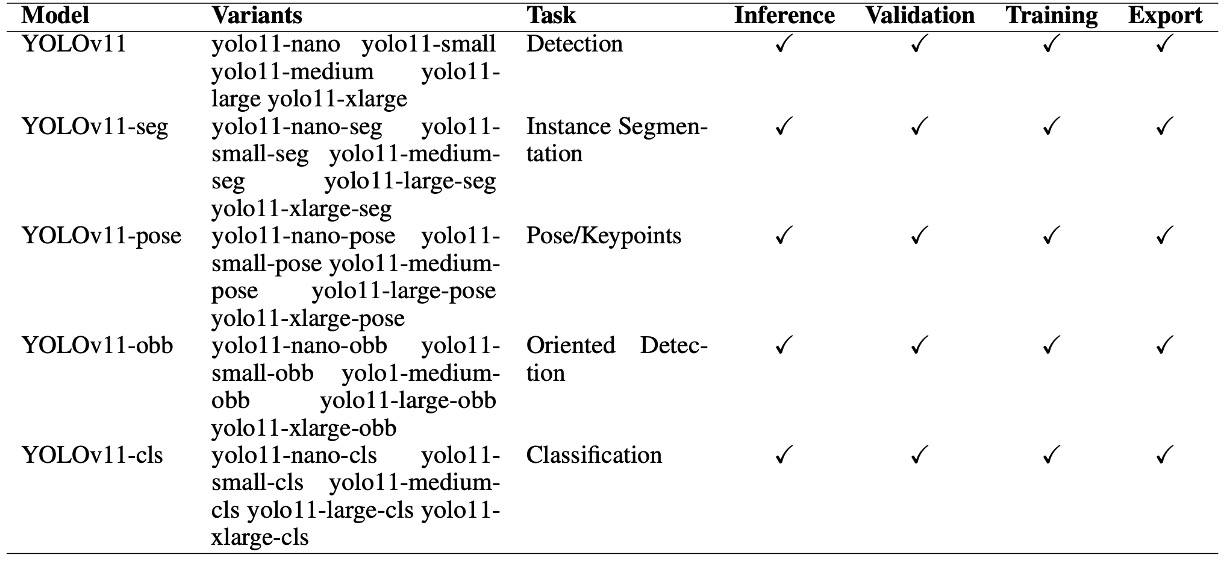\n\n\n\nBeyond standard object detection, Ultralytics offers YOLO11 variants for segmentation, pose estimation, rotated bounding boxes (OBB), and classification, with a consistent inference, validation, training, and export interface.\n\nIn practical terms, this integration is meaningful. Researchers and engineers can choose models for detection, segmentation, pose estimation, and the other tasks within the same toolkit.\n\nHowever, note that YOLOv11 isn’t the state-of-the-art in accuracy for every task; more often, it maintains a “usable and consistent” standard.\n\nIn other words, its strength isn’t peak performance in a single task, but rather the convergence of various computer vision needs into a single entry point, forming a relatively stable multi-task ecosystem. This positioning also aligns with Ultralytics’ product strategy, making the YOLO series applicable across a broader range of real-world scenarios.\n\n## Discussion\n\n\n\n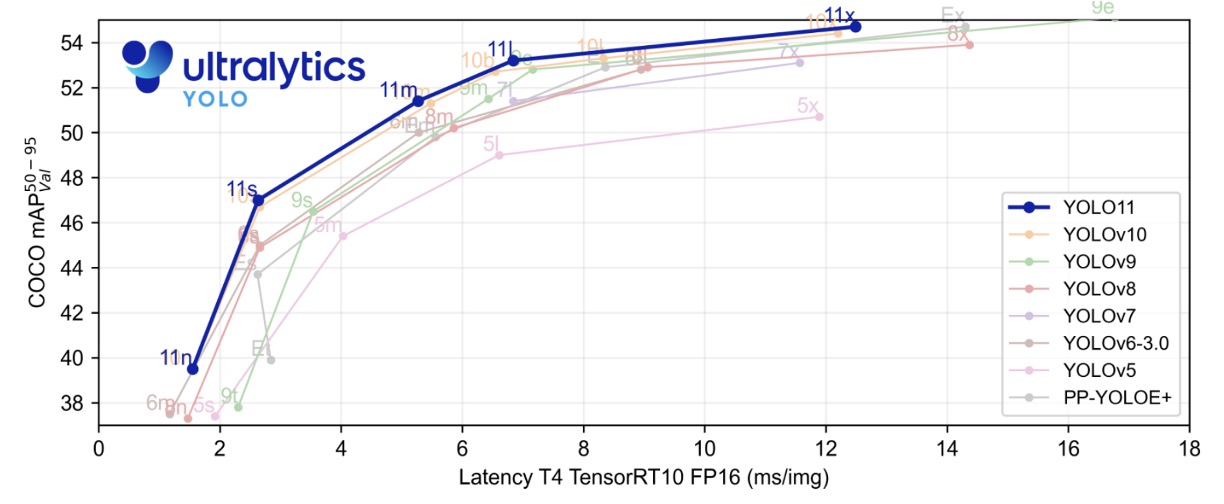\n\n\n\nThis comparison figure from the independent overview plots **T4 GPU TensorRT10 FP16 single-image latency** on the horizontal axis against **COCO validation mAP@50–95** on the vertical axis. We need to read accuracy and latency together.\n\nYOLO11 n, s, m, and x trace a competitive curve at their respective latency positions, but the graph does not show that every size beats all YOLOv8, YOLOv9, or YOLOv10 variants under identical conditions. In the official [YOLO11](https://docs.ultralytics.com/models/yolo11/) and [YOLOv8](https://docs.ultralytics.com/models/yolov8/) model tables, YOLO11m scores 51.5 mAP versus YOLOv8l's 52.9, while using 20.1M rather than 43.7M parameters. That is an accuracy-versus-model-size tradeoff, not a win on every metric.\n\nIn the figure's high-latency range, YOLO11x is at about 54.5 mAP@50–95 and 12–13 ms; at the low-latency end, YOLO11s is around 47 mAP and 2.5 ms. These values depend on the plotted hardware, precision, and inference backend, so deployment still calls for measurement in the target environment.\n\n### Conclusion\n\nAfter reading this paper, I think YOLOv11’s contribution is more about engineering refinements than methodological breakthroughs.\n\nIt uses C3k2 through the backbone and feature-fusion path, with C2PSA after SPPF; the overall benchmarks show useful efficiency and solid low-latency results. The overview does not isolate the gain from each module. These changes do not alter YOLO's basic paradigm—they optimize an existing design.\n\nStrictly speaking, the magnitude of these improvements doesn’t quite justify being called a “next-generation architecture”...\n\nBut hey, it’s released, so let’s accept it.\n","imageSizes":{"/content/papers/assets/827cb0ee834fbc08f98f948852bd7d5bb1c53ecdc2339cb09f694a143cb5bfc2.jpg":{"width":1224,"height":536},"/content/papers/assets/b3b6150503fc14f67b976e98edbefee2c291e7c9f5df0bb77472ee4e9a4c006e.jpg":{"width":1224,"height":568},"/content/papers/assets/c7ed08b0e5ebfb4231d7dfe6dc071509c45ffbff405718f852712b48a96d455f.jpg":{"width":1224,"height":504}}}